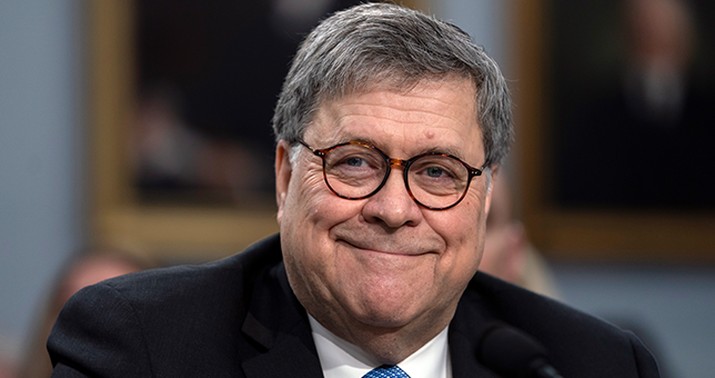
AG Barr: Nationwide Injunctions Violate Separation Of Powers And Make District Court Judges Far Too Powerful
Barr pointed out, nationwide injunctions have been used an unprecedented number of times during Trump’s administration. In fact, more national injunctions have been issued under Trump than during the
entire 20th century.
Since President Trump took office, federal district courts have issued 37 nationwide injunctions against the Executive Branch. That’s more than one a month. By comparison, during President Obama’s first two years, district courts issued two nationwide injunctions against the Executive Branch, both of which were vacated by the Ninth Circus. And according to the Department’s best estimates, courts issued only 27 nationwide injunctions in all of the 20th century.
Some say this proves that the Trump Administration is lawless. Not surprisingly, I disagree. The only case litigated on the merits in the Supreme Court—the so-called “travel ban” challenge—ended with President’s policy being upheld.
The use of such nationwide injunctions violated the separation of powers courts have traditionally observed:
Article III vests federal courts with “the judicial power” to decide “Cases” or “Controversies.” As the Supreme Court has instructed, that means concrete disputes among individual parties. In the words of Chief Justice Marshall in Marbury v. Madison, “the province of the Court is solely to decide on the rights of individuals, not to inquire how the Executive or Executive officers perform duties in which they have a discretion.”
Limiting judicial power to resolving concrete disputes between parties, rather than conducting general oversight of the Political Branches, ensures that courts do not usurp policy-making functions…
Consistent with that understanding, federal courts did not issue any nationwide injunctions during the first 175 years of the Republic. The first documented nationwide injunction issued in 1963 from the D.C. Circuit. The absence of nationwide injunctions does not reflect an unwillingness to issue injunctions against the government. Quite the contrary. In 1937 the lower courts had issued thousands of injunctions against New Deal programs. But, in keeping with the unbroken English tradition and two centuries of American law, those injunctions bound the government only with respect to the parties to those cases. The government continued to enforce New Deal programs against others. For example, courts issued more than 1,600 injunctions against a particular agricultural tax, but the government still collected it from more than 71,000 non-challengers…
But today, courts pass judgment on laws or executive actions bounded only by judicial doctrines of “deference.” Assuming the role of gatekeeper, a judge acts as a one-man Council of Revision. That not only embraces a judicial role that the Framers rejected, but also diminishes the constitutional prerogatives of Congress and the Executive.
Secondly, nationwide injunctions effectively made district court judges more powerful than even the Chief Justice of the Supreme Court, which was never the intent:
The Constitution empowers Congress to create lower federal courts, and in designing a system of 93 judicial districts and 12 regional circuits, Congress set clear geographic limits on lower-court jurisdiction. In our system, district-court rulings do not bind other judges, even other judges in the same district. This system has many virtues. It creates checks and balances within the judiciary itself and encourages what former D.C. Circuit Judge Harold Leventhal called “percolation”—the process by which many lower courts offer their views on a legal issue before higher courts resolve it…
Nationwide injunctions not only allow district courts to wield unprecedented power, they also allow district courts to wield it asymmetrically. When a court denies a nationwide injunction, the decision does not affect other cases. But when a court grants a nationwide injunction, it renders all other litigation on the issue largely irrelevant. Think about what that means for the Government. When Congress passes a statute or the President implements a policy that is challenged in multiple courts, the Government has to run the table—we must win every case. The challengers, however, must find only one district judge—out of an available 600—willing to enter a nationwide injunction. One judge can, in effect, cancel the policy with the stroke of the pen.
No official in the United States government can exercise that kind of nationwide power, with the sole exception of the President. And the Constitution subjects him to nationwide election, among other constitutional checks, as a prerequisite to wielding that power. Even the Chief Justice of the United States must convince at least four of his colleagues to bind the Federal Government nationwide.
Even The NYT's notes that legal experts largely agree with Barr’s take on nationwide injunctions:
The injunctions let judges who might have strong views impose them broadly, bypassing established tools like class-action lawsuits, said Samuel Bray, a law professor at the University of California, Los Angeles who published an article last month advocating that federal judges no longer use nationwide injunctions.
“How can a single judge decide a question for the whole country?” Mr. Bray said…
There is speculation that the Supreme Court will address universal injunctions in the coming year. “The justices don’t like the districts courts changing national policy overnight,” said Josh Blackman, a professor at South Texas College of Law Houston.
I suspect we’d be hearing a lot more outrage about this if 37 national injunctions had been filed against a Democrat president. In fact, I suspect this would suddenly become a crisis the next time a Democrat is elected to the White House.
AG Barr: Nationwide injunctions violate separation of powers and make district court judges far too powerful


 ~~~~~~~~~