The condition we agreed to AFTER incinerating hundreds of thousands of civilians.
Your dates and facts are all wrong, TEACHER.
‘
Following the bombing of Hiroshima on August 6, 1945 (left), the Japanese government met to consider what to do next. The emperor had been urging since June that Japan find some way to end the war, but the Japanese Minister of War and the heads of both the Army and the Navy held to their position that Japan should wait and see if arbitration via the Soviet Union might still produce something less than a surrender. Military leaders also hoped that if they could hold out until the ground invasion of Japan began, they would be able to inflict so many casualties on the Allies that Japan still might win some sort of negotiated settlement. Next came the virtually simultaneous arrival of news of the
Soviet declaration of war on Japan of August 8, 1945, and the atomic bombing of Nagasaki of the following day. Another Imperial Council was held the night of August 9-10, and this time the vote on surrender was a tie, 3-to-3. For the first time in a generation, the emperor (right) stepped forward from his normally ceremonial-only role and personally broke the tie, ordering Japan to surrender.
On August 10, 1945, Japan offered to surrender to the Allies, the only condition being that the emperor be allowed to remain the nominal head of state.
TWO DAYS AFTER NAGASAKI
On August 12, the United States announced that it would accept the Japanese surrender, making clear in its statement that the emperor could remain in a purely ceremonial capacity only. Debate raged within the Japanese government over whether to accept the American terms or fight on. Meanwhile,
American leaders were growing impatient, and on August 13 conventional air raids resumed on Japan. Thousands more Japanese civilians died while their leaders delayed.
The Japanese people learned of the surrender negotiations for the first time when, on August 14, B-29s showered Tokyo with thousands of leaflets containing translated copies of the American reply of August 12. Later that day, the emperor called another meeting of his cabinet and instructed them to accept the Allied terms immediately, explaining "I cannot endure the thought of letting my people suffer any longer"; if the war did not end "the whole nation would be reduced to ashes."
The only question remaining now was if Japan's military leaders would allow the emperor to surrender. Loyalty to the emperor was an absolute in the Japanese military, but so was the refusal to surrender, and now that the two had come into conflict, open rebellion was a possible result. The emperor recorded a message in which he personally accepted the Allied surrender terms, to be broadcast over Japanese radio the following day. This way everyone in Japan would know that surrender was the emperor's personal will. Some within the Japanese military actually attempted to steal this recording before it could be

broadcast, while others attempted a more general military coup in order to seize power and continue the war. Other elements of the Japanese military remained loyal to the emperor. The Minister of War, General Anami Korechika, personally supported continuing the war, but he also could not bring himself to openly rebel against his emperor. The strength of his dilemma was such that he opted for suicide as the only honorable way out. In the end, his refusal to assist the coup plotters was instrumental in their defeat by elements within the military that remained loyal to the emperor.

On
August 15, 1945, the emperor's broadcast announcing Japan's surrender was heard via radio all over Japan. For most of his subjects, it was the first time that they had ever heard his voice. The emperor explained that "the war situation has developed not necessarily to Japan's advantage," and that "the enemy has begun to employ a new and most cruel bomb." Over the next few weeks, Japan and the United States worked out the details of the surrender, and on
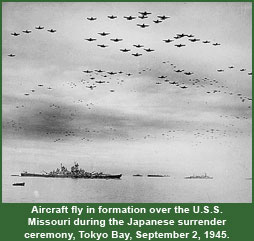
September 2, 1945, the formal surrender ceremony took place on the deck of the U.S.S. Missouri.


