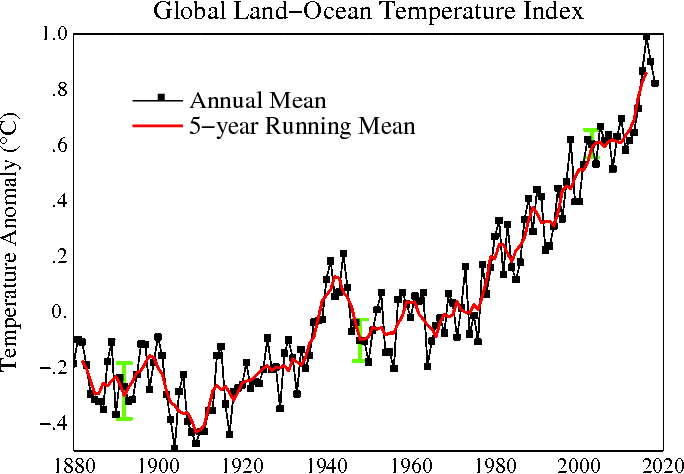
A comprehensive body of scientific evidence indicates beyond reasonable doubt that global climate change is now occurring and that its manifestations threaten the stability of societies as well as natural and managed ecosystems. Increases in ambient temperatures and changes in related processes are directly linked to rising anthropogenic greenhouse gas (GHG) concentrations in the atmosphere.
Unless the emissions of GHGs are curbed significantly, their concentrations will continue to rise, leading to changes in temperature, precipitation, and other climate variables that will undoubtedly affect agriculture around the world.
Climate change has the potential to increase weather variability as well as gradually increase global temperatures. Both of these impacts have the potential to negatively impact the adaptability and resilience of the worlds food production capacity; current research indicates climate change is already reducing the productivity of vulnerable cropping systems.[49]
European Federation of Geologists
In 2008, the European Federation of Geologists[50] (EFG) issued the position paper Carbon Capture and geological Storage :
The EFG recognizes the work of the IPCC and other organizations, and subscribes to the major findings that climate change is happening, is predominantly caused by anthropogenic emissions of CO2, and poses a significant threat to human civilization.
It is clear that major efforts are necessary to quickly and strongly reduce CO2 emissions. The EFG strongly advocates renewable and sustainable energy production, including geothermal energy, as well as the need for increasing energy efficiency.
CCS [Carbon Capture and geological Storage] should also be regarded as a bridging technology, facilitating the move towards a carbon free economy.[51]
European Geosciences Union
In 2005, the Divisions of Atmospheric and Climate Sciences of the European Geosciences Union (EGU) issued a position statement in support of the joint science academies statement on global response to climate change. The statement refers to the Intergovernmental Panel on Climate Change (IPCC), as "the main representative of the global scientific community", and asserts that the IPCC
represents the state-of-the-art of climate science supported by the major science academies around the world and by the vast majority of science researchers and investigators as documented by the peer-reviewed scientific literature.[52]
Additionally, in 2008, the EGU issued a position statement on ocean acidification which states, "Ocean acidification is already occurring today and will continue to intensify, closely tracking atmospheric CO2 increase. Given the potential threat to marine ecosystems and its ensuing impact on human society and economy, especially as it acts in conjunction with anthropogenic global warming, there is an urgent need for immediate action." The statement then advocates for strategies "to limit future release of CO2 to the atmosphere and/or enhance removal of excess CO2 from the atmosphere."[53]
Geological Society of America
In 2006, the Geological Society of America adopted a position statement on global climate change. It amended this position on April 20, 2010 with more explicit comments on need for CO2 reduction.
Decades of scientific research have shown that climate can change from both natural and anthropogenic causes. The Geological Society of America (GSA) concurs with assessments by the National Academies of Science (2005), the National Research Council (2006), and the Intergovernmental Panel on Climate Change (IPCC, 2007) that global climate has warmed and that human activities (mainly greenhouse‐gas emissions) account for most of the warming since the middle 1900s. If current trends continue, the projected increase in global temperature by the end of the twentyfirst century will result in large impacts on humans and other species. Addressing the challenges posed by climate change will require a combination of adaptation to the changes that are likely to occur and global reductions of CO2 emissions from anthropogenic sources.[54]
Geological Society of London
In November 2010, the Geological Society of London issued the position statement Climate change: evidence from the geological record:
The last century has seen a rapidly growing global population and much more intensive use of resources, leading to greatly increased emissions of gases, such as carbon dioxide and methane, from the burning of fossil fuels (oil, gas and coal), and from agriculture, cement production and deforestation. Evidence from the geological record is consistent with the physics that shows that adding large amounts of carbon dioxide to the atmosphere warms the world and may lead to: higher sea levels and flooding of low-lying coasts; greatly changed patterns of rainfall; increased acidity of the oceans; and decreased oxygen levels in seawater. There is now widespread concern that the Earths climate will warm further, not only because of the lingering effects of the added carbon already in the system, but also because of further additions as human population continues to grow. Life on Earth has survived large climate changes in the past, but extinctions and major redistribution of species have been associated with many of them. When the human population was small and nomadic, a rise in sea level of a few metres would have had very little effect on Homo sapiens. With the current and growing global population, much of which is concentrated in coastal cities, such a rise in sea level would have a drastic effect on our complex society, especially if the climate were to change as suddenly as it has at times in the past. Equally, it seems likely that as warming continues some areas may experience less precipitation leading to drought. With both rising seas and increasing drought, pressure for human migration could result on a large scale.[55]
International Union of Geodesy and Geophysics
In July 2007, the International Union of Geodesy and Geophysics (IUGG) adopted a resolution titled The Urgency of Addressing Climate Change. In it, the IUGG concurs with the comprehensive and widely accepted and endorsed scientific assessments carried out by the Intergovernmental Panel on Climate Change and regional and national bodies, which have firmly established, on the basis of scientific evidence, that human activities are the primary cause of recent climate change. They state further that the continuing reliance on combustion of fossil fuels as the worlds primary source of energy will lead to much higher atmospheric concentrations of greenhouse gases, which will, in turn, cause significant increases in surface temperature, sea level, ocean acidification, and their related consequences to the environment and society.[56]
Meteorology and oceanography
American Meteorological Society
The American Meteorological Society (AMS) statement adopted by their council in 2012 concluded:
There is unequivocal evidence that Earths lower atmosphere, ocean, and land surface are warming; sea level is rising; and snow cover, mountain glaciers, and Arctic sea ice are shrinking. The dominant cause of the warming since the 1950s is human activities. This scientific finding is based on a large and persuasive body of research. The observed warming will be irreversible for many years into the future, and even larger temperature increases will occur as greenhouse gases continue to accumulate in the atmosphere. Avoiding this future warming will require a large and rapid reduction in global greenhouse gas emissions. The ongoing warming will increase risks and stresses to human societies, economies, ecosystems, and wildlife through the 21st century and beyond, making it imperative that society respond to a changing climate. To inform decisions on adaptation and mitigation, it is critical that we improve our understanding of the global climate system and our ability to project future climate through continued and improved monitoring and research. This is especially true for smaller (seasonal and regional) scales and weather and climate extremes, and for important hydroclimatic variables such as precipitation and water availability. Technological, economic, and policy choices in the near future will determine the extent of future impacts of climate change. Science-based decisions are seldom made in a context of absolute certainty. National and international policy discussions should include consideration of the best ways to both adapt to and mitigate climate change. Mitigation will reduce the amount of future climate change and the risk of impacts that are potentially large and dangerous. At the same time, some continued climate change is inevitable, and policy responses should include adaptation to climate change. Prudence dictates extreme care in accounting for our relationship with the only planet known to be capable of sustaining human life.[59]
Australian Meteorological and Oceanographic Society
The Australian Meteorological and Oceanographic Society has issued a Statement on Climate Change, wherein they conclude:
Global climate change and global warming are real and observable ... It is highly likely that those human activities that have increased the concentration of greenhouse gases in the atmosphere have been largely responsible for the observed warming since 1950. The warming associated with increases in greenhouse gases originating from human activity is called the enhanced greenhouse effect. The atmospheric concentration of carbon dioxide has increased by more than 30% since the start of the industrial age and is higher now than at any time in at least the past 650,000 years. This increase is a direct result of burning fossil fuels, broad-scale deforestation and other human activity.[60]
Canadian Foundation for Climate and Atmospheric Sciences
In November 2005, the Canadian Foundation for Climate and Atmospheric Sciences (CFCAS) issued a letter to the Prime Minister of Canada stating that
We concur with the climate science assessment of the Intergovernmental Panel on Climate Change (IPCC) in 2001 ... We endorse the conclusions of the IPCC assessment that 'There is new and stronger evidence that most of the warming observed over the last 50 years is attributable to human activities'. ... There is increasingly unambiguous evidence of changing climate in Canada and around the world. There will be increasing impacts of climate change on Canadas natural ecosystems and on our socio-economic activities. Advances in climate science since the 2001 IPCC Assessment have provided more evidence supporting the need for action and development of a strategy for adaptation to projected changes.[61]
Canadian Meteorological and Oceanographic Society
In November 2009, a letter to the Canadian Parliament by The Canadian Meteorological and Oceanographic Society states:
Rigorous international research, including work carried out and supported by the Government of Canada, reveals that greenhouse gases resulting from human activities contribute to the warming of the atmosphere and the oceans and constitute a serious risk to the health and safety of our society, as well as having an impact on all life.[62]
Royal Meteorological Society (UK)
In February 2007, after the release of the IPCCs Fourth Assessment Report, the Royal Meteorological Society issued an endorsement of the report. In addition to referring to the IPCC as worlds best climate scientists, they stated that climate change is happening as the result of emissions since industrialization and we have already set in motion the next 50 years of global warming what we do from now on will determine how worse it will get.[63]
World Meteorological Organization
In its Statement at the Twelfth Session of the Conference of the Parties to the U.N. Framework Convention on Climate Change presented on November 15, 2006, the World Meteorological Organization (WMO) confirms the need to prevent dangerous anthropogenic interference with the climate system. The WMO concurs that scientific assessments have increasingly reaffirmed that human activities are indeed changing the composition of the atmosphere, in particular through the burning of fossil fuels for energy production and transportation. The WMO concurs that the present atmospheric concentration of CO2 was never exceeded over the past 420,000 years; and that the IPCC assessments provide the most authoritative, up-to-date scientific advice. [64]
Paleoclimatology
International Union for Quaternary Research
The statement on climate change issued by the International Union for Quaternary Research (INQUA) reiterates the conclusions of the IPCC, and urges all nations to take prompt action in line with the UNFCCC principles.
Human activities are now causing atmospheric concentrations of greenhouse gases including carbon dioxide, methane, tropospheric ozone, and nitrous oxide to rise well above pre-industrial levels
.Increases in greenhouse gases are causing temperatures to rise
The scientific understanding of climate change is now sufficiently clear to justify nations taking prompt action
.Minimizing the amount of this carbon dioxide reaching the atmosphere presents a huge challenge but must be a global priority.[66]
Biology and life sciences
Life science organizations have outlined the dangers climate change pose to wildlife.
American Association of Wildlife Veterinarians[67]
American Institute of Biological Sciences
In October 2009, the leaders of 18 US scientific societies and organizations sent an open letter to the United States Senate reaffirming the scientific consensus that climate change is occurring and is primarily caused by human activities. The American Institute of Biological Sciences (AIBS) adopted this letter as their official position statement:[68][69]
The letter goes on to warn of predicted impacts on the United States such as sea level rise and increases in extreme weather events, water scarcity, heat waves, wildfires, and the disturbance of biological systems. It then advocates for a dramatic reduction in emissions of greenhouse gases.[70]
American Society for Microbiology[71]
Australian Coral Reef Society[72]
Institute of Biology (UK)[73]
Society of American Foresters issued two position statements pertaining to climate change in which they cite the IPCC[74] and the UNFCCC.[75]
The Wildlife Society (international)[76]
Human health
A number of health organizations have warned about the numerous negative health effects of global warming
American Academy of Pediatrics[77]
American College of Preventive Medicine[78]
American Medical Association[79]
American Public Health Association[80]
Australian Medical Association in 2004[81] and in 2008[82]
World Federation of Public Health Associations[83]
World Health Organization[84]
There is now widespread agreement that the Earth is warming, due to emissions of greenhouse gases caused by human activity. It is also clear that current trends in energy use, development, and population growth will lead to continuing and more severe climate change.
The changing climate will inevitably affect the basic requirements for maintaining health: clean air and water, sufficient food and adequate shelter. Each year, about 800,000 people die from causes attributable to urban air pollution, 1.8 million from diarrhoea resulting from lack of access to clean water supply, sanitation, and poor hygiene, 3.5 million from malnutrition and approximately 60,000 in natural disasters. A warmer and more variable climate threatens to lead to higher levels of some air pollutants, increase transmission of diseases through unclean water and through contaminated food, to compromise agricultural production in some of the least developed countries, and increase the hazards of extreme weather.
Miscellaneous
A number of other national scientific societies have also endorsed the opinion of the IPCC:
American Astronomical Society[85]
American Statistical Association[86]
Engineers Australia (The Institution of Engineers Australia)[87]
International Association for Great Lakes Research[88]
Institute of Professional Engineers New Zealand[89]