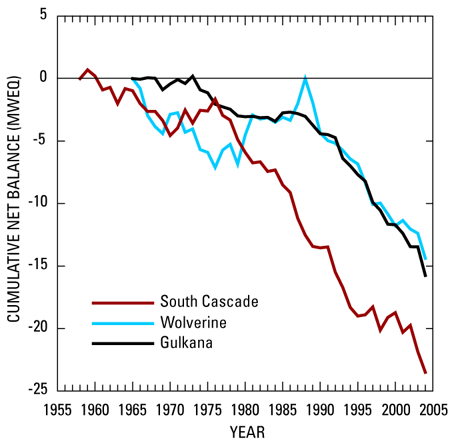
Large snow variances can apparently throw off mass balance observations. That's another reason I don't do ice.
To me --- the grounded leading edge of the glacier would be a better indicator...
The other issue you two gladiators have is that Ian is going back TWICE or FIVE times as far in time as the papers that OldieRocks cites...
DING !!! Round 2... Judges will score Round1 as a slight advantage to the skeptic team ..

Really?
Glacial Retreat | MountBakerExperience.com
Fountain and his colleagues use ground and aerial photography to analyze change in surface area of glaciers across the western U.S. They study the correlation between this data and changes in local, regional and global climate.
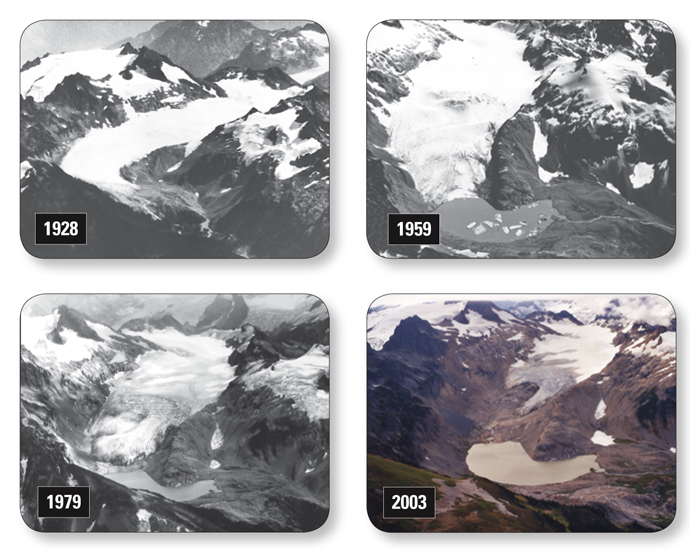
Fountain said the glaciers on Mt. Baker have lost an average of 25 percent of their surface area since 1900. Mt. Baker’s glaciers have fared better than those in the surrounding Cascade Range, most of which have lost closer to 50 percent of their surface area. At 10,781 feet, Mt. Baker stands much higher than the surrounding peaks, so it gets snowfall even when the surrounding peaks are getting rain. That high-elevation snowfall sustains Mt. Baker’s glaciers, but the line between snow and rain is moving up the mountain.
“Precipitation hasn’t really changed that much in the last 100 years,” he said. “What’s changed is air temperature. In the Pacific Northwest, snow is fairly warm compared to places like Utah, so we might have a ton of precipitation that falls as rain at the lower elevations, but as the regional temperature rises, the elevation at which rain turns to snow also rises. At the same time, summers are getting warmer, so glaciers are melting more each summer.”
Fountain pointed out that this level of melting is not unprecedented in our region. He said the glaciers on Mt. Baker were the same size or smaller than they are now in the late 1940s. Glaciers generally retreated from around 1900 until the 1950s, and actually advanced from the ’50s to the early ’80s as the climate cooled slightly, before receding again. There is evidence of rapid melting of the ice caps as the Earth warmed after the last Ice Age, and dozens of recorded advancements and recessions in the glacial record since then.
What’s different about this melting period, Fountain said, is the cause.
“In the past, the fingerprint of change has been natural, because humans weren’t around. But now, the change is human-caused.”
I asked Fountain how climate change would affect the future of skiing. “You know,” he said, “We’re on a runaway train. If you took humans away right now, the earth would still warm up for 100 years because of a lag effect. If we continue to burn fossil fuels at our current rate, we’re talking five or six degrees of warming. There wouldn’t be any more glaciers. Forget the ski industry – it’s gone. In general, wet places will get wetter, dry places will get dryer, but it’s hard to accurately predict the type of havoc that amount of warming would wreak on air currents and weather systems. When they get into the five to nine degree models, I just stop reading,” he said. “It’s too depressing.”
Now Ian, your author painted the scientists as if they were ignoring the earlier melt. They are not, but there are major differances between now and then.