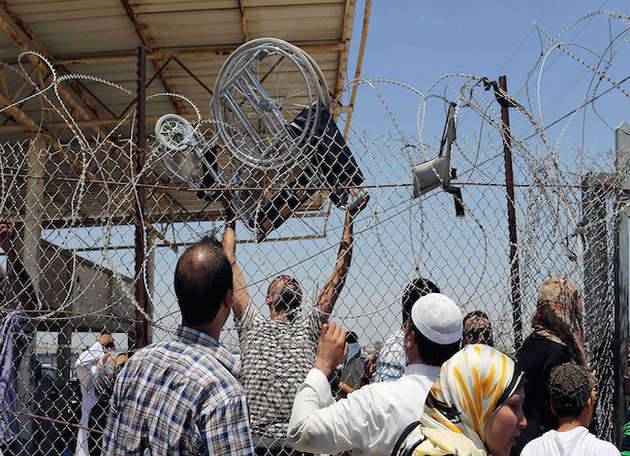
When Egypt decided to open the Rafah border crossing which separates it from Gaza for two days, December 3 and 4, a sense of guarded relief was felt in the impoverished Strip. True, 48 hours were hardly enough for the tens of thousands of patients, students and other travelers to leave or return to Gaza, but the idea that a respite was on its way helped to break, albeit slightly, the sense of collective captivity felt by entrapped Palestinians.
Of course, the Rafah border crisis will hardly be resolved by a single transitory decision, mainly because Gaza is blockaded for political reasons, and only a sensible political strategy can end the suffering there or, at least, lessen its horrendous impact. Palestinians speak angrily of an Israel siege on Gaza, a reality that cannot be countered by all the official Israeli hasbara and media distortions. In fact, not only is it far worse than a blockade as an economic restriction but it is a constant violent process aimed at brutalizing, and punishing a community of 1.9 million people, 55% of which according to the UN are children. However, the Egyptian closure of the Rafah border crossing, which has contributed to the 'success' of the Israeli siege is rarely discussed within the same context: as a political decision first and foremost.
In a border-related agreement that was reportedly signed mid-November between Palestinian Authority President, Mahmoud Abbas and Egypt's Abdul Fatah al-Sisi, both sides seemed genial and unperturbed about the tragedy bubbling up north of the Egyptian border. The 'activities' near Rafah were intended to "secure the border," Sisi told Abbas, according to a statement issued by the Egyptian President's office. These activities "could never be meant to harm the Palestinian brothers in the Gaza Strip."
The term 'activities' here is, of course, a reference to the demolishing of thousands of homes alongside the 12-kilometer border between Rafah in Gaza and Egypt, in addition to the destruction and flooding of hundreds of tunnels, which have served as Gaza's main lifeline that sustained the Strip throughout the Israeli siege during most of the last decade. Abbas, of course, has no qualms about the Egyptian action, the result of which has been the closure of the Rafah crossing for 300 days in 2015 alone, according to a new study originating in Gaza.
Last year, in an interview with Egypt's 'Al-Akbar' newspaper, Abbas said that the destruction of the tunnels was the best solution to prevent Gazans from using the smuggling business for their own benefits. He then spoke about 1,800 Gazans becoming millionaires as a result of the tunnel trade, although no corroboration for this specific number was ever divulged. Of course, Abbas has rarely been concerned about the rising fortunes of the alleged 'millionaires', because his Authority, which subsists on international handouts, is rife with them. His grievance is with Hamas, which has been regulating tunnel trade and taxing merchants for the goods they import into the Strip. Not only were the tunnels a lifeline for Gaza's economy, the underground business helped fill a void in Hamas' own budget, a fact that has irked Abbas for years.
MORE