Does that pic in the op look like its in the woods? And what powers your charger?
I will wait for you to post a link for that specific charger.
.
Here I posted a link in my original post..
car charging centers - Google Search
They are advancing everyday, some cars can be charged with solar power..
Solar Powered Cars - Electric Vehicle Charging Stations
I asked for specific...
You gave me propaganda..
Again...
The U. S. Uses 91% fossil fuel, 9% green energy most of it hydro and bio fuel.
.
Well now, someone else that likes stinky facts, pulled straight from their ass.
Coal 33%
Natural gas 33%
Nuclear 20%
Hydropower 6%
Renewables 7%
Petroleum 1%
Other gases <1%
What is U.S. electricity generation by energy source? - FAQ - U.S. Energy Information Administration (EIA)
What a fibber
Renewable energy to hit 9 percent of U.S. total in 2017
by
Stephen Edelstein, Contributing Writer
11/10/2016
Share This:
U.S. renewable-energy generating capacity is not only growing, but it is beginning to erode coal's share of the electricity-generating mix, according to new data from the U.S. Department of Energy (DOE).
The agency predicts renewable energy—particularly solar power—to continue growing.
At the same time, a combination of renewable energy and natural gas are expected to further decrease the amount of coal used to generate electricity.
DON'T MISS: Renewable energy growth accelerating, says International Energy Agency
In 2017,
renewable energy should account for 9 percent of U.S. electricity-generation capacity, according to the DOE's most recent Short-Term Energy Outlook.
That's up from 8 percent this year, the agency says.
Solar power is expected to account for most of the anticipated growth.
Renewable Energy - IER
According to the Energy Information Administration, “renewable energy refers to resources that are replenished in a relatively short period of time.” Renewable energy sources include hydropower, wood biomass (used to generate heat and electricity), alternative biomass fuels (such as ethanol and biodiesel), waste, geothermal, wind, and solar.
The use of renewable fuels dates to Neolithic times, when cave dwellers made fire from wood and other biomass for cooking and heating. For thousands of years thereafter, renewable energy was all humans used. The small amounts of energy accessible to humans through traditional dispersed renewable energy sources meant that for millennia, human lives remained unchanged. Today, many are seeking to use technology made possible by modern, concentrated energy forms to capture and harness dispersed renewable energy potential into concentrated forms. Renewable energy relies upon the natural forces at work upon the earth, including the internal heat represented by geothermal, the pull of lunar gravity as it affects the potential for tidal power, and solar radiation such as that stored through photosynthesis in biomass.
Renewable Energy in the US
About 9.9 percent of all energy consumed in the United States in 2015 was from renewable sources
, and they account for about 13.4 percent of the nation’s total electricity production[ii].
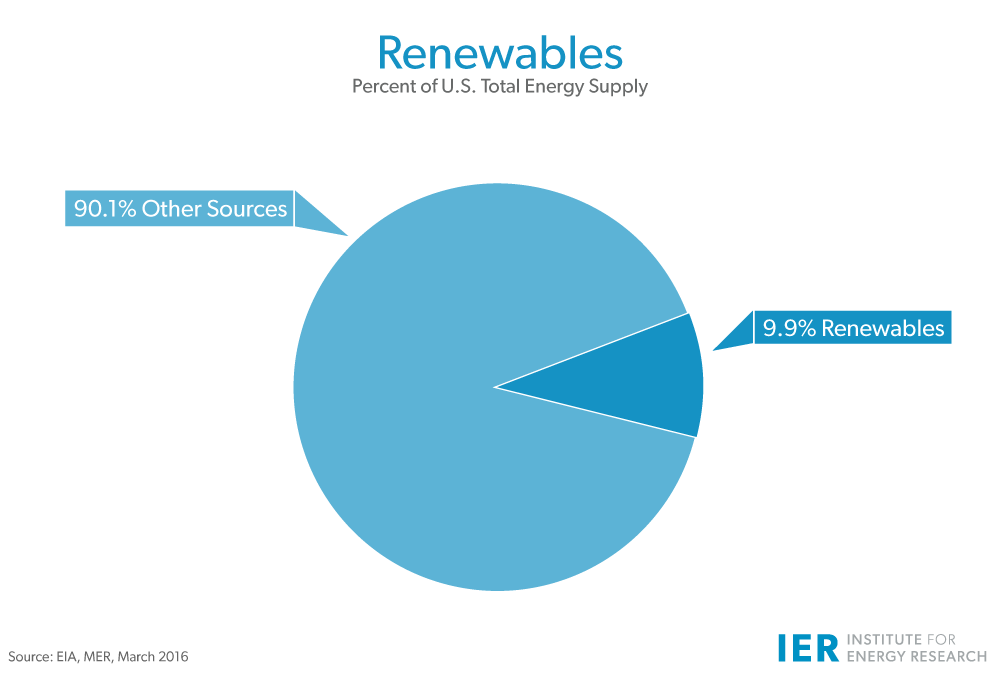
While a relatively small fraction of our overall energy supply in 2012 (the most recent data from the Energy Information Administration), the United States was the world’s largest consumer of renewable energy from geothermal, solar, wood, wind, and waste for electric power generation producing 22% of the world’s total. In 2015, the distribution of U.S. renewable consumption by source was [iii]:


