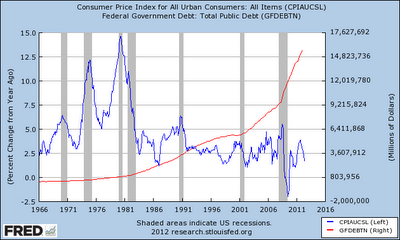
We both know idiots like Peter Schiff and Kyle Bass have said hyperinflation is around the corner. I know it's basically impossible, unless a country suffers a loss of its industrial capacity, has massive corruption, and basically has debts denominated in a currency other than its own. This is the historical trifeca for hyperinflation.
I don't know too much about Kyle Bass, but I follow Peter Schiff pretty close and I know he has said the same thing that I have said. Hyperinflation is a
worse case scenario. It's a pretty recent interview, so maybe he has changed his tune a couple of times.
I never put a timeline on it. I know what is going to happen, I cannot tell you when it is going to happen and I never claim to know exactly when we will have hyperinflation. But I also say that hyperinflation is not guaranteed, it is a worse-case scenario. I say that if we keep doing what we are doing, we will eventually have hyperinflation. But I have also said that I do not think we are going to keep doing what we are doing. I think the spectre of hyperinflation once it looms large enough will force central banks to reverse policy.
His predictions about the price of Gold are not as accurate as we both would have liked, but we are generally on the same page here. As for 'idiots,' that's debatable. He has been pretty spot on about his booms and bust forecast during the Dot Com Bubble and Housing Bubble. I can't really say that about most economist or financial pundits so he deserves some credit here.
The Big Mac index isn't such a great metric. There's some PPP issues there, but I digress.
Well, you don't believe the Big Mac index is great, and I don't believe the CPI is great. As long as we can both take either with a grain of salt and not herald one over the other as a 'be-all-end-all' metric, that is fine. The Big Mac index used some of the same methodology the Consumer Price Index used to measure prices across the world. The only problem is that the CPI changed.
As you can see, prices were in perfectly alignment with the CPI, until the mid-2000's. I believe the CPI has been changed to understate it's inflation and should be taken with a grain of salt.
What software are you using? I don't play FOREX but I'm curious.

It's Kewl.
At work, I use e-Singals, but at home I use MultiCharts. e-Singals performs much better but they wanted to charge me an extra $1,500 just so I can use my brokerage account on a second computer and I'm not doing that. Especially since it's illegal for me to work from home.
The charts you've seen were the MultiCharts platform. It's free to try for a month or so. Works in real-time data as well. Really good stuff on there.
I've been trying to explain this to the hard currency crowd for YEARS: the dollar's purchasing power has increased SIGNIFICANTLY if we use the common denominator of hours of labor needed to purchase a basket of goods. Our ability to acquire more goods and services has increased over time as real incomes have risen.
Things are getting cheaper in terms of the cost to make goods and services at the average industrial wage. When the industrial wage is low, it takes more labour hours to purchase something than if the industrial wage is high. The CPI has a metric which is similar to this called Hedonic Adjustments, which determines inflation based on the quality of a good or service, rather than the nominal price increase of the item.
But I believe these are mitigating factors which mask certain cost involved which have increased.
All the problematic inflation Ive seen is a result of increasing energy prices. The is a relative value deal but filters through every sector of the economy and becomes an inflation deal. I think it stems from the government sector paying increased prices for the stuff (real goods and services) it purchases. This also includes indexing government sector wages to the CPI, which is how the country has decided to define inflation. Every time the government sector pays a higher price for something, it's basically changing goalposts and trending the currency downward. Our own leaders don't even understand how the monetary system functions, so I'm frankly not surprised.
According to the BLS report in January, Gasoline fell by 3.0%; however, this was the time where the national average for gasoline was rising and prices increased by 1.0%. Discrepancies I generally look out for when I look at CPI reports, because according to the CPI this surge in gas prices was all in everyone's head.
Imports are real benefits and exports are real costs. The trade deficit improves our standard of living immensely. If any jobs a lost in the process, it's due to the fact taxes are way too high for the current level of government spending. The real wealth of a nation consists of everything it produces and keeps, including all net imports, minus what it must export.
I don't believe trade deficits are bad. Just the size of the Trade Deficit to the extent that the United States has is bad. It devalues the strength of the US Dollar and makes exports more expensive for the United States. Foreign economies need to devalue their currencies just to keep their exports stable.
If you think all those financial assets are worthless pieces of paper, I will gladly take that burden off your hands.
Only if you are giving gold in exchange.
The Chinese don't loan us anything, including their assets. If you're referring to Treasuries, they're simply gloried savings' accounts which represent the total savings of the US economy. The foreign sector simply shifts funds between reserve accounts and Treasuries the same way you or I would shift funds back and forth between our checking and savings accounts. They're isn't going to be some Peter Schiff day of reckoning. Ever. Well, we might see him in a straight jacket if he keeps losing his clients massive wads of money.

The day of reckoning is generally when the investors stop buying US debt. Interest rates are already starting to rise much sooner surprisingly, and through no fault of the Federal Reserve. So I wouldn't count Peter Schiff out just yet.
I'll try again, just not tonight.
Fair...
Sure there is....It's just that the Austrian Business Cycle is completely off the wall. We'll get into it if you want.
Okay, I'll bite. Why is the Austrian theory of mal-investment wrong.
They were a HUGE problem. It's just that these myths stay alive and are pervasive.
Lets say an inflow of gold allowed the US government to increase the money supply (issue more notes) due to the fact they has more gold to back the currency. The monetary expansion was in a set proportion to the value of the US dollar in terms of gold. At some point, the increasing money supply with hit the inflation barrier, given no real increase in the overall capacity of the economy which would make exports significantly less attractive, thus reducing the external deficit so to speak.
From a practical standpoint, not theoretical, the adjustments to trade that were required to correct imbalances were very slow. At the same time, deficit counties had to deal with high unemployment and recession. A gold standard creates a bias in economies with a burden on the shoulders of countries with weaker currencies ( a result of trade deficits). This rigid structure prevented governments from creating monetary and fiscal policies which would benefit their domestic economies.
Not necessarily. The trade balance only shows one side of the capital in/outflows of the country. The other side of the capital flows are from the Capital Account. When economist compute the current account (trade balance), they don't include the sale of financial assets (the capital account).
Using today's example, the United States imports more goods and services than it exports, creating a current account surplus. However, more foreign Investors tend spend money on Americans than America spends on foreign investors. This creates a capital account deficit. The capital account is counterbalanced by the current account. Having assets backed in gold makes investing in the country more attractive to foreign investors. This counteraction in the Balance of Payments accounting would stabalise any trade deficit/surplus , but it wouldn't make the imbalance disappear.
Are natural resources finite? Yes or no? We know there are finite amounts of oil, copper, gold, silver, nickel, etc. in the ground. Eventually, at some point, not today or tomorrow, we will run out, but I get your point. There's improved technology, better refining and extraction methods, but some day the spigot will run dry.
Yes, natural resources are finite. But even if you believe something is finite, it doesn't necessarily reveal much about the general commodity. We are not really running out of resources. What we are doing is finding more efficient ways of producing and extracting these resources.
Considering copper, in the early 1960, telephone use was expanding largely in the United States. At the time, the only way to carry data over telephone use was with Copper. As telephone use began to expand, the price of copper began to rise. As the demand for copper increased, so did the price. People began to worry that we wouldn't have enough copper to expand telephone use.
We managed to get around this problem. Copper producers found new sources of copper which were previously too expensive to explore. Also they've have discovered a substituted called fiber-optic cables which is made out of sand.
I own some gold, but as a commodity, it's subject to volatility, that's for sure. Gold has doesn't have an intrinsic value, it's a non-productive asset. When I own a stock, I own a piece of a business which produces real goods and services for consumers as well as generating profits.
Gold doesn't pay a dividend, if that is what you are getting at. But there are plenty of investments which doesn't pay dividends. Doesn't make them horrible investments, but to say that it doesn't have intrinsic value is a rather strange statement. Even some Gold bashers acknowledge that Gold has some unique properties.
The idea of tying a commodity to a currencies isn't new. That commodity can very well be anything. It could be Platinum or Bananas for all we know, but there are number a characteristics which gold has (which chemist will know better than I) which makes gold unique. There is nothing really like Gold and unlike most metals, it is pretty difficult to find a replacement for it. It's difficult to forge, and yet, soft enough to manipulate it's matter. You can make it into just about anything and it's extremely useful in an industrial metal. Your cellphone probably has about .003 grams of Gold inside. It is scarce, finite, and almost impossible to destroy.
Historically, gold has been a horrible investment against inflation. Stocks have performed much better with an average of seven percent inflation-adjusted dollars over the past two hundred years. For example, if we switched to rocks, paper, sticks, gold or silver as a currency, Google, Apple and Lockheed would still generate enormous surpluses as people exchange their money for real goods and services produced by these firms.
If someone burred an ounce of Gold in their backyard in 1949 along with a 20 dollar Reserve Note and dug it up again today, they would find that this ounce of Gold would buy $1,253 worth of stuff, while that $20 dollar bill only buys.... $20 dollars worth of stuff. And it doesn't have the same purchasing power as it did during 1949. Stocks have been in a Bull market for 30 years, while Gold has been in a bear market for around the same time period. Much of that has changed. Even with the big correction in the price of Gold, Gold Mining Stocks are coming back from their correction.
But essential, Gold is money. You don't compare it to stocks, but to other currencies.
What do you define as a 'true gold standard'? I'm more than familiar with the gold standard, fixed exchange rates, etc. I didn't like Bretton Woods, either. I'm venturing not for the same reason you probably disliked it.
There are many ideas of it, but the general variations have a monetary system without a central bank. Modern economies already run their fiat system without one. There is no reason why this couldn't be done without a central bank too. Also the True Gold Standard calls for the stripping of Gold restrictions in the economy. This includes legal tender laws preventing Gold from being used in voluntary transactions.
By the way, I wasn't attempting to repeat myself. The gold standard - and its history - is pretty linear and easy to understand. I just don't think mentioning the ten or so booms and busts of the 19th century is a good way to sell the gold standard. Getting back to Peter Schiff (yes, I hate this guy in an irrational way), he somehow lauds the 19th as some golden era (no pun intended).
Do you also hate him for figuring out a way for people to purchase goods and services using a Gold-Backed checking account, too?
The next response. Already getting late here.
Cycle booms and bust are much bigger due to the liquidity which can be concentrated throughout the economy. Recessions are unfortunate, but are necessary to reallocate mis-directed resources in the economy. Deficit spending alone with decreasing rates can act as a stimulate in the economy when a recession occurs, but it allows encourages a misdirection of these resources, which can only be sustained by the Government's ability to spend, print and borrow.
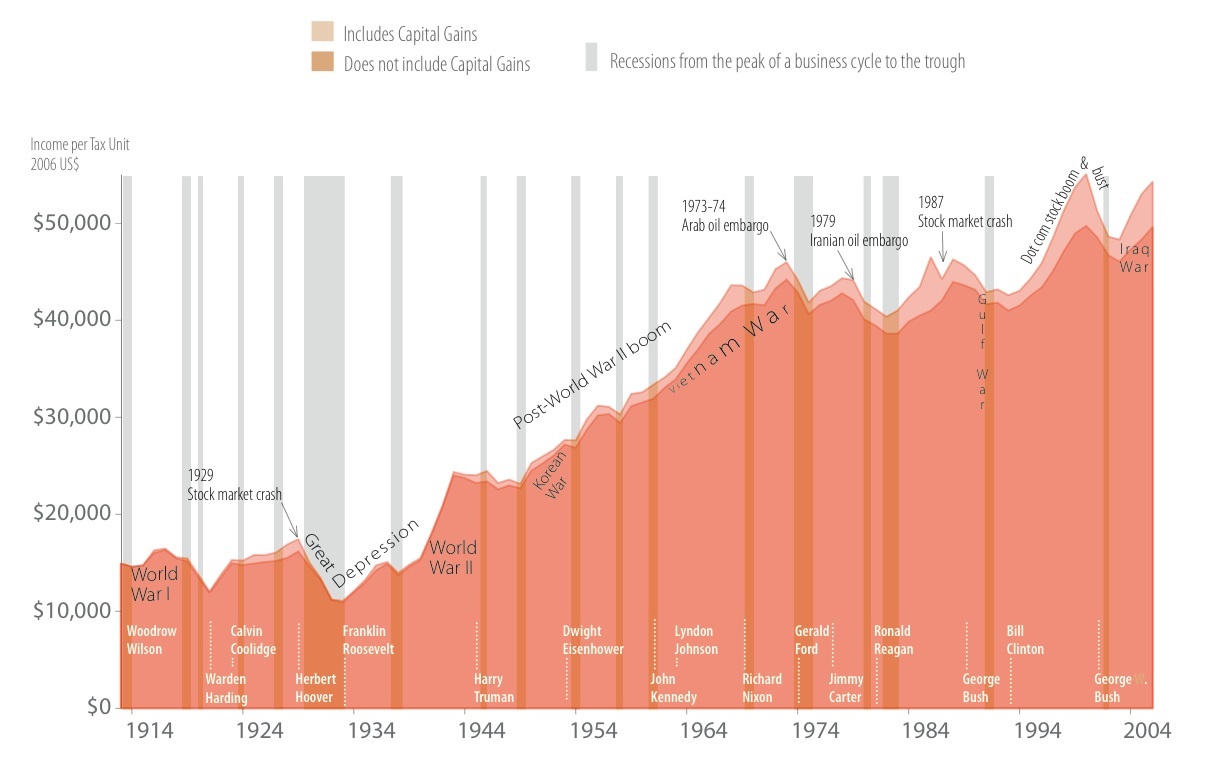
This is how a very bad tech and stock market bust turned into a housing and real estate bust. The Dot Com bubble and the Housing bubble are really the same bubble. However, a gold standard would have stopped what happened in 2001 dead in it's tracks.