The incomes are adjusted to 2009 dollars, the ranges are selected because you have to have ranges if you're going to distinguish between ranges. What it sounds like you want is to compare a sliding scale dynamic income you can manipulate and call what you please to conform to your meme. Is that how "middle class" works in your mind? We change it depending on what result we want to show? Sometimes $75k is upper income and sometimes it's middle income?
I got that. My question is....why 75k? Why is that your measure of 'middle class'? Almost all measures of middle class use some percentage of median income. You use an apparently arbitrary number.
Why that number? What is its significance. And why do you use it to define 'middle class'?
Well darling, it's not MY measure or MY graph.
Um, kiddo.....you're citing it. Its your graph now. If you know nothing behind it, have no clue why it drew its arbitrary lines where they did, then perhaps you should dig a little deeper into your own sources before quoting them.
I've given you ample opportunity to explain yourself. You clearly have no such explanation for why such an arbitrary number was used. Nor can you rationally justify 75k as the threshold of 'upper income'. And without a rational reason, there's no reason to use it.
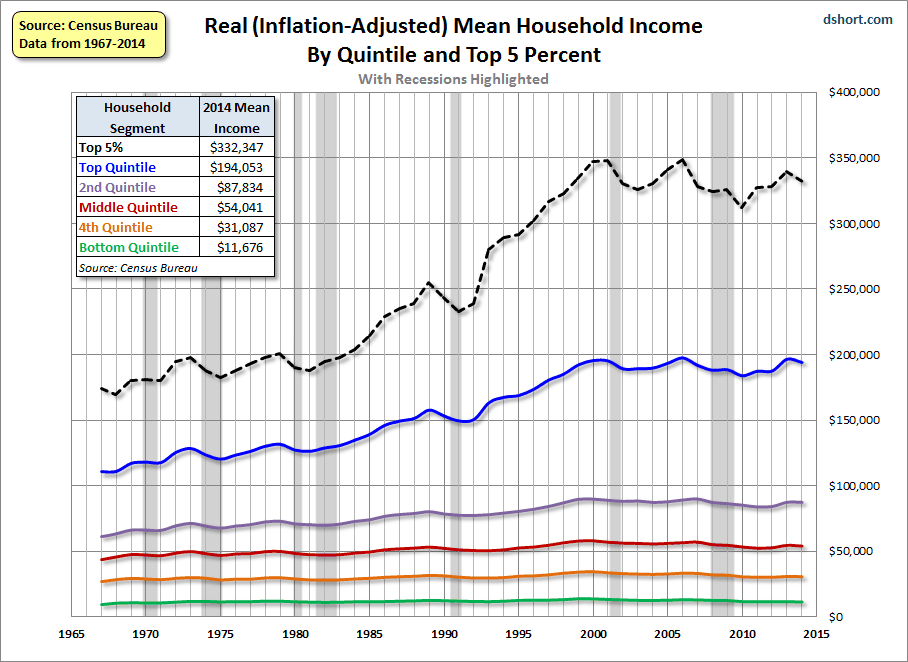
With the lowest, 2nd lowest and middle quintile essentially stagnant despite in 2013 dollars (and actually in decline since 2007), how can you rationally argue that the middle income group is becoming an upper income group. The middle quintile is at roughly the same place it was 50 years ago.
You'll note that the information comes from the US Census Bureau. I'm just passing along information, you can take it however you please. Is there some magical dollar amount one reaches and suddenly becomes a different class? What IS "middle class" to you? Is it just whatever amount it needs to be in order to make the point you are making at the moment?
You'll note that the Census Bureau doesn't draw the line for 'upper income' at 75,000. Your source does.......for some reason even you don't know. Nor bothered to find out before citing it. If you ever do, feel free to share it.
Meanwhile, the Quintile system is used by the Census Bureau, giving us ample reason as to why its being used now. And it shows stagnation and decline in 3/5ths of American households. With moderate growth in the 2nd highest quintile, dramatic growth among the upper quintile and wild growth in the upper 5%.
If the American worker is producing double what he did 50 years ago.....why is the increases in income missing 3/5ths of the US population?
I don't need to get into a pissing contest with you over a graphic from the US Census. No lines were "arbitrary" or drawn to make some tricky political point.
Then explain why you using $75,000 as your 'upper income' group. And why you're using only 3 groups, when the Census Bureau uses at least 5. IF they're not arbitrary, then there will be some objective reason why. Is it a percentage of mean income, like most measures of middle class? Is it the quintile system that the Census Bureau uses?
Explain it to us.
You can't. You have no idea why you're using the lines you are. You have no reason, no rationale for why you're using the numbers you are. Nor any reason why you're defining 'middle class' as below $75,000. With no rational reason, your definitions are objectively meaningless.
So much for your 'degree of common sense'.
What exactly are you quibbling about?
Sigh....for the third time;
Skylar said:
With the lowest, 2nd lowest and middle quintile essentially stagnant despite in 2013 dollars (and actually in decline since 2007), how can you rationally argue that the middle income group is becoming an upper income group. The middle quintile is at roughly the same place it was 50 years ago.
What about these 2 whole sentences confound and confuse you so completely that it require *three* recitations before you can comprehend them?
Sound them out if you have to, sweetheart. Oh, and the bottom 3 have been in decline since 2000.....not 2007.
And seriously? Are you going to actually try to make an argument that increased production over the past 50 years has nothing to do with technology and is all produced by the work force? Sounds like what you seem to think.
The per capita productivity of the American worker has doubled.since the 60s. Undoubtedly technology plays a role. Yet the benefits of the increases in productivity have essentially skipped the bottom 3 quintiles, with their wages essentially stagnant. And in decline since 2000.
And focused overwhelmingly in the upper quintile, with the most stark increases in income coming in the upper 5%. In both real dollars and percentage of increase.