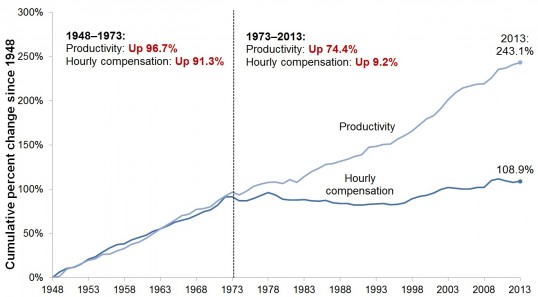
Yes, people are borrowing more. But you are making up that it is because people are not paid enough. You don't know that. You are just making an assumption to fit your ideology.
What's your explanation for US wage stagnation over the past few decades?
Five Causes of Wage Stagnation in the United States | AFL-CIO
"Before digging into the details, it's important to note a few things.
"First off, wage stagnation is not a small problem, it's something that affects 90% of all workers."
The problem with that, is that it all depends on your method, and your ideological bent.
There are numerous research in the area of wages verses productivity, and many of the contradict.
For example.... Say you have a laborer who fashions car doors for an auto factory, by moving sheet metal in a press, setting it up, pressing the sheets, and then putting them on a rack to be transported to an assembler.
As the value of cars increases, the workers wage would increase in relative proportion to the value of the labor.
The company replaces the machine with a new machine that feeds the sheet metal in itself, and then aligns it itself, and then a presses the metal, and then loads it on a conveyor itself. The worker only needs to monitor the machine, and verify accuracy.
Now the worker is at most, pushing a button. Would you yourself, pay someone as much money for doing barely any work?
No. Anyone can sit, and monitor a machine, and hit a button. You don't need $20/hour to do this.
So the problem is, that high skill jobs are being replaced with low skill jobs.
As our economy improve, the demand for low-skill labor, is declining. The demand for high skill labor is going up. And at the same time, we have an increased number of people in the low-skill no-skill labor market.
Therefore what we are seeing is normal, and expected.
So what are some solutions?
What is universally true, is that supply verses demand, determines price.
So... in order to increase the value of low-skill or no-skill labor, we need to either A: Increase the demand for low-end labor. or B: we need to decrease the supply of low-end labor.
If the demand for low-end labor goes up, or the supply of low-end labor goes down, the price... the wage paid for low-end labor will increase.
How do we accomplish that?
Well there are a number of ways. One way, which we just did, and is in fact working, is we lowered the corporate tax rate, which makes it more profitable to build stuff in the US. Manufacturing here is increasing, and largely due to tax cuts.
Some food for thought: the U.S. had as many people working in the manufacturing sector in December as it did 69 years ago.

www.marketwatch.com
So that part is working.
Another way, is by reducing costly regulations, and reducing the cost of using human labor. For example, repeal all the Obama care regulations.
Then you can also tackle the other side, which is reducing the supply of low-end workers. How do you do this?
First, stop illegal immigration. Illegals typically are in the low-skill, no-skill labor market, and they depress wages. Stopping illegal activity will reduce the supply of low-end workers, will will push up wages.
The other way, is by encouraging more people to leave the low-skill no-skill markets. How do you do that?
One way would be to encourage more people who do not want to go to college, to go to trade schools and learn a trade skill.
Another way, is to dis-encourage bad degrees. Like I think we should have a prevention of people using student loans for an Art History degree. You get an Art History degree and end up working at Burger King.
The more people we move out of low-skill no-skill jobs, the smaller the supply of low-end labor will be, and prices will go up.
By the way, this isn't theory. This is how the world works. Contrary to idiotic left-wing lies, Denmark doesn't have a unionized McDonald's workers. Contrary to the claim, they don't negotiate with McDonald's on wages.
Denmark doesn't have a minimum wage. So why do McDonald's stores in Denmark pay their employees $16 an hour to start?
Because they have a small low-skill no-skill labor market. People don't stay in the low-end market, they get a skill, or a trade, or degree, and move up out of that market.
By the way, another way we can reduce the size of the low-skill no-skill market, is by eliminating welfare and food stamps.
When you stay on government assistance, you end up staying in the low-skill no-skill market.
As much as Socialists talk about Scandinavia, most of those country (I think all of them), do not have welfare. There is no living off the government. You don't work... you don't eat. Everyone has to work. They have Unemployment Compensation, but you only qualify for that after a full year of full time work, and you don't work, you don't get it. And that Unemployment Compensation only lasts for a specific amount of time, and then if you don't have a job by the time it runs out, it just runs out. You work, or you starve.
And people who work, will naturally progress up the income ladder. Even if you work the crappiest of jobs, like minimum wage at Wendy's... if you just stay there working full time, coming in on time, and do your job right, and get along with people... in a few years you'll be in management. And few years after that, you can move into corporate management.
But if you quit and live on welfare, no you'll be back to minimum wage again.
So those are ways to improve the low wage market.