So, since Romney only got 1.1 million less votes than Bush (2004), no one can say with any credibility that Republicans stayed home in 2012. They did not. They voted. Only, decidedly more Independents and Democrats voted, and that brought President Obama to 51.01% in 2012. And indeed, the record setting Latino statistic was a big part of that.
I really have a hard time wrapping my mind around how stupid you liberals are. The world is dynamic, not static.
When Bush ran in 2000, the US population was 282 million. When Romney ran in 2012 the US population was 314 million.
RealClearPolitics notes the voters who stayed home in 2012:
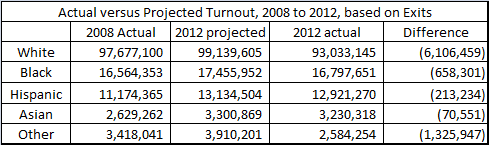
From mid-2008 to mid-2012, the census estimates that the number of whites of voting age increased by 3 million. If we assume that these “new” voters would vote at a 55 percent rate, we calculate that the total number of white votes cast should have increased by about 1.6 million between 2008 and 2012.
The following table summarizes these estimates for all racial groups, and compares the results to actual turnout.
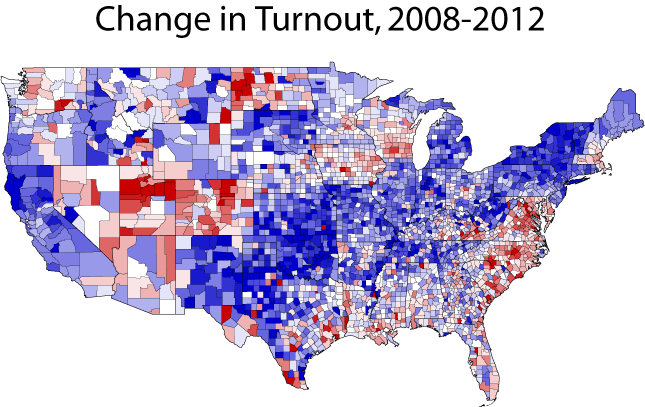
In the map below, blue indicates a reduced turnout.
Who were these missing voters?
For those with long memories, this stands out as the heart of the “Perot coalition.” That coalition was strongest with secular, blue-collar, often rural voters who were turned off by Bill Clinton’s perceived liberalism and George H.W. Bush’s elitism. They were largely concentrated in the North and Mountain West: Perot’s worst 10 national showings occurred in Southern and border states. His best showings? Maine, Alaska, Utah, Idaho, Kansas, Nevada, Montana, Wyoming, Oregon and Minnesota. . . . . .
Perhaps most intriguingly, even after all of these controls are in place, the county’s vote for Ross Perot in 1992 comes back statistically significant, and suggests that a higher vote for Perot in a county did, in fact, correlate with a drop-off in voter turnout in 2012.
What does that tell us about these voters? As I noted, they tended to be downscale, blue-collar whites. They weren’t evangelicals; Ross Perot was pro-choice, in favor of gay rights, and in favor of some gun control. You probably didn’t know that, though, and neither did most voters, because that’s not what his campaign was about.
His campaign was focused on his fiercely populist stance on economics. He was a deficit hawk, favoring tax hikes on the rich to help balance the budget. He was staunchly opposed to illegal immigration as well as to free trade (and especially the North American Free Trade Agreement). He advocated more spending on education, and even Medicare-for-all. Given the overall demographic and political orientation of these voters, one can see why they would stay home rather than vote for an urban liberal like President Obama or a severely pro-business venture capitalist like Mitt Romney.
Trende's advices mirrors my position and Coulter's position:
But the GOP still has something of a choice to make. One option is to go after these downscale whites. As I’ll show in Part 2, it can probably build a fairly strong coalition this way. Doing so would likely mean nominating a candidate who is more Bush-like in personality, and to some degree on policy. This doesn’t mean embracing “big government” economics or redistribution full bore; suspicion of government is a strain in American populism dating back at least to Andrew Jackson. It means abandoning some of its more pro-corporate stances. This GOP would have to be more "America first" on trade, immigration and foreign policy; less pro-Wall Street and big business in its rhetoric; more Main Street/populist on economics.
For now, the GOP seems to be taking a different route, trying to appeal to Hispanics through immigration reform and to upscale whites by relaxing its stance on some social issues. I think this is a tricky road to travel, and the GOP has rarely been successful at the national level with this approach.
Here's what Romney would have had to do differently to have won the election:
State | Electorate (% White) | % Whites for Romney | White Vote Needed for Victory (%) | Difference (%) |
| CO (9) | 78 | 54 | 57.1 | 3.1 |
| FL (29) | 67 | 61 | 61.5 | 0.5 |
| IA (6) | 93 | 47 | 50.1 | 3.1 |
| NV (6) | 64 | 56 | 61.2 | 5.2 |
| NH (4) | 93 | 47 | 50.2 | 3.2 |
| OH (18) | 79 | 57 | 58.3 | 1.3 |
| PA (20) | 78 | 57 | 60.4 | 3.4 |
| VA (13) | 70 | 61 | 63.2 | 2.2 |
| WI (10) | 86 | 51 | 54.9 | 3.9 |
[TBODY]
[/TBODY]
Look at the spread in the white vote in those states. Low of 47 to a high of 61. There's a lot of movement possible in there.
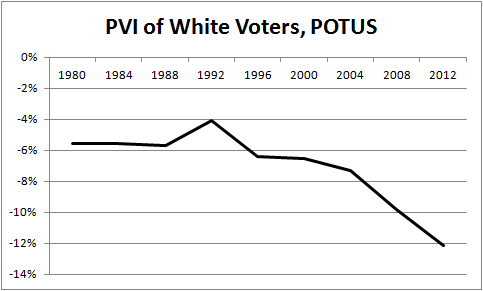
Look at this chart. How low can the Democrats go in terms of white vote? What this chart shows is the percent difference between the Democrats share of the Total Vote and their share of the White Vote.
It’s been in long-term decline, and the decline is accelerating; about
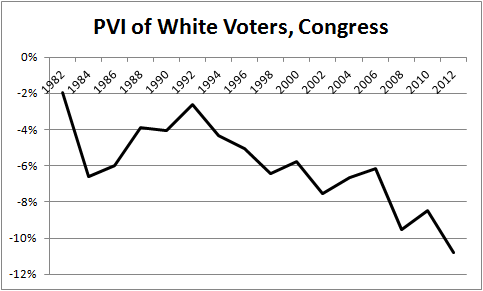
a point-and-a-half toward Republicans per cycle since 1992. Now you may think this is a function of antipathy toward Barack Obama. But it has been on a similar tangent in Congress as well, also at a rate of
about 1.5 points every four years:
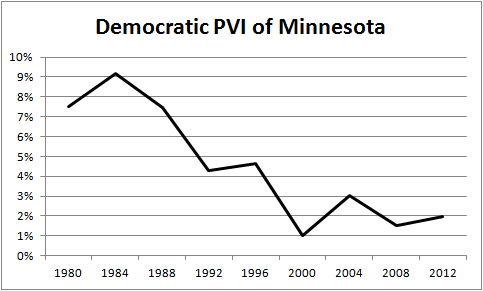
Democrats often point to states becoming blue and their analysis always implies that change is uni-directional. Only red states turn blue and all blue states always stay blue, Not so.
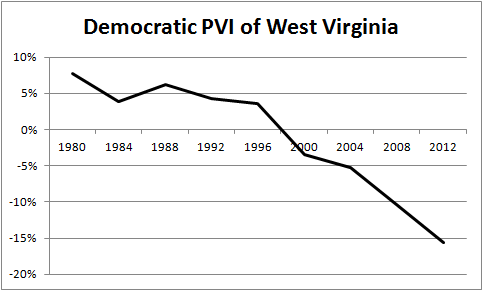
The Washington Post noticed that this wasn't so. Look at what the Democrats face in West Virginia and other states with high white proporations of the population:
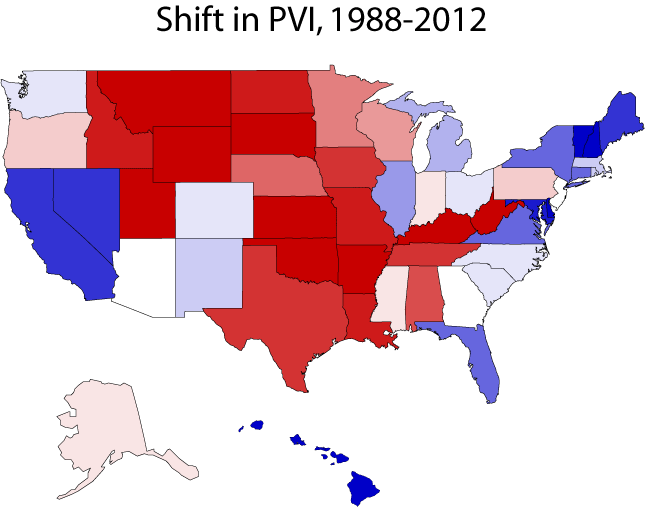
Here's what's going on at the national level:
The diversifying parts of the country have shifted toward Democrats, as has the Northeast. But far overlooked is the movement in the heavily white interior. This really does matter: It wasn’t that long ago that states like West Virginia, Kentucky, Tennessee, Arkansas, and Missouri were places where Democrats could win regularly at the local level, and be competitive at the presidential level.
Nineteen states have moved at least a point toward Democrats, while 25 have moved toward Republicans by a similar amount. If you weight the shift in each state by electoral vote, it actually works out to a slight shift toward Republicans overall.
Now, there is a theoretical maximum for Republicans among whites; sooner or later you run into Madison, Wis., and Ann Arbor, Mich. But we tend to assume that it’s “natural” for Democrats to win huge portions of conservative Hispanics, and almost all conservative blacks. Against this backdrop, it seems a bit touchy to assume that Republicans will max out at around 60 percent of the white vote. This might be the case, but as we’ll discuss next time, it’s entirely possible that as our nation becomes more diverse, our political coalitions will increasingly fracture along racial/ethnic lines rather than ideological ones.
Look at it this way: In 1988, George H.W. Bush, running against a weak opponent in a fantastic environment for the “in party,” won the white vote by 20 points. In 2012, Mitt Romney, running against an incumbent president in what was a neutral-to-slightly-favorable environment for the “in party” by Election Day, accomplished the same thing.
Look at which demographic is seeing the biggest changes in support for Republicans. Youth.
Democrats have nothing to offer white youth.
The question that should be asked is "How low can the white support for Democrats go when the Democrats are becoming increasing racialized in their policies and appeal?" The data shows that the Democrats are driving white voters away.
Coulter is right, the data and the trends support her position.

It’s looking like a tough offyear election for Democrats, with their Senate majority at serious risk and their chances of gaining House seats down toward zero.