Judging by the run of successful natural disaster films in the past few years, people are fascinated by the idea of the end of the world. In Danny Boyle's 28 Days Later, a virus ravaged the UK and beyond; an asteroid was the world-ending threat in Deep Impact and Armageddon; and climate change got a starring role in The Day After Tomorrow. In the real world, we don't know how the Earth (or humanity) might meet its end or when that will happen. Pondering and predicting the event has usually been a job for the world's great religions: all of them have some idea about how humans will meet their maker. Indeed, "the end" (or judgement day) is usually a deity's way of cleansing our planet, to allow a fresh race of people who are morally purer to repopulate the resulting clean slate. Usually, there is too much sin or debauchery and the time has come to start again.
Stories of brimstone, fire and gods make good tales and do a decent job of stirring up the requisite fear and jeopardy. But made-up doomsday tales pale into nothing, creatively speaking, when contrasted with what is actually possible. Look through the lens of science and "the end" becomes much more interesting. Since the beginning of life on Earth, around 3.5 billion years ago, the fragile existence has lived in the shadow of annihilation. On this planet, extinction is the norm of the 4 billion species ever thought to have evolved, 99% have become extinct. In particular, five times in this past 500 million years the steady background rate of extinction has shot up for a period of time. Something no one knows for sure what turned the Earth into exactly the wrong planet for life at these points and during each mass extinction, more than 75% of the existing species died off in a period of time that was, geologically speaking, a blink of the eye.
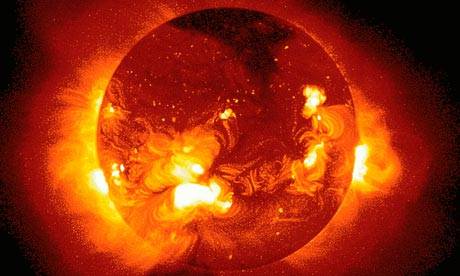
An exceptionally strong magnetic storm would have deadly effects.
One or more of these mass extinctions occurred because of what we could call the big, Hollywood-style, potential doomsday scenarios. If a big enough asteroid hit the Earth, for example, the impact would cause huge earthquakes and tsunamis that could cross the globe. There would be enough dust thrown into the air to block out the sun for several years. As a result, the world's food resources would be destroyed, leading to famine. It has happened before: the dinosaurs (along with more than half the other species on Earth) were wiped out 65 million years ago by a 10km-wide asteroid that smashed into the area around Mexico. Monica Grady, an expert in meteorites at the Open University, says it is a question of when, not if, a near-Earth object (NEO) collides with our planet. "Many of the smaller objects break up when they reach the Earth's atmosphere and have no impact. However, a NEO larger than 1km wide will collide with Earth every few hundred thousand years and a NEO larger than 6km, which could cause mass extinction, will collide with Earth every hundred million years. We are overdue for a big one."
Other natural disasters include sudden changes in climate or immense volcanic eruptions. All of these could cause global catastrophes that would wipe out large portions of the planet's life, but, given we have survived for several hundreds of thousands of years while at risk of these, it is unlikely that a natural disaster such as that will cause catastrophe in the next few centuries. In addition, cosmic threats to our existence have always been with us, even thought it has taken us some time to notice: the collision of our galaxy, the Milky Way, with our nearest neighbour, Andromeda, for example, or the arrival of a black hole. Common to all of these threats is that there is very little we can do about them even when we know the danger exists, except trying to work out how to survive the aftermath.
More
Is the end of the world really nigh? | Science | The Observer


