So, you want some quotes? Here you go:
"A misleading graph purporting to show that past changes in Greenland’s temperatures dwarf modern climate change has been circling the internet since
at least 2010."
"Based on an early Greenland ice core record produced
back in 1997, versions of the graph have, variously, mislabeled the x-axis, excluded the modern observational temperature record and conflated a single location in Greenland with the whole world."
"More recently, researchers have drilled numerous additional ice cores throughout Greenland and produced an updated
estimate past Greenland temperatures. This modern temperature reconstruction, combined with observational records over the past century, shows that
current temperatures in Greenland are warmer than any period in the past 2,000 years. That said, they are likely still cooler than during the early part of the current geological epoch – the
Holocene – which started around 11,000 years ago."
"Since scientists cannot directly measure temperatures from ice cores, they have to rely on measuring the oxygen isotope –
18O – which is correlated with temperature, but imperfectly so."
"Odyssey of errors
A temperature reconstruction using the Greenland Ice Sheet Project 2 (“
GISP2”) ice core was first published by
Prof Kurt Cuffey and
Dr Gary Clow in a
1997 paper published in the Journal of Geophysical Research: Oceans.
Prof Richard Alley of
Penn State University also used the record in a
2000 paper. Neither of these papers provided a comparison of GISP2 record with current conditions, as the uncertainties in the ice core proxy reconstruction were too large and the proxy record only extended back to 1855.
The GISP2 ice core record was used in a number of papers in the late 1990s and 2000s that examined changes over the last ice age and the start of the current warm era – the Holocene – around 11,000 years ago. Around 2009, it caught the attention of
Dr J Storrs Hall of the
Foresight Institute, a technology-focused nonprofit group, who wrote a
blog post suggesting that it disproved the idea that “human-emitted CO2 is the only thing that could account for the recent warming trend”.
That post was
republished on a climate sceptic blog called
Watts Up With That, which followed up with
its own version of a GISP2 graph in late 2010 by
Dr Don Easterbrook, an emeritus professor of geology at the
Western Washington University. Easterbrook’s graph, shown below, was shared widely across the internet by climate sceptics and is still
frequently seen – with
many small variations – to this day in discussions on Twitter, blogs and news article comment threads."
"This graph is misleading for a number of reasons.
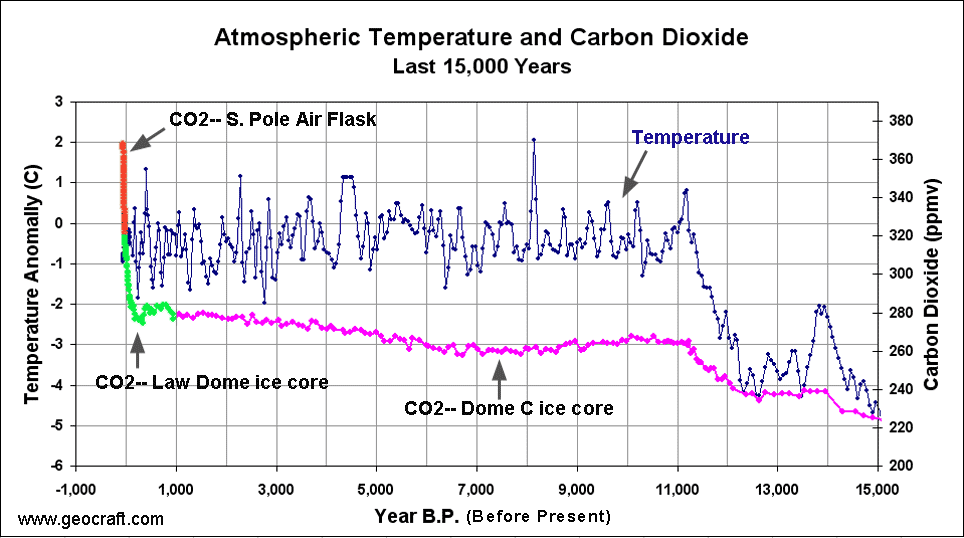
First, the x-axis is mislabelled. In fact, it should say “Years before 1950”, rather than “Years before present (2000 AD)”. The GISP2 ice core only extends up to 1855 – 95 years before 1950. This means that none of the modern observational temperature period overlaps with the proxy reconstruction. (Easterbrook’s graph shows the uptick in the final 100 years or so of the record – shown in red – incorrectly indicating that it is the observational temperature period.)
The figure was also featured
in another post on the same blog, which conflated Greenland with global temperatures. Any individual location will have significantly more variability than the globe as a whole. A single ice core is also subject to uncertainties around elevation changes and other perturbations to the ice core over time.
As Prof Alley told then-New York Times journalist Andrew Revkin
back in 2010:
“The data still contain a lot of noise over short times (snowdrifts are real, among other things). An isotopic record from one site is not purely a temperature record at that site, so care is required to interpret the signal and not the noise.”
The GISP2 reconstruction is fairly old and more recent research
has questioned the assumptions made in changing the relationship between temperature and 18O during the Holocene and how to best account for elevation change of the ice sheet at the GISP2 site. The GISP2 reconstruction changes the relationship between 18O and temperatures by a factor of two during the Holocene, while more recent reconstructions keep it constant. Similarly, elevation change influences 18O records. The old GISP2 reconstruction did not take elevation changes into account.
Scientists reconstructing past Greenland temperatures now use estimates from many different ice cores, which reduces the uncertainties associated with any single one and gives a more accurate picture of changes over Greenland as a whole."
Alley made this point explicitly,
telling Revkin:
“So, what do we get from GISP2? Alone, not an immense amount. With the other Greenland ice cores… and compared to additional records from elsewhere, an immense amount… Using GISP2 data to argue against global warming is, well, stupid, or misguided, or misled, or something, but surely not scientifically sensible.”
Enough? There's more. Read the ******* article.



 www.carbonbrief.org