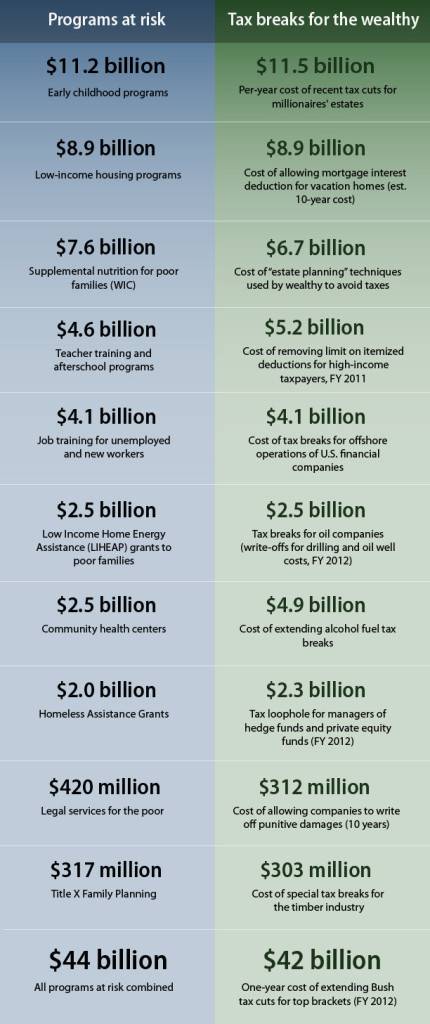
So your basic thesis is that the earnings of any person are not theirs, but actually belong to the state and therefore anything not collected by the state is a loss by the state?
How much money is earned by those that are not on your target list that they do not send to the government? Is this money counted as a loss from the government coffers also?
At what point does any person exceed the amount of money that you deem it acceptable for a person to earn? Is any money kept by an individual acceptable? Why not just take it all and give back what ever seems like the right amount according to the intelligencia?
Should any private property be allowed to be held by individuals?
so you think rich people are on a par with poor in this county ? no special treatment ? WOW
are you rich ?
Generally, every person's income and wealth that they have is theirs and does not belong to the state. That's not legally in dispute, which is to say that most all the time it is legally theirs. The problem is that our economic system is skewed and biased in a way that allows the wealthy to consistently acquire more than their equitable share of income and wealth, legally. Because of this failure of the existing economic system, the only equalizer, so to speak, is a progressive income tax and inheritance tax. Obviously, the tax rates are not progressive enough (nor is the estate tax rate enough) as, particularly since that immoral bozo Reagan's administration and his efforts have exacerbated the situation such that the wealthy keep getting even wealthier and the poor and the middleclass still keep getting poorer ands poorer.
As far as how much money a person should get and should not get, that can't be answered by a specific dollar amount, if that is your question. But the answer is that, for sure, the few at the top have in inordinate amount of the nation's income and wealth while the rest lack an inordinate amount of income and wealth and the easily available stats point that out in spades. It is not necessary to answer your question with an objective amount certain. The answer is in a resolution to the builtin bias of our economic system that would produce a much more equitable compensation level and price level that would then result in a more even level of wealth and income in this country such that there would not be such a lopsided concentration of income and wealth that there is now. And whatever the resultant levels of income and wealth that would be, that would be your answer. What is known is that currently the top 1% own 37% of the wealth and the top 10% own 71% of the wealth. Fixes to our system that would appropriately and systematically result in lower incomes at the top and increase incomes for the rest would be improvements to the economy and for the country as would rolling back certain prices where the cost to produce is far lower than the prices offered and currently obtained. Not saying the everyone should earn exactly the same, not saying that. In a a society as large as ours is, there is room for some appropriate level of disparity in incomes and wealth, but not the current massive disparity that we currently have. So, looking for a certain dollar amount of income limit is not the answer and really not even relevant, but achieving an appropriate market driven economic system that results in more parity is what is desperately required, now!
Private property is fine and is certainly desirable. The right to ownership of property, per se, is not in dispute. Though, certain things that are defined as property need to be revisited and modified legally. For instance, patents and copyrights need to be modified, the length of time that they are allowed to be kept in force in particular. The time period is much to long. Covenants not to compete need to be modified. And, to the extent that current property rights are applied in such a way that allows for legal monopolistic practices by business to go on legally also should be revisited so that such monopolistic behavior can be much reduced or completely eliminated....now! Also, certain things that are subject to protection by patent or copyright should be revisited and possibly eliminated from such protection, or at the very least, protection should be reduced.
BTW, earnings and income are not the same. Earnings are only a subset of income. There are many things that are income that are definitely not earnings. Even the IRS points this out. And, statistically, for the record, the wealthier a person is, the less earnings they have and the more 'unearned income' they have. This is particularly true with the top 1% of taxpayers.