Navigation
Install the app
How to install the app on iOS
Follow along with the video below to see how to install our site as a web app on your home screen.
Note: This feature may not be available in some browsers.
More options
Style variation
You are using an out of date browser. It may not display this or other websites correctly.
You should upgrade or use an alternative browser.
You should upgrade or use an alternative browser.
City on the moon...
- Thread starter Darkwind
- Start date

leftwinger
Diamond Member
No water. No air.

fncceo
Diamond Member
- Nov 29, 2016
- 47,736
- 42,437
- 3,615
No water. No air.
So … Los Angeles

rightwinger
Award Winning USMB Paid Messageboard Poster
- Aug 4, 2009
- 311,849
- 275,055
- 3,615
So, if you look in the right places, you can get a glimpse into some of the plans Musk has for space. He wants Mars, but it looks like some cooler heads talked him into the importance of a moon base to support Mars.
A fascinating watch.
I see no reason to keep a colony on the moon
The logistics of supplying it would be overwhelming for very little scientific value

Yarddog
Diamond Member
- Jun 13, 2014
- 20,768
- 15,695
- 2,405
So … Los Angeles
I nominate Karen Bass as mayor of Moon City ..soon hopefully!
Yarddog
Diamond Member
- Jun 13, 2014
- 20,768
- 15,695
- 2,405
I see no reason to keep a colony on the moon
The logistics of supplying it would be overwhelming for very little scientific value
what if Elon wants to pay for it? why not? tourist trips to moon city would have a very expensive price tag.

Darkwind
Diamond Member
- Jun 18, 2009
- 43,374
- 32,540
- 3,615
- Thread starter
- #8
A moon base would act as only a staging area for Mars. Eventually, the resources and tech will catch up to the point where they can sustain a colony and start harvesting the moon's resources for us.I see no reason to keep a colony on the moon
The logistics of supplying it would be overwhelming for very little scientific value

1srelluc
Diamond Member

Natural Citizen
American Made
- Aug 8, 2016
- 31,098
- 32,266
- 2,945
Those are the kinds of videos I don't mind spending time to watch. Really cool stuff. Good post, OP...

So, if you look in the right places, you can get a glimpse into some of the plans Musk has for space. He wants Mars, but it looks like some cooler heads talked him into the importance of a moon base to support Mars.
A fascinating watch.
Wait till the HOA nazis descend onto this idea.
Yarddog
Diamond Member
- Jun 13, 2014
- 20,768
- 15,695
- 2,405
I see no reason to keep a colony on the moon
The logistics of supplying it would be overwhelming for very little scientific value
How about a mission to find all those missing socks? its pretty obvious isnt it?
But actually being able to create and launch satelites isnt too bad !

So, if you look in the right places, you can get a glimpse into some of the plans Musk has for space. He wants Mars, but it looks like some cooler heads talked him into the importance of a moon base to support Mars.
A fascinating watch.
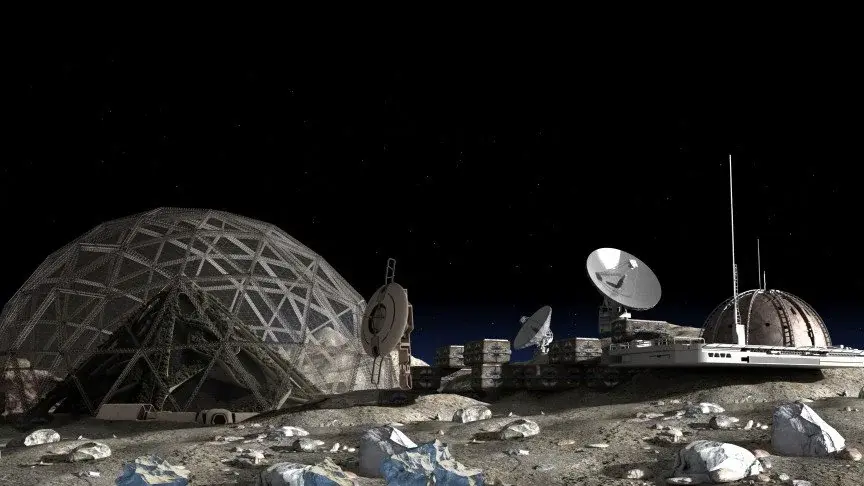
Wow like the lil rocket home has @ least one if not two windows per compartment & they don't even need shades, like what a view!!! The dome in the background looks big enough to be a recreation dome for like a croquet field or other types of entertainment(bowling alley, casino etc.). Heavy footwear would be needed but other than that the model looks like it could be workable. Food could be grown in a hothouse structure if a nuclear powered/heated boiler was provided, which could also heat water for showers/bathing. The big problem would be locating or transporting water.
Mayor Bass would be more functional as the Mars City Mayor.I nominate Karen Bass as mayor of Moon City ..soon hopefully!
Yarddog
Diamond Member
- Jun 13, 2014
- 20,768
- 15,695
- 2,405
Mayor Bass would be more functional as the Mars City Mayor.
True that. the Moon is not far away enough, great point.

trevorjohnson83
Gold Member
- Nov 24, 2015
- 2,361
- 369
- 138
I use to tie two of the exact same little plastic cups together, drop one of a ledge and have the other one drag along the top, fun little experiment, moon craters to make energy.

Project Horizon - Wikipedia
Project Horizon was a 1959 U.S. Army study proposing a permanent military and scientific base on the Moon, intended to be operational by 1966 but never realized.Overview
Project Horizon was initiated in 1959 by the U.S. Army Ballistic Missile Agency to explore the feasibility of establishing a manned lunar outpost for both military and scientific purposes. The project aimed to secure U.S. interests on the Moon, develop techniques for moon-based surveillance, communications, and operations, and serve as a platform for further space exploration and potential military operations. The plan was motivated by Cold War competition, particularly the fear that the Soviet Union might establish a lunar presence first.Wikipedia+3
Proposed
The base was envisioned to house 10–20 personnel, with initial operations starting with 12 soldiers by December 1966. Construction would rely on cylindrical metal tanks (10 feet in diameter, 20 feet long) buried beneath lunar soil for protection against radiation and meteorites. Two nuclear reactors would provide power, and a parabolic antenna would maintain communication with Earth. After construction, the initial quarters would be converted into bio-science and physics laboratories.Wikipedia+2
Logistics
Project Horizon required an ambitious 147 rocket launches using Saturn I and II rockets to transport materials and personnel to the Moon. A lunar landing-and-return vehicle would shuttle astronauts between lunar orbit and the surface, avoiding the need for a direct-ascent superbooster. Surface operations would include vehicles for excavation, hauling, reconnaissance, and rescue. Engineers also considered using natural lunar caves or depressions covered with pressure bags to create additional living space.Wikipedia+2
Historical
The project was part of the early U.S. space race strategy, reflecting military urgency after the Soviet launch of Sputnik in 1957. Despite detailed planning, Project Horizon never progressed beyond the feasibility stage. President Dwight Eisenhower rejected the plan when responsibility for space exploration shifted to the civilian NASA, and the technical, financial, and political challenges proved insurmountable. The estimated cost was $6 billion, and the project was ultimately abandoned in favor of NASA’s Apollo program, which focused on peaceful lunar exploration.Defense Media Network+3
Legacy
Although never built, Project Horizon remains a fascinating example of Cold War-era ambition and early lunar planning. It demonstrated the technical imagination and strategic thinking of the U.S. military in the late 1950s and influenced later discussions about lunar bases and space militarization.Defense Media Network+1
.
Copilot Search
Copilot Search delivers AI-powered insights, helping you explore topics, uncover relevant instant answers, and connect ideas seamlessly.
Copilot Search
Copilot Search delivers AI-powered insights, helping you explore topics, uncover relevant instant answers, and connect ideas seamlessly.
Last edited:
Interesting sequence of images/concepts;
 www.bing.com
Copilot Search
Copilot Search delivers AI-powered insights, helping you explore topics, uncover relevant instant answers, and connect ideas seamlessly.
A glimpse here.
IIRC there is a PDF of the full report/text somewhere on the 'net.
IIRC there is a PDF of the full report/text somewhere on the 'net.
Project Horizon: Army Base on the Moon - Defense …
The Moon Is a Harsh Mistress is a 1966 science fiction novel by American writer Robert A. Heinlein about a 2075 revolt by a lunar penal colony against Earth's rule. Three million "Loonies" (lunar inhabitants) live in underground cities where a virtually anarcho-capitalist society has developed. When the Federated Nations threaten the colony's resources, computer technician Manuel "Mannie" O'Kelly-Davis, political agitator Wyoming Knott, and rational-anarchist Professor Bernardo de la Paz join forces with "Mike," a self-aware supercomputer, to plan an independence movement timed to culminate on July 4, 2076.
The novel explores libertarian ideals, focusing on the concepts of individual liberty, voluntary association, and free-market economics. The book also popularized the term TANSTAAFL ("There Ain't No Such Thing As a Free Lunch"), which in the story underscores the Moon's harsh reality that every resource and every freedom carries a cost. The book is respected for its credible presentation of a comprehensively imagined future human society on both the Earth and the Moon.
Originally serialized monthly in Worlds of If (December 1965 – April 1966), the book was nominated for the Nebula Award in 1966 and won the 1967 Hugo Award for Best Novel. The novel went on to influence later science fiction as well as discussions of economics, politics, and hacker culture.
...

 en.wikipedia.org
The novel explores libertarian ideals, focusing on the concepts of individual liberty, voluntary association, and free-market economics. The book also popularized the term TANSTAAFL ("There Ain't No Such Thing As a Free Lunch"), which in the story underscores the Moon's harsh reality that every resource and every freedom carries a cost. The book is respected for its credible presentation of a comprehensively imagined future human society on both the Earth and the Moon.
Originally serialized monthly in Worlds of If (December 1965 – April 1966), the book was nominated for the Nebula Award in 1966 and won the 1967 Hugo Award for Best Novel. The novel went on to influence later science fiction as well as discussions of economics, politics, and hacker culture.
...
The Moon Is a Harsh Mistress - Wikipedia
Similar threads

- Replies
- 54
- Views
- 575


- Replies
- 12
- Views
- 73


New Topics
-

-

-
-
-
 Zone1 The global hunger crisis is directly linked to unprotected sex in third world countries. Prove me wrong.
- Started by MarathonMike
- Replies: 1


