Long known as the “roof of the world,” the Tibetan Plateau is about the size of Western Europe and supplies water to nearly 2 billion people in Asia as the source of several major rivers, including the Yangze, Mekong, Salween (Gyalmo Ngulchu), Indus, Brahmaputra and Yellow rivers. But because of the impact of climate change, the glaciers are retreating rapidly, grasslands are shrinking as desertification expands, regional precipitation has become irregular, water levels are dropping in major rivers and the permafrost is thawing. The melting of Tibetan glaciers, the largest mass of frozen fresh water outside the polar regions, is linked to many environmental consequences both locally and globally, including heat waves in Europe, according to some studies.
Glacial retreat
Chinese officials estimate Tibet holds 14.5 percent of the world’s total glacier mass. While there are a few different theories on what is causing the glaciers to melt, researchers agree the pace is staggering. China's state-run Xinhua news agency reported in April that an average of 247 square kilometers of glacier is disappearing annually, and that some 7,600 square kilometers of glacier, or about 18 percent of the total, has disappeared since the 1950s. Zhang Mingxing, a Chinese official who heads the Tibet Mountaineering Administration, said the glacier at the Everest base camp, 5,200 meters above sea level, has already disappeared. “There is nothing but stones
,” he was quoted as saying by Xinhua.
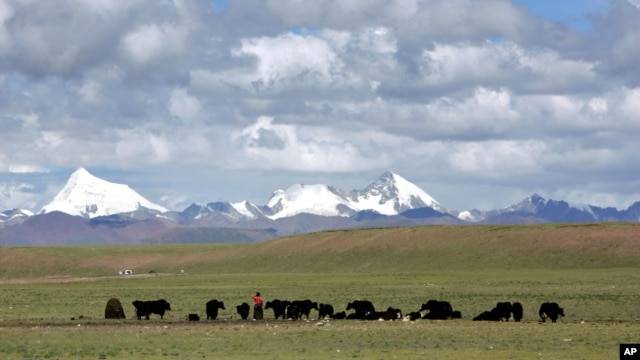
Herders graze their yak in the grasslands of the high Tibetan Plateau in the county of Naqu, Tibet
Prior Chinese research of substances within Tibetan glaciers indicated carbon from forest fires, crop burning and domestic cooking stoves from India have caused the melting. While these could be contributing factors, scientists say the global rise in temperatures is indisputably the primary cause. Tibetans say there has been a drastic change of temperature since 1980s. One U.S.-based Tibetan who recently returned to Lhasa expressed shock at seeing the climatological impact on people’s clothing style. “When I lived in Lhasa, it was very rare that people could walk outside in T-shirts,” said the man, who asked that his name be withheld. “Now people are walking in shorts!”
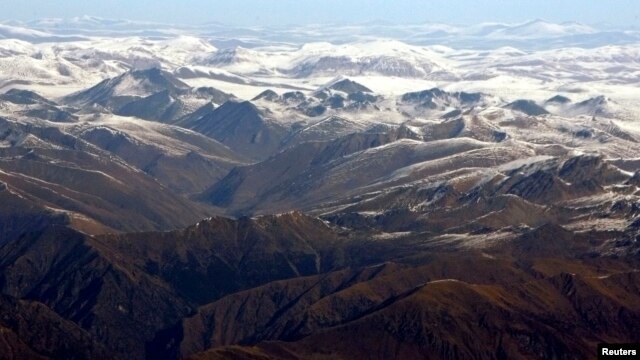
Tibetan Plateau in background of Himalayan range, viewed from flyover in Nepal.
National Geographic reported in 2010 that one glacier was retreating by about 300 meters a year, the length of a U.S. football field. As early as 2009, China’s leading scientist on glaciers, Qin Dahe, said glaciers on the Tibetan Plateau were melting faster than in any other part of the world. In the short term, he warned, the melt would trigger more flooding and mudslides; in the long term: "water supplies in the region will be in peril.” Some researchers have predicted that most of the Himalayan glaciers will be gone in 20 years.
Water needs