I'm 100% for it. Regardless we have to continue exports to maintain our status as world power, otherwise we'd give that status to China. If countries were to become isolated, then yes, no country would complete with the USA, we'd be set.
I think we should also end foreigners owning U.S. real estate. That said millennial's already screwed the pooch on that one. Many figured they were above property ownership. They didn't take into account they'll be paying the Chinese rent in the form of 5Kish by their 60th B-days.
Isolated countries fail economically.
To be fair, there has never been an isolated country on a scale of the US.
AND, as we seen to be destined to be fucked by any trading partner, isolation could be a competitive policy.
THe choice seems to be either be the world's *****, or take our ball and go home.
How do you mean? The USSR failed miserably. Pretty big country.
Failed because they tried to have a big empire AND we fought them.
Not because they were isolated.
Being isolated is bad for capitalism. Very bad .
Being the world's ***** on trade, hasn't been that great either.
If only there was a third option. But there does not seem to be one.
We have the biggest economy in the world with the most wealth and we’ve had super low unemployment. Seems to be fine.
No, we're not. Our middle class wages have stagnated and our middle class and lower class have lost faith in the future.
People are dying from this shit. To the point that our life expectancy is actually FALLING.
Good macro economic numbers have been hiding generations of pain.
Try to change policy.
That is an internal problem . We have the wealth and jobs. That wouldn’t change if we were isolated.
It is not an internal problem. It is a problem caused by external trade and the inflow of labor.
Time to change policy.
What do you base that on. Again, tons of wealth and jobs. That’s the formula for good wages. If we had too much inflow we’d have high unemployment and certainly wouldn’t have labor shortages. Your claim is baseless. Learn some economics.
Because we have NOT had rising wages for the middle class and working poor.
If it is the formula for "good wages" something went wrong.
Yes something is wrong. Has nothing to do with trade. We have near monopolies, wage collusion, government corruption... internal problems have hurt the market.
How do you know which factors are causing the issue? Cause the reduction of demand, by losing so many manufacturing jobs, while flooding the labor market, seems, like two factors that could have quite an impact.
Good question. I would say you want to first start by following the money. The wealth is here, we have plenty of jobs, where is the money going? I think we know the answer to that. So then why are markets so broken? Here is a good article I mostly agree with you should read.
Economists look to new explanations for wage stagnation.

harvardmagazine.com
MARKET CONCENTRATION, the economist’s term for how much an industry is dominated by one or a few firms, touches ever more aspects of American life. From the obvious (the Amazons and Walmarts of the retail economy) to the obscure (the beer industry, which may appear diverse, is dominated by two firms), market concentration has increased in three-quarters of U.S. industries during the twenty-first century. This has had wide-ranging effects not only on consumers, but also, economists increasingly believe, on labor. “Fewer firms in a given industry makes it easier for them to have more bargaining power [over employees], and harder for workers to switch to another employer,” says Jason Furman, professor of the practice of economic policy at the Harvard Kennedy School, and former chair of the Obama administration’s Council of Economic Advisers.
Today’s labor markets increasingly look like a monopsony: a market in which there is only one buyer—the inverse of a monopoly, in which there is only one seller. The more an industry is dominated by a small number of corporations, the more those companies can control the cost of labor. Traditionally, Furman says, economists have relied on a supply-and-demand story about the labor market: “There’s a supply of workers and demand for workers, and the wage is what clears the market, just like the price of wheat is what clears the market for wheat. That explains a lot about wages, but it probably doesn’t explain everything…[T]hat research program went as far as it could.”
In the last three years, Furman explains, economists have looked to monopsony and other factors beyond market competition to explain the stagnation of Americans’ wages during the last few decades. Fewer companies in a given industry make it easier for those companies to coordinate, either indirectly or through overt collusion, to keep wages low. Think of a town with two big-box retail stores: each store knows what the other pays its cashiers, and neither wants to raise wages. Firms can also use noncompete agreements, which ban employees from taking jobs at rival companies, to prevent workers from finding new jobs elsewhere. About 24.5 percent of the American work force has signed a noncompete, according to one Brookings Institution analysis, and this number is not much lower (about 21 percent) for workers earning less than the median salary.
But wages stagnation is across the board, not limited to "given industries".
There are few industries I can think of that don't have some form of this. The use of noncompete agreements is all over.
Why are you limiting the discussion to industries? Nothing prevents labor from moving from industry to service jobs.
What service jobs aren't tied to some industry?
Financial, Medical, Food, Bars, off the top of my head.
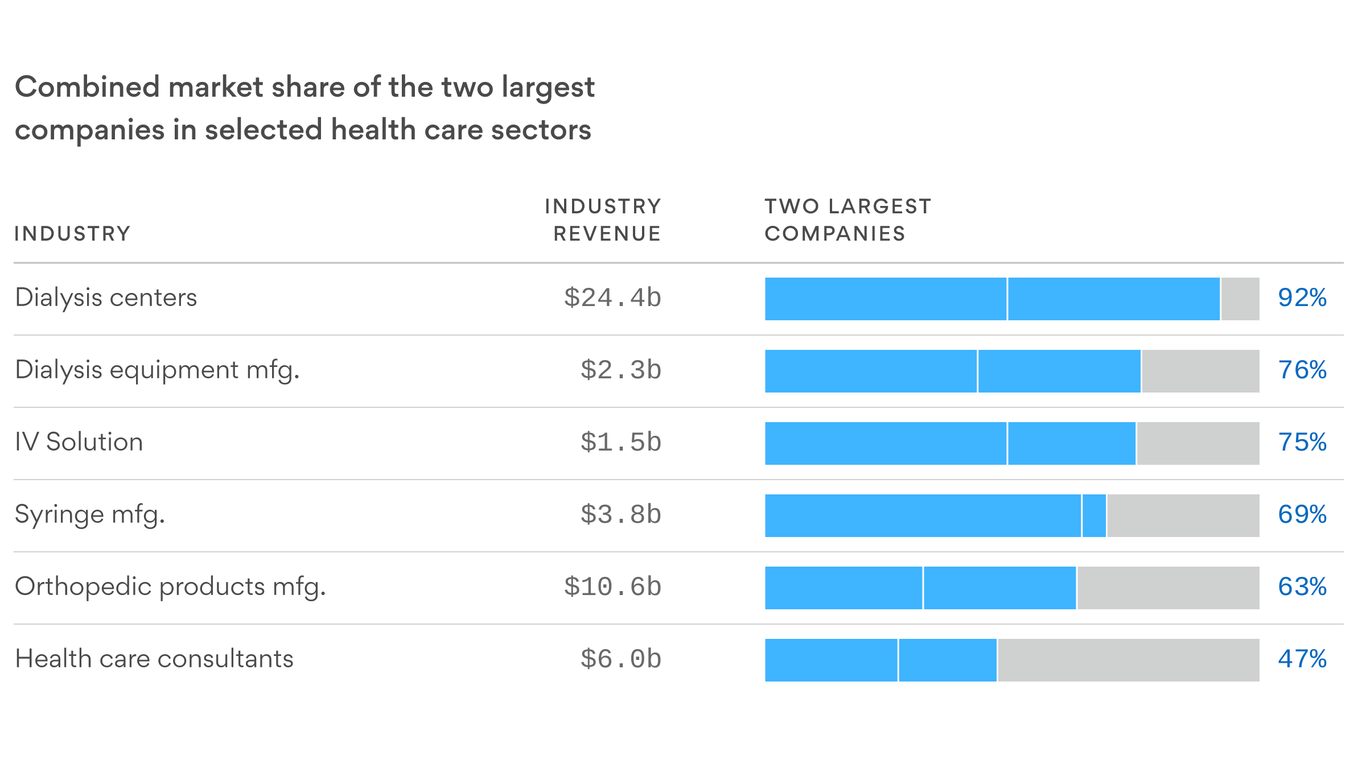
Markets are consolidating out in the open and behind the scenes.

www.axios.com
If the dialysis centers are being especially cheap, just about everyone in it, could transfer to another modality, sometimes without any training.
I'm just not seeing this factor as the answer that you think it is.
Supply and demand are the wide ranging issues, that can effect EVERYTHING at once.
I'm amazed you believe it is trade even though all the evidence says it's not, but then you are so resistant to something with so much evidence. Just amazing. Again, the wage market is clearly not healthy. Really low unemployment and labor shortages should increase wages.
Trade and immigration means that American labor is competing almost directly with Third World labor.
I'm amazed you DON'T believe it is trade.
Look at what the employment rate has been. We have labor shortages. Blaming trade makes no sense. If they are stealing our jobs why do we have so many?
Not stealing jobs, suppressing wages.
I don't think they are even suppressing wages. Seriously, look at wages between the US and virtually anywhere in the world.
We have the highest wages on the planet. We have wages higher than 1st world Europe.
If you think our wages are being suppressed... then compared to where? Where in the world can you get paid more money to do the same job we do here?
Where?
If trade or competition with 3rd world countries is keeping wages down..... then they are doing a really sucky job at keeping wages down.
Compared to the way that wages used to rise with productivity. Which has not happened in decades.
That is factually not true.
There are only two ways in which people claim wages have not risen.
One: they look at household income.
The problem with looking at household income, is that society has drastically changed. For example, prior to the 1970s, it was common for kids to live at home while going to college, and then often to continue to live at home until they were married.
That has changed. Kids will often leave home as teens, and stay living by themselves until they are married. I myself, am in this group, as I have been living alone since 1999.
Additionally people tend to get married later in life, and divorce is also high.
So lets compare what was normal in the 1970s, verses today.
1970s, you had two adults working, one making $60K, another making $40K, and say a teenager making $15K. Household income $115K.
Now fast forward to today, and you have two divorced people and a kid living on his own. You have three single person households, one with $60K, $40K, and $15K. Average household income, $38K.
So these change in the culture, has depressed the statistics on wages. On a person by person basis, there is no evidence whatsoever, that wages have fallen. I would challenge you to point to a single job anywhere, that if you look back 10 to 20 years, was paid more money back then, than they are now. No such job exists.
When I started working at Wendy's, the starting wage was $5.25. That exact same Wendy's location, in the same suburb, now is offering $10/hr to start.
There is another problem with measuring average wages. This has to do with unemployed and immigration.
Typically immigrants have zero-skills. Also typically, people living on welfare, are more often than not, are zero-skill labor.
When unemployment goes down, this results in depressing the average wages, because these people are not immigrating into the US from Mexico, and practicing law for a major corporation. They are not filling out applications at hospitals for brain surgeon. And the same is true for welfare queens, and people who spent the last 3 years on government assistance.
Now this isn't a knock on those people, just a fact. If they were skilled aerospace engineers, they wouldn't be on unemployment, or immigrating generally.
So logically if you have 100 people, 50 earning $50K, 25 earning $75K. And 25 earning $25K. Average wage $50K.
Now add in 50 immigrants or people on welfare. Where are they going to show up on the income scale? The lowest end. 50 more people earning $25 is going to do what? Raise the average wage? Of course not. The average wage will go down to $41K.
If you want to improve average wages, there are two ways to do that. Cut immigration, and kick everyone off government assistance who is able to work.