That is the way the myth goes! I personally don't believe in virgin birth.
so a goddess of fertility.....married.....who impregnates herself with her husband's
severed and mummified penis.....and you say the myth says she's a virgin......I put it to you that myth doesn't go anywhere near virgin birth.....the only place you'll find that claim is an atheist "I'm going to prove Christianity is a copycat religion" website.....
and, it has nothing at all to do with the actual myth of Isis......
Osiris' penis was never recovered to impregnate Isis, it was eaten by a fish.
You want to rewrite mythology as well as the bible.
ISIS IS A VIRGIN MOTHER!!! | Freethought Nation
As it turns out, we would be completely wrong and utterly unscholarly to assert that Isis was not a virgin, as so many have been doing around the internet and elsewhere.The fact of Isis’s perpetual virginity is demonstrated in the ZG Sourcebook, where the information is carefully cited. It is repeated here for the reader’s ease of reference.
PROOF THAT ISIS WAS A VIRGIN MOTHER, FROM PRIMARY SOURCES AND THE WORKS OF HIGHLY CREDENTIALED AUTHORITIES
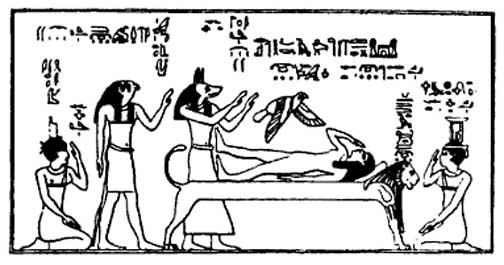
The virginity of Horus’s mother, Isis, has been disputed, because in one myth she is portrayed as impregnating herself with Osiris’s severed phallus. In depictions of Isis’s impregnation, the goddess conceives Horus “while she fluttered in the form of a hawk over the corpse of her dead husband.” …in an image from the tomb of Ramesses VI, Horus is born out of Osiris’s corpse without Isis even being in the picture. In another tradition, Horus is conceived when the water of the Nile—identified as Osiris—overflows the river’s banks, which are equated with Isis. The “phallus” in this latter case is the “sharp star Sothis” or Sirius, the rising of which signaled the Nile flood. Hence, in discussing these myths we are not dealing with “real people” who have body parts.
‘Osiris…begetting a son by Isis, who hovers over him in the form of a hawk.’
(Budge,
On the Future Life: Egyptian Religion, 80)
As is often the case with mythical figures, despite the way she is impregnated, Isis remained the “Great Virgin,” as she is called in a number of pre-Christian Egyptian writings. As stated by Egyptologist Dr. Reginald E. Witt,
In Isis in the Ancient World:
The Egyptian goddess who was equally “the
Great Virgin” (hwnt) and “Mother of the God” was the object of the very same praise bestowed upon her successor [Mary, Virgin Mother of Jesus].
One of the inscriptions that calls Isis the “Great Virgin” appears in the
temple of Seti I at Abydos dating to the 13th century BCE. As stated by professor of Old Testament and Catholic Theology at the University of Bonn Dr. G. Johannes Botterweck, in the
Theological Dictionary of the Old Testament:
..The Pyramid Texts speak of “the great virgin” (
hwn.t wr.t) three times (682c, 728a, 2002a…

; she is anonymous, appears as the protectress of the king, and is explicitly called his mother once (809c). It is interesting that Isis is addresseed as
hwn.t in a sarcophagus oracle that deals with her mysterious pregnancy. In a text in the Abydos Temple of Seti I,
Isis herself declares: “I am the great virgin.”…
It should be noted that the king or pharaoh, whose mother is called “the great virgin,” is also the living Horus; hence, his great virgin mother would be Isis.
Also, in the temple of Neith and Isis at Sais was an ancient inscription that depicted the virgin birth of the sun:
The present and the future and the past, I am. My undergarment no one has uncovered. The fruit I brought forth, the sun came into being.
As
Dr. Botterweck also writes:
In the Late Period [712-332 BCE] in particular,
goddesses are frequently called “(beautiful) virgins,” especially Hathor, Isis, and Nephthys.
During the Greco-Roman period, Isis was equated with the constellation of Virgo, the Virgin, as I relate in Christ in Egypt:
…The identification of Isis with the Virgin…is made in an ancient Greek text called
The Katasterismoi, or
Catasterismi, allegedly written by the astronomer Eratosthenes (276-194 BCE), who was for some 50 years the head librarian of the massive Library of Alexandria. Although the original of this text has been lost, an “epitome” credited to Eratosthenes in ancient times has been attributed by modern scholars to an anonymous “Pseudo-Eratosthenes” of the 1st to 2nd centuries AD/CE. In this book, the title of which translates as “Placing Among the Stars,” appear discussions of the signs of the zodiac. IN his essay on the zodiacal sign of Virgo (ch. 9), under the heading of “Parthenos,” the author includes the goddess Isis, among others, such as Demeter, Atagartis and Tyche, as
identified with and as the constellation of the Virgin. In
Star Myths of the Greeks and Romans, Dr. Theony Condos…translates the pertinent passage from the chapter “Virgo” by Pseud-Eratosthenes thus:
Hesiod in the Theogony says this figure is Dike, the daughter of Zeus [Dios] and Themis… Some say it is Demeter because of the sheaf of grain she holds,
others say it is Isis, others Atagartis, others Tyche…
(For more information, including the original Greek, where the father-god Zeus is termed
Dios, meaning the “Divine One” or “God,” see
Christ in Egypt, 156ff.)
Also, there exists at the
Metropolitan Museum of Art in New York an
ancient Carnelian ring stone from the Imperial period (1st-2nd cents. AD/CE) that is an “adaptation” of a Greek artifact from the fourth century BCE. The ring stone possesses an image of the Greco-Egyptian hybrid god Serapis-Hades and Isis standing before him holding an “ear of wheat and the
sistrum.” The Greek inscription reads:
The phrase is translated as “The Lady Isis, Immaculate,” the latter word from the Greek verb
agneuw, meaning “to be pure or chaste.”