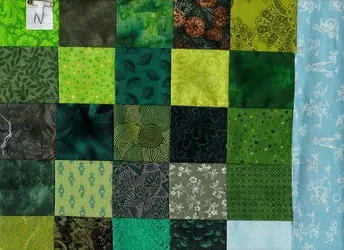
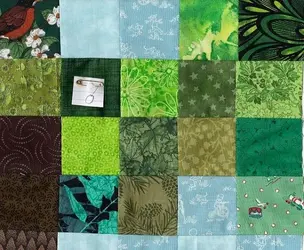
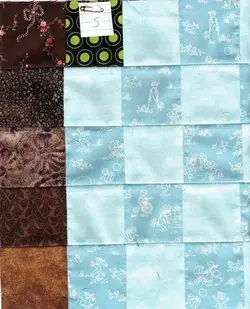
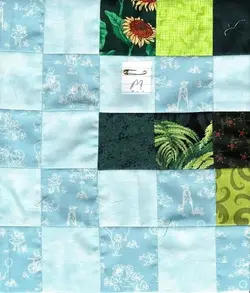
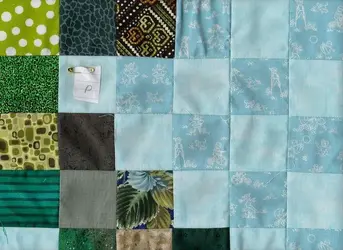
(This was written to a friend who told me he couldn't see a pattern on the page above.) hahahaha
I forgot to say some things about using the paper as foundation piecing. Reverse side foundation piecing can be done using one inch squares of fabric onto a paper ground. Our mothers used paper to piece difficult-to-handle works like "world without end" (a star pieced with little bitty strips) and "spider web" (a circle divided into 8 equal parts with straight lines, separated, and strip pieced. You then cut or just sewed under the curved outside piece and either added made-up pieces to make a square or appliqued the spider web onto a black, white, or other color background.
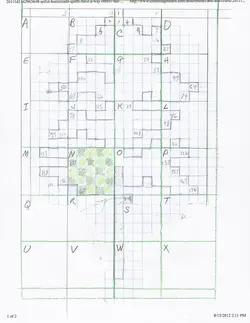
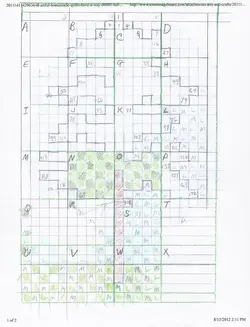
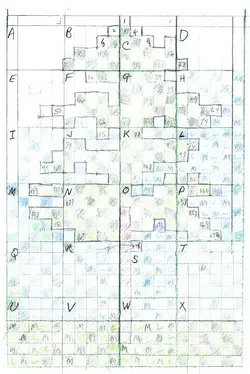
Today, we just draw lines on paper, put a couple of pieces of fabric together along a seam line, turn the paper over, sew the quarter inch seam, turn it over and press each piece out going the opposite way from one anther, rinse, repeat, all the way across. On a machine you put your stitch length at one millimeter or one-and-a-half, and that way, after the whole thing is done, the paper pops off easy. Otherwise, if the stitch is too long, it could take 3 hours to remove all the paper fragments from a 12-inch square area. That's a true pain, so the small perforations made by the machine needle if close enough together, just pop apart with little residue left behind. The other use for the paper is to transfer the design on an earlier page, which they also copy out, by charting rows 1 and 2 in alternating light and dark sky colors The next row, place tree top center square at center; Row 4, count 9 spaces, place one square in 10, 11, and 12, count 9 spaces. And so forth. It's easier to chart it visually for others. Once the spaces are marked either with a washout pencil our counted and sewn, counted, sewn, counted, sewn, etc--any method the person doing the piecing likes, it becomes a tiny postage stamp quilt of the tree in the pattern on the page preceding this one.
For this quilt, which is 21 by 64, the empty page turned sideways and used as a foundation gives you one half of the tree, say the top, and the second page, you just chart everything in the lower half of the tree picture. I left space to put two sky or grass rows both at either side and top and bottom, to center the tree, because when you bind the miniature work, it looks more like a real picture if you have a little empty space around your object. Too many things can go wrong when an inexperienced quilter does stuff. If one row was a little off, and there was no ground or sky around, you could get odd looking rectangles along the binding line and not squares. Adding space around a picture makes the binding not an issue. Who cares if a dispersive sky or grass area is a little weird? Not so if it's a picture part. Some things the eye does not forgive, and that is a bad binding on a quilt, a quilt that is six inches wider at the top than the bottom, whing-whang quilts, unquilted quilts, on and on.
When the two halves are completed, the squares will all match if you use the reverse method unless the office fairy made the squares enlarged or reduced (which my cheapy printer will not do). hahahaha, so you just match them up, sew through paper and fabric to get a whole picture.
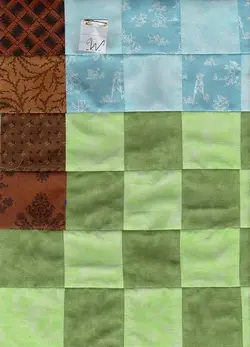
To get finished half inch squares of fabric, you have to use 1 inch pieces of fabric, sew small stitches, and have the finished seams going all one way on the other side than you sew on lines. People who do foundation quilting could if desired do it that way. A beginner is going to tell herself, oh, why go to all that trouble, then set about to start the flawed work that only a miracle could help them finish. How do I know all this? Because I too was once a beginner, and everything that could be done wrong, I have done it, and sometimes done it repeatedly until I figured out a better way, which I teach, but which people like me, the near-unteachable artist, had to go through the rebellion process and destroy quite a little bit of fabric before learning the lessons of accuracy that smarter people just accept when told without pushing the envelope to the max.
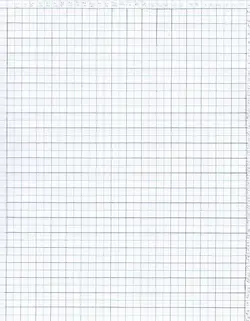
The only other thing I can say is that the page was left blank on purpose. If you set your printer to "color" it will pick up both the blue and the dark lines, so you will have a superior separation of 1/4" squares from 1/2" squares. If you have no graph paper at home, printing the page will give you a piece to play with to chart your own design. I'll try and chart a little design now and then and sew it out from time to time, but right now, I have to keep that 30 more charity quilts before the end of the year, and it may be a cold day next January when I finally get back here to print out paper.
If you're a new quilter and didn't understand a word I said, get a good book on foundation piecing that covers at least 5 or 6 techniques, or just one on reverse foundation piecing, if you can find one. If you just hate foundation piecing, go ahead, just sew the parts together. I'm doing the 2.5" squares that way, and I still haven't found my @$%*# pin cushion yet. I have no idea, but I'm resolved this charity quilt will just have to be not too perfect. I did 4 squares and only resewed 5 or 6 pieces to fit. I'm not doing any more of that. It's ridiculous. It's only a quilt, will probably be dragged over a floor or <gulp> used once and then thrown away and burned at the dump.
See what risks we quilters take? The nicest young people in the world can take clorox to a master work quilt that took 1900 hours to make and decimate it in 6 months of use by washing bedding twice a week. Another will be handing it down with instructions to a child who preserves her quilts well, for 200 years or more. Care is everything to the quilter who did her best. OTOH, people get tired of seeing the same quilt forever, so they do tend to get rid of them after a few years, usually after a picnic they accidentally spread the quilt over ground that had a car sitting there that leaked oil all over the ground, and it wasn't discovered until somebody set a hot bowl of baked beans over the spot and set the oil color forever onto the back and into the batting of the quilt. That's why when I give a quilt away, I talk to God and ask him to take it off my hands when it is given into the possession of someone else. That way I have no emotional tie to the quilt, it's not mine any more. Yep.


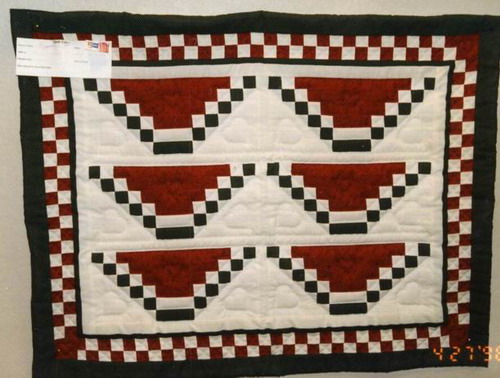




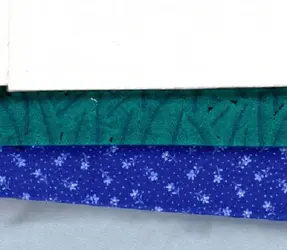
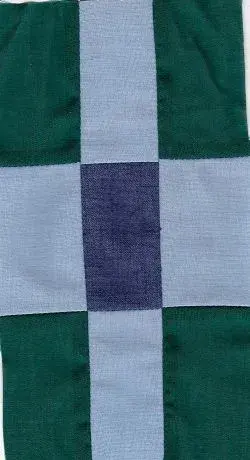
 Or setting the entire quilt catywumpus on elongated triangles over a yard as to length and width. Think I'm thinking up nightmares? Nope. In my 25 years of owning a quilt shop, 17 of them were spent quilting people's quilt tops. Some were beautiful, but shaped like trapezoids. You can't fix stupid. If you try, the maker will think YOU messed up HER beautiful quilt top. Best thing to do is to hand it back to her with an estimate of your skilled labor and 85 hours of unripping, resizing squares, and sewing them into proper squares, how much smaller the resultant work would be. Some people don't like your frank discussion, either, but you have to do it or you could be legally liable to compensate the quilter for your turning her quilt top into the nightmare that it actually is. Your best strategy is to take pictures of the top with its measurements disclosed by laying a tape measure over the horizontal area that measures five feet, and the horizontal area that measures four feet; the vertical area that shows a length of 8 feet, and the vertical area of the opposite side that measures 9 feet.