You are accusing the US as having trained a high ranking ISIS leader. I am simply pointing out that your allegation does not hold up to even the smallest amount of examination. There is no evidence of the claim you push in your OP. If you have more evidence than the single anonymous comment being used as an anti-American talking point, post it. Otherwise, you should expect to be called out on your anti-American propaganda.I have found only one sentence from one anonymous source claiming that the US trained a unit of the Georgian military that allegedly had a connection to a mercenary Chechen in the Georgian military and is now a leader in ISIS. All the allegations that the US military trained Omar al Shishani are rooted from one journalist alleging a comment made by an unknown source.Yes they are a threat to Russia . They border Isis territory .
What's that have to do with the USA ?
Do you own a map?
Yes I do . Russia borders all kinds of "Stanz" and has a large Muslim population in that area . Isis and sympathizers are all kinds of problems for Russia .
We were specifically discussing ISIS, not anywhere that has a border to Russia. I am sorry that the language eludes you.
Isis is a bigger threat to Russia or the US?
With the declaration of the Chechen jihadists backing ISIS Russia has a problem unless they take them out.
Navigation
Install the app
How to install the app on iOS
Follow along with the video below to see how to install our site as a web app on your home screen.
Note: This feature may not be available in some browsers.
More options
Style variation
You are using an out of date browser. It may not display this or other websites correctly.
You should upgrade or use an alternative browser.
You should upgrade or use an alternative browser.
America helped train Omar al Shishani ISIS military commander Whoopsies! Oh and he's a Chechen
- Thread starter tinydancer
- Start date

tinydancer
Diamond Member
- Thread starter
- #42
Another mess we shouldn't have meddled in. Most of today's most brutal Islamic Terrorist groups have connections with our CIA. I'm shocked so few Americans realize that. ISIS for instance, is an American/Saudi/British Intelligence creation. It was created to kill Assad in Syria.
More Americans just need to get more informed about what their Government is doing around the world. Right now, most are completely oblivious.
I have to tell you I am freaked out over this baby.
You get al Shishani as a trained US OP. Whoa geeze we are talking crazy train here.
All links lead back to the same comment allegedly made by a Georgian military person. The stories from various sources are all based on that one statement that can not be verified.I have found only one sentence from one anonymous source claiming that the US trained a unit of the Georgian military that allegedly had a connection to a mercenary Chechen in the Georgian military and is now a leader in ISIS. All the allegations that the US military trained Omar al Shishani are rooted from one journalist alleging a comment made by an unknown source.
GIve your link and I will work it back. I gave you all mine.

paulitician
Platinum Member
- Oct 7, 2011
- 38,401
- 4,169
- 1,130
Another mess we shouldn't have meddled in. Most of today's most brutal Islamic Terrorist groups have connections with our CIA. I'm shocked so few Americans realize that. ISIS for instance, is an American/Saudi/British Intelligence creation. It was created to kill Assad in Syria.
More Americans just need to get more informed about what their Government is doing around the world. Right now, most are completely oblivious.
I have to tell you I am freaked out over this baby.
You get al Shishani as a trained US OP. Whoa geeze we are talking crazy train here.
Most of the major terror groups today have ties with our CIA. ISIS especially, is an appalling American creation. I read an article today that asserted, we're so freaked out about Russia getting involved in Syria, that we're actually ramping up support for ISIS. It's a horrific bloody mess. And most Americans have no idea what's going on.
tinydancer
Diamond Member
- Thread starter
- #45
You are accusing the US as having trained a high ranking ISIS leader. I am simply pointing out that your allegation does not hold up to even the smallest amount of examination. There is no evidence of the claim you push in your OP. If you have more evidence than the single anonymous comment being used as an anti-American talking point, post it. Otherwise, you should expect to be called out on your anti-American propaganda.I have found only one sentence from one anonymous source claiming that the US trained a unit of the Georgian military that allegedly had a connection to a mercenary Chechen in the Georgian military and is now a leader in ISIS. All the allegations that the US military trained Omar al Shishani are rooted from one journalist alleging a comment made by an unknown source.Do you own a map?
Yes I do . Russia borders all kinds of "Stanz" and has a large Muslim population in that area . Isis and sympathizers are all kinds of problems for Russia .
We were specifically discussing ISIS, not anywhere that has a border to Russia. I am sorry that the language eludes you.
Isis is a bigger threat to Russia or the US?
With the declaration of the Chechen jihadists backing ISIS Russia has a problem unless they take them out.
Hey it's not my fault you trained him.
Not my problem at all nor the fact that you obviously love and adore him and never made one move against him all these months.
paulitician
Platinum Member
- Oct 7, 2011
- 38,401
- 4,169
- 1,130
You are accusing the US as having trained a high ranking ISIS leader. I am simply pointing out that your allegation does not hold up to even the smallest amount of examination. There is no evidence of the claim you push in your OP. If you have more evidence than the single anonymous comment being used as an anti-American talking point, post it. Otherwise, you should expect to be called out on your anti-American propaganda.I have found only one sentence from one anonymous source claiming that the US trained a unit of the Georgian military that allegedly had a connection to a mercenary Chechen in the Georgian military and is now a leader in ISIS. All the allegations that the US military trained Omar al Shishani are rooted from one journalist alleging a comment made by an unknown source.Yes I do . Russia borders all kinds of "Stanz" and has a large Muslim population in that area . Isis and sympathizers are all kinds of problems for Russia .
We were specifically discussing ISIS, not anywhere that has a border to Russia. I am sorry that the language eludes you.
Isis is a bigger threat to Russia or the US?
With the declaration of the Chechen jihadists backing ISIS Russia has a problem unless they take them out.
Hey it's not my fault you trained him.
Not my problem at all nor the fact that you obviously love and adore him and never made one move against him all these months.
We fund, arm, and train Islamic Terrorist groups all the time. It is the ugly truth.
tinydancer
Diamond Member
- Thread starter
- #47
Another mess we shouldn't have meddled in. Most of today's most brutal Islamic Terrorist groups have connections with our CIA. I'm shocked so few Americans realize that. ISIS for instance, is an American/Saudi/British Intelligence creation. It was created to kill Assad in Syria.
More Americans just need to get more informed about what their Government is doing around the world. Right now, most are completely oblivious.
I have to tell you I am freaked out over this baby.
You get al Shishani as a trained US OP. Whoa geeze we are talking crazy train here.
Most of the major terror groups today have ties with our CIA. ISIS especially, is an appalling American creation. I read an article today that asserted, we're so freaked out about Russia getting involved in Syria, that we're actually ramping up support for ISIS. It's a horrific bloody mess. And most Americans have no idea what's going on.
I've been the idiot. That I have. I hope I have been this honest enough. My heart hurts. Truly hurts.
Now you are just being a liar. I have shown how your OP is anti-American propaganda and you have decided to double down on it.Another mess we shouldn't have meddled in. Most of today's most brutal Islamic Terrorist groups have connections with our CIA. I'm shocked so few Americans realize that. ISIS for instance, is an American/Saudi/British Intelligence creation. It was created to kill Assad in Syria.
More Americans just need to get more informed about what their Government is doing around the world. Right now, most are completely oblivious.
I have to tell you I am freaked out over this baby.
You get al Shishani as a trained US OP. Whoa geeze we are talking crazy train here.
BTW, Omar would not have a need or even use for US training. He grew up fighting Russians in the Chechen-Russian wars. He knows everything there is to know about fighting Russians.
You can not back up your crap either.You are accusing the US as having trained a high ranking ISIS leader. I am simply pointing out that your allegation does not hold up to even the smallest amount of examination. There is no evidence of the claim you push in your OP. If you have more evidence than the single anonymous comment being used as an anti-American talking point, post it. Otherwise, you should expect to be called out on your anti-American propaganda.I have found only one sentence from one anonymous source claiming that the US trained a unit of the Georgian military that allegedly had a connection to a mercenary Chechen in the Georgian military and is now a leader in ISIS. All the allegations that the US military trained Omar al Shishani are rooted from one journalist alleging a comment made by an unknown source.We were specifically discussing ISIS, not anywhere that has a border to Russia. I am sorry that the language eludes you.
Isis is a bigger threat to Russia or the US?
With the declaration of the Chechen jihadists backing ISIS Russia has a problem unless they take them out.
Hey it's not my fault you trained him.
Not my problem at all nor the fact that you obviously love and adore him and never made one move against him all these months.
We fund, arm, and train Islamic Terrorist groups all the time. It is the ugly truth.
paulitician
Platinum Member
- Oct 7, 2011
- 38,401
- 4,169
- 1,130
Another mess we shouldn't have meddled in. Most of today's most brutal Islamic Terrorist groups have connections with our CIA. I'm shocked so few Americans realize that. ISIS for instance, is an American/Saudi/British Intelligence creation. It was created to kill Assad in Syria.
More Americans just need to get more informed about what their Government is doing around the world. Right now, most are completely oblivious.
I have to tell you I am freaked out over this baby.
You get al Shishani as a trained US OP. Whoa geeze we are talking crazy train here.
Most of the major terror groups today have ties with our CIA. ISIS especially, is an appalling American creation. I read an article today that asserted, we're so freaked out about Russia getting involved in Syria, that we're actually ramping up support for ISIS. It's a horrific bloody mess. And most Americans have no idea what's going on.
I've been the idiot. That I have. I hope I have been this honest enough. My heart hurts. Truly hurts.
Hey, it's very hard and painful to admit that your Government is doing so much harm in the world. Most Americans won't do it. They truly believe their Government is always the 'Good Guy.'
paulitician
Platinum Member
- Oct 7, 2011
- 38,401
- 4,169
- 1,130
You can not back up your crap either.You are accusing the US as having trained a high ranking ISIS leader. I am simply pointing out that your allegation does not hold up to even the smallest amount of examination. There is no evidence of the claim you push in your OP. If you have more evidence than the single anonymous comment being used as an anti-American talking point, post it. Otherwise, you should expect to be called out on your anti-American propaganda.I have found only one sentence from one anonymous source claiming that the US trained a unit of the Georgian military that allegedly had a connection to a mercenary Chechen in the Georgian military and is now a leader in ISIS. All the allegations that the US military trained Omar al Shishani are rooted from one journalist alleging a comment made by an unknown source.Isis is a bigger threat to Russia or the US?
With the declaration of the Chechen jihadists backing ISIS Russia has a problem unless they take them out.
Hey it's not my fault you trained him.
Not my problem at all nor the fact that you obviously love and adore him and never made one move against him all these months.
We fund, arm, and train Islamic Terrorist groups all the time. It is the ugly truth.
Al Qaeda and ISIS wouldn't be what they are today without American funding and training. Their origins are tied with the CIA. ISIS didn't just magically appear with all that cash and weapons. It was supplied to them. But by whom? I'll let you think about that yourself.
tinydancer
Diamond Member
- Thread starter
- #52
You are accusing the US as having trained a high ranking ISIS leader. I am simply pointing out that your allegation does not hold up to even the smallest amount of examination. There is no evidence of the claim you push in your OP. If you have more evidence than the single anonymous comment being used as an anti-American talking point, post it. Otherwise, you should expect to be called out on your anti-American propaganda.I have found only one sentence from one anonymous source claiming that the US trained a unit of the Georgian military that allegedly had a connection to a mercenary Chechen in the Georgian military and is now a leader in ISIS. All the allegations that the US military trained Omar al Shishani are rooted from one journalist alleging a comment made by an unknown source.We were specifically discussing ISIS, not anywhere that has a border to Russia. I am sorry that the language eludes you.
Isis is a bigger threat to Russia or the US?
With the declaration of the Chechen jihadists backing ISIS Russia has a problem unless they take them out.
Hey it's not my fault you trained him.
Not my problem at all nor the fact that you obviously love and adore him and never made one move against him all these months.
We fund, arm, and train Islamic Terrorist groups all the time. It is the ugly truth.
Sadly and one more time....
Who are the moderates
Another mess we shouldn't have meddled in. Most of today's most brutal Islamic Terrorist groups have connections with our CIA. I'm shocked so few Americans realize that. ISIS for instance, is an American/Saudi/British Intelligence creation. It was created to kill Assad in Syria.
More Americans just need to get more informed about what their Government is doing around the world. Right now, most are completely oblivious.
I have to tell you I am freaked out over this baby.
You get al Shishani as a trained US OP. Whoa geeze we are talking crazy train here.
Most of the major terror groups today have ties with our CIA. ISIS especially, is an appalling American creation. I read an article today that asserted, we're so freaked out about Russia getting involved in Syria, that we're actually ramping up support for ISIS. It's a horrific bloody mess. And most Americans have no idea what's going on.
I've been the idiot. That I have. I hope I have been this honest enough. My heart hurts. Truly hurts.
Hey, it's very hard and painful to admit that your Government is doing so much harm in the world. Most Americans won't do it. They truly believe their Government is always the 'Good Guy.'
Oh Paulie my political journey has been a wild one.But i will tell you without a doubt this one is a crazy.
tinydancer
Diamond Member
- Thread starter
- #53
Have you ever considered that maybe......just maybe.......people in other countries really wish that western busybodies would just go away and leave them alone? ........It hurts. Will keep on trying but I don't want anyone who serves to pay the price for individuals like myself who wish desperately to bring cave people into the 21st century.
Holey toledo man ABSOLUTELY! I was talking to a couple the other day who were talking about their olive fields. Oh I felt so bad for them. They were true refugees and I thought my heart was going to break for them.
This is horrible for the true refugees. How can I make life better for them? I can't Sunni Man. Oh this heart breaking is taking a shit kicking.
tinydancer
Diamond Member
- Thread starter
- #54
You can not back up your crap either.You are accusing the US as having trained a high ranking ISIS leader. I am simply pointing out that your allegation does not hold up to even the smallest amount of examination. There is no evidence of the claim you push in your OP. If you have more evidence than the single anonymous comment being used as an anti-American talking point, post it. Otherwise, you should expect to be called out on your anti-American propaganda.With the declaration of the Chechen jihadists backing ISIS Russia has a problem unless they take them out.
Hey it's not my fault you trained him.
Not my problem at all nor the fact that you obviously love and adore him and never made one move against him all these months.
We fund, arm, and train Islamic Terrorist groups all the time. It is the ugly truth.
Al Qaeda and ISIS wouldn't be what they are today without American funding and training. Their origins are tied with the CIA. ISIS didn't just magically appear with all that cash and weapons. It was supplied to them. But by whom? I'll let you think about that yourself.
When I'm doodling around today and then I find the Chechen link by fluke /////////////////////////
YAY!
tinydancer
Diamond Member
- Thread starter
- #55
Have you ever considered that maybe......just maybe.......people in other countries really wish that western busybodies would just go away and leave them alone? ........It hurts. Will keep on trying but I don't want anyone who serves to pay the price for individuals like myself who wish desperately to bring cave people into the 21st century.
you know our journey dear heart.
I only interfere now over Bacha Bazi and other issues. Surely you would not want me turn a blind eye to this?
waltky
Wise ol' monkey
Shishani bites the dust...

Death of Islamic State's Shishani may damage foreign recruitment
Thu Jul 14, 2016 - The death of Islamic State's "minister of war" may disrupt its operations, a senior U.S. military officer said on Thursday, and an Iraqi security expert said it could damage the group's important recruitment efforts in ex-Soviet republics.
See also:
US Preparing for Islamic State's ‘Terrorist Diaspora'
July 14, 2016 - Top U.S. counterterror and law enforcement officials are offering grim warnings about what awaits once the Islamic State terror group's self-declared caliphate ultimately collapses.
Death of Islamic State's Shishani may damage foreign recruitment
Thu Jul 14, 2016 - The death of Islamic State's "minister of war" may disrupt its operations, a senior U.S. military officer said on Thursday, and an Iraqi security expert said it could damage the group's important recruitment efforts in ex-Soviet republics.
Abu Omar al-Shishani (the Chechen), a close military adviser to Islamic State leader Abu Bakr al-Baghdadi, was killed in combat in the Iraqi district of Shirqat, south of Mosul, Amaq, a news agency that supports IS, said on Wednesday. It was the first confirmation of Shishani's death, which the Pentagon said in March had probably occurred as a result of a U.S. air strike in eastern Syria. Pentagon spokesman Peter Cook said on Thursday that Shishani had been the target of an attack on Sunday against an Islamic State leadership meeting near Mosul. Cook said the department was aware of reports Shishani had been killed but was not currently able to confirm that.

A still image taken on July 14, 2016 from an undated video posted on social media, shows Islamic State senior operative Abu Omar al-Shishani (C) sitting with fighters in an unknown location.
Cook said the United States believed Shishani was killed in March but learned recently that he might still be alive and decided to carry out a strike targeting him. He said the Pentagon was still assessing the results of the strike. Hisham al-Hashimi, who advises Iraq's government on Islamist armed groups, said Shishani had been wounded in the March attack but was treated at a hospital in Shirqat, an Islamic State stronghold about 250 km (160 miles) north of Baghdad. He said Shishani was killed earlier this week in a nearby village along with an aide by an air strike during combat with U.S.-backed Iraqi forces closing in on the area.

A still image taken on July 14, 2016 from an undated video posted on social media, shows Islamic State senior operative Abu Omar al-Shishani stands with fighters in Al Hasakah, Syria
The commander of the U.S.-led coalition battling Islamic State, U.S. Army Lieutenant General Sean MacFarland, expressed confidence in the intelligence that led to the recent strike on Shishani in the Tigris River valley where Shirqat is located, but declined on Thursday to declare him dead. "We're being a little conservative in calling the ball on whether or not he's actually dead or not. But we certainly gave it our best shot," MacFarland told reporters in Baghdad. Iraqi military officials had no immediate comment.

A still image taken on July 14, 2016 from an undated video posted on social media, shows Islamic State senior operative Abu Omar al-Shishani being interviewed in an unknown location.
Some analysts speculated that Shishani might in fact have died in March but Islamic State delayed its announcement to allow time to line up a successor. Yet there was no immediate word from IS about who would take over for the ginger-bearded jihadist who held as many as three senior posts and was a strong force for recruitment from Russia's mainly Muslim North Caucasus region and Central Asia. "(IS) lost something important: the charisma that he had to inspire and seduce Salafists from Chechnya, the Caucasus and Azerbaijan - the former Soviet republics," Hashimi said. Asked about the potential impact, MacFarland said it could disrupt Islamic State operations if Shishani were indeed dead. "They would have to figure out who's going to pick up his portfolio," he said.
RUSSIAN SPEAKERS
See also:
US Preparing for Islamic State's ‘Terrorist Diaspora'
July 14, 2016 - Top U.S. counterterror and law enforcement officials are offering grim warnings about what awaits once the Islamic State terror group's self-declared caliphate ultimately collapses.
Much of the U.S. and coalition strategy against IS has been predicated on the idea that without the ability to hold territory in Iraq and Syria, the terror group will falter, unable to make good on its promise of a utopian society. Yet as the fall of the IS caliphate looks to draw nearer, U.S. officials are increasingly cautious, saying the group will remain a dynamic and formidable threat for some time to come. "We all know there will be a terrorist diaspora out of the caliphate," FBI Director James Comey told the House Homeland Security Committee on Thursday. "Those thousands of fighters are going to go someplace," he said. "Our job is to spot them and stop them before they come to the United States to harm innocent people."
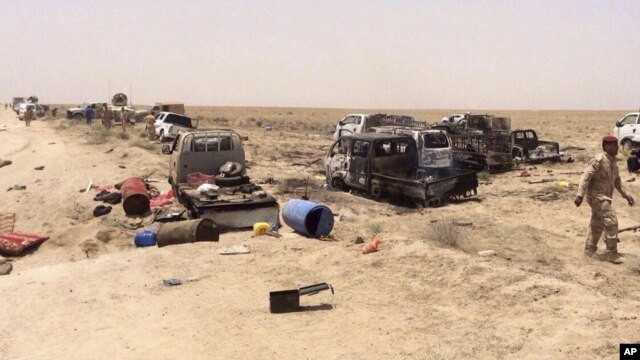
Iraqi security forces inspect vehicles belonging to escaping Islamic State militants outside Fallujah, Iraq
As many as 40,000 foreign fighters from more than 120 countries are believed to have flocked to the conflict in Syria, with a majority of them joining IS while the group grew and saw its fortunes rise as it advanced across Iraq. Now, Comey and others worry the terror group is in a prime position to take advantage of the flow home. "ISIL's external operations has been building and entrenching during the past two years," according to National Counterterrorism Center Director Nicholas Rasmussen. ISIL is an acronym for Islamic State. "We don't think that battlefield reverses alone in Iraq will be sufficient to degrade that terrorism capability," he said. "Over time we will degrade their capability … but there may be a significant lag."
Forged documents
Adding to the concerns is the terror group's use of forged documents to get its operatives into Europe, where some became key players in the terror attacks that rocked Paris and Brussels. "We know it's a part of ISIL's tradecraft," Comey said. U.S. Homeland Security officials say they have bolstered the department's abilities to detect fraudulent travel documents, though the risk remains that an IS operative could find a way to sneak into the U.S.
Concerns also persist about the challenges facing some U.S. allies, especially in Europe where, despite ongoing crackdowns, intelligence officials fear IS has become "deeply rooted," using perhaps hundreds of jihadists who returned from Syria and Iraq to mold thousands of would-be foreign fighters into guerilla units. "The Europeans have made progress since the horrific attacks in Paris and Belgium, but clearly more progress has to be made," CIA Director John Brennan said Wednesday during an appearance at the Brookings Institution. "Some of the countries themselves, their internal and external services, will not talk with one another; they're not knitted together," he said. Just getting intelligence on IS is proving to be problematic. "ISIL is a savvy, experienced adversary that knows how we collect intelligence," Rasmussen said Thursday. "I would describe our efforts to gain an understanding of ISIL intentions and strategy and direction as being a harder target right now than what we faced with al-Qaida."
Social media

Seriously. If Putin wants it he can have it. And how about we stop training ANYBODY over there too! It always comes back to bite us in the ass!Let's get the **** out of that shit show !
People never stop to think what a money pit the Mid East is for us . Imagine if we spent all that money over here?
Imagine if we spent the money on renewable energy, battery/power storage....
The Middle East wars are the largest subsidy to the Oil Business that has ever existed. What if people had to pay for these wars by a special tax on gas? What if they had to pay for the true cost of oil.

Seriously. If Putin wants it he can have it. And how about we stop training ANYBODY over there too! It always comes back to bite us in the ass!Let's get the **** out of that shit show !
People never stop to think what a money pit the Mid East is for us . Imagine if we spent all that money over here?
Imagine if we spent the money on renewable energy, battery/power storage....
The Middle East wars are the largest subsidy to the Oil Business that has ever existed. What if people had to pay for these wars by a special tax on gas? What if they had to pay for the true cost of oil.
We haven'f gotten any oil from any mid east wars. Stop parroting left wing propiganda. And stop saying we, you're not an american, dumb ****.
Seriously. If Putin wants it he can have it. And how about we stop training ANYBODY over there too! It always comes back to bite us in the ass!Let's get the **** out of that shit show !
People never stop to think what a money pit the Mid East is for us . Imagine if we spent all that money over here?
Imagine if we spent the money on renewable energy, battery/power storage....
The Middle East wars are the largest subsidy to the Oil Business that has ever existed. What if people had to pay for these wars by a special tax on gas? What if they had to pay for the true cost of oil.
We haven'f gotten any oil from any mid east wars. Stop parroting left wing propiganda. And stop saying we, you're not an american, dumb ****.
So no American companies are working in the Oil Business in ME.
Oil is a world traded commodity, so while oil doesn't go direct to america it controls the price of oil worldwide...
That was a very naive post...
And being not American, that is only used when you lost your point... I still employ people in the US...
Seriously. If Putin wants it he can have it. And how about we stop training ANYBODY over there too! It always comes back to bite us in the ass!Let's get the **** out of that shit show !
People never stop to think what a money pit the Mid East is for us . Imagine if we spent all that money over here?
Imagine if we spent the money on renewable energy, battery/power storage....
The Middle East wars are the largest subsidy to the Oil Business that has ever existed. What if people had to pay for these wars by a special tax on gas? What if they had to pay for the true cost of oil.
We haven'f gotten any oil from any mid east wars. Stop parroting left wing propiganda. And stop saying we, you're not an american, dumb ****.
So no American companies are working in the Oil Business in ME.
Oil is a world traded commodity, so while oil doesn't go direct to america it controls the price of oil worldwide...
That was a very naive post...
And being not American, that is only used when you lost your point... I still employ people in the US...
Hey stupid. Just because American oil companies use Middle Eastern oil it doesn't mean America goes to war for oil...as a matter of fact when we go to war in the ME oil prices always go up, and then after the war we leave without control of the oil, so we don't control the price. As far as you not being an american - yes you should never refer to your lself as american because your not and you should butt the **** out of our buisness.
Last edited:
Similar threads


- Replies
- 13
- Views
- 327


New Topics
-

-

-

-

-
 ICE Shooting: New Video from Case With Agents Accused of Lying Under Oath
- Started by EvilEyeFleegle
- Replies: 1
Latest Discussions
-
-

-
-
-
 Zone1 In what ways is antisemitism “cloaked” as being against “just” Israel?
- Latest: Natural Citizen