
Ok course but again, quantify the 'complex" events to account for the rapid descents. You again are making assumptions, like NIST did that collapse was a foregone conclusion, without taking into account the complex mass involved.
Again you give a simple answer that defies explanation. Of course you say "The upper section hit the floors and sheared the connections." Your highlighted section is not giving the answer.The upper section hit the floors and sheared the connections. See the above explanation (ppertinent parts in red), complete with numbers.
You still fail to consider that the time required for all of these failures would not be in the 12-15 second range, You fail to account for the 2 masses colliding and that when this happens there would be a noticeable jolt, and hesitation as ech and every subsequent connection is overcome.
And you still fail to explain this by posting a totally non explanation from NIST!?
Again you ask me questions that NIST should have provided the answers to you about. As a staunch believer in their theory, why do you not know these things?
It is you who has been saying that the NIST report is correct and yet you post nothing but assumptions and repeat the NIST flawed theory?Yet you come in here and say that this didn't happen and this should have happened, blah, blah, blah. If you don't have answers to my questions, then you have no proof or reason behind your claims.
It discusses estimated, conservative loads asshole! It does not explain how the **** these loads were able to overcome the equal, and opposite resistive loads by the lower, in the short collapse time!Read the NIST explanation I quoted above.
Read the NIST explanation I quoted above.
Bullshit, this is their assumption based on a guess, with no figures to substantiate it.Read the NIST explanation I quoted above. The force of the descending debris was WAY over the load that the floors could handle.
You want to insist that 2 1/4 mile long towers fell in such short collapse times because of localized failure due because of an unsubstantiated guess that fireproofing was dialoged, because they did a test of this theory with a ******* shotgun?Again, at what temperature does steel start to weaken? If steel conducts heat as well as you say, then why do they fire proof it? This shoots a complete hole in your claim.
Thus causing the rapid collapses? You're a ******* loon, and when I ask you to post how you come to this conclusion besides all the speculative guessing that NIST did, you post even more speculative guess work!! Brilliant!
I've already explained this before. Now it's up to you to validate that unprotected steel the likes that are used in buildings like the WTC and others , can explode into themselves in just short of FF acceleration, and maybe you can explain why NIST themselves mentioned that the failed towers fell "essentially at FF"?WHY DO THEY FIREPROOF STEEL?
Read my answer to you attempt at being evasive.Read the NIST explanation I quoted above.
It explains nothing!
That's right localized failyre, that has not come close to being proven that it would automatically lead to a complete and total failure, with "essentially FF" (NIST)It's called localized failure. I will ask you yet again. How can a baseball thrown at a window smash said window when the entire mass/structure of the house is behind it?
Localized failure that had to advance a collapse sequence through the rest of the undamaged lower, more robust structure.
No asshole, I asked you to consider what I mentioned, and to show where NIST considers it as well, and you have failed!This puts a serious dent in your explanation.
Again justify how this automatically means total building collapse in such rapid times. Why do you not account for the mass of the lower? Where are your NIST calculations?Because it's the weaker floor truss connections that fail! Jesus H. Christ...
So how long should it take for these angle/floor truss connections to fail? And why did the lower building not halt the collapse fronts?I f I want to see if one floor of the towers will support it's intended load, one of the thins I'm going to check is if the floor truss CONNECTIONS can handle it. If the angle/floor truss connections around the perimeter columns can't handle the intended load, it doesn't matter if they were welded to ******* 20' diameter solid steel columns. It's the connections themselves that are the weakest links and they will SHEAR.
And depending on the size (mass) of said football player, it might take a few tries to bust through the ******* door you idiot!To drive my point through your head, let's look at the door of a house. If I run a football player into said door, how does the load propagate through all the components? If the door itself holds up, the load it transferred to the hinges attached to the door jamb with screws. Those screws will probably rip out of the door jamb. But according to you, the mass and structure of the entire house behind that door should make everything resist.
Tell me, would it be faster to go through an open door then a closed one?
Can you, or this football player walk through the closed door in the same amount of time as if it was ******* open?
Think about that you ******* moron!
This is my ******* point. Things take time, these buildings had tons of ******* heavy steel components, and concrete. Now you actually believe it logical to assume that like the analogy you presented above, that a smaller damaged mass, will overcome the larger one with all these connections in the short amount of time witnessed?
Explain how this is so, but in your explanation do not fail to consider the mass of resistance below the collapse front like you've been doing.
Again the buildings were designed to withstand the impacts of airliners. They did. Even NIST admitted they did a good job of that, and base their collapse initiation on the ******* fires that they have not been able to explain, the intense heat that IS necessary to overcome steels properties.A historical look??? Look in the mirror jack. A historical look shows that there has never been a 208' x 208' square, 100 floor, tube in tube designed, steel tower, that was struck by a 767 in the upper third, that remained standing.
This is no game I am stating historical facts, and use the buildings designers own statements, and NIST report against your failed logic, that is not based on any real world facts.I can play your stupid historical games also.
Do you not think that perhaps there are other things that can catch on fire before STEEL WILL, AND THAT IS A GOOD REASON TO USE FIRE RETARDANT?
Yeah idiot...do you not understand this concept, Is it not prudent to do?THAT made no sense whatsoever. SO because OTHER things catch fire, they fireproof the steel?? Go read about fireproofing on steel and get back to me. Better yet, I'll help you out.
STRUCTUREmag - Structural Engineering Magazine, Tradeshow: Fireproofing Steel Structures
Obviously, structural steel is a non-combustible material; however, the high-sustained temperatures of a fire can severely damage unprotected steel. Structural steel will lose approximately 50% of its load carrying capacity as temperatures approach 1100°F. Fireproofing works by encasing the steel and insulating it, keeping the steel temperature below the point where design strength is compromised. In order to determine the amount of fireproofing required in to achieve this goal, UL tests fireproofing products in accordance with ASTM E119 (UL 263). The results of the test are published in the UL Directory, which specifies the thickness and density of the material, as well as how the assembly is to be constructed in order to achieve various levels of hourly rating.
So you can take your "conduction" bullshit and try it elsewhere. You need to learn a few things before parroting your garbage from other sources that have no clue what they are talking about.
Yeah, they fireproof steel in case OTHER things catch fire.
No where has a building fire been so hot as to cause a total 12-15 second global collapse of a hirise....NO WHERE!Office fires do not approach the heat required to cause this kind of damage that will leave 1500 degree rubble piles underneath them.
Go ahead and post a link to where you have seen this, and I'll post the Cardington Fire Tests Results. You are a mammoth idiot
How about one of my examples?
Take a semi truck and trailer. Stack it up vertically.... Now take VW and hoist it up 12 feet
above the cab, so it gets a running start like NIST has said the WTC tops had...
Do you think the semi will be crushed all the way down in mere seconds?
Actually replace the VW with an identical semi truck and do the same thing.. Do you still expect the lower semi truck to just be squished, and the top one have so much PE that it will totally pulverize the lower one? In mere seconds???
I don't know how ******* retarded you really are, but the answer to most rational and intuitive people would be NO! Absolutely not.
But yet this is the flawed thinking that you present.
The lower did not just consist of the damned truss/angle supports in a few spots. This is but a small part of the entire ******* building.
Fire takes time to damage steel to it's failure point, even if loaded, it takes time. We can expect to see its slow demise, and start to creep, then expect to see it fail towards that part.
Each subsequent lower floor, complete with those angle/supports presented another obstacle to the failed, falling part. **** common sense will tell anyone with the capacity to think, that these "collapses" should have taken much longer then what was observed.
You ever work with fire and steel?
Navigation
Install the app
How to install the app on iOS
Follow along with the video below to see how to install our site as a web app on your home screen.
Note: This feature may not be available in some browsers.
More options
Style variation
You are using an out of date browser. It may not display this or other websites correctly.
You should upgrade or use an alternative browser.
You should upgrade or use an alternative browser.
9/11 Conspiracy Solved?: Names, Connections, Details Exposed...
- Thread starter paulitician
- Start date
More knowledge for you Mr. Jones...
Fireproofing – what is it and why
do we need it?
Steel structures, consisting of structural steel
members, connections, fasteners and frames,
act together in resisting imposed actions (loads,
pressures, displacements, strains, etc).
Load bearing steel framed buildings or building
structures need to cater for all the loads that
building can experience, including the dead load
of the building itself, live loads applied to the
building in use, wind and snow loading.
We need to pay special attention to the
fireproofing of steel framed buildings to ensure
that during pre-determined fire scenarios that the
steel does not get above critical temperatures,
where the yield strength limit (the amount of
load that can be carried prior to collapse) are
not exceeded.
http://www.pfpa.com.au/docs/Steel Fireproofing/Rakic - Type of Fireproofing materials.pdf
How does that fit into your "steel conducts heat away from the fire" bullshit. Sounds like that what they're saying right?

Again where is the conclusive evidence that the WTC steel got above the critical failure point? And fireproofing is used to protect against transfer of too much heat to the unexposed surfaces of the assemblies. Why do you think steel is covered in fireproofing you ******* idiot? It can transfer heat to other connected, or adjacent parts of a structure, because that is what steel/metal does when heat is applied to it you ******* idiot!
Now you want to continue going round in circles, or answer the questions I posed to you regarding the energy of the smaller mass on the larger unmolested lower, and how it is possible for these collapses to not experience any noticeable hesitation or halting when the 2 collided?
You have posted nothing that substantiates your wild unscientific belief in the NIST report regarding how the laws of physics, ie: the conservation of momentum is left out of their BS explanation.
Why no noticeable jolt when a smaller mass collided with a much larger one?
Do you agree with this?
”A perfectly inelastic collision is where a body moving at velocity strikes a body, typically at rest, then both bodies stick together (to form “accreted mass”
 , and then both bodies move together after that, at the same final velocity.
 If both bodies are similar masses, then the final velocity will be 1/2 of the original velocity. If body A is much larger than body B, then the final velocity will be closer to the original velocity.
But if body A is much smaller then body B, can the initial velocity be expected to be sustained?
Last edited:

SFC Ollie
Still Marching
i think we know who is going in circles..............
1) a perfect inelastic collision assumes that no mass is lost during the collision, which we know is not the case as, during each collision, concrete was pulverized and and ejected AND outer columns were ejected resulting in a loss of mass for each floor.
2) a perfect inelastic collision assumes that the collided floors stick together, which is highly improbable. Further, we know that this is not the case as, during each collision, concrete and interior contents were pulverized, creating a significant barrier of debris between floors.
3) most fatally, by its very nature, a perfect inelastic collision model cannot take into account the resistance from the supporting columns below when calculating the final velocity. Another problem is that Bazant does not show any calculations revealing the mass he is using for the upper colliding mass and what mass he is using for the lower mass. In fact, as far as I can tell, the collapse equations are derived indirectly, by a series of equations that calculate an overall collapse energy balance and that rest on dubious propositions...
There should be a great deal of crush UP during the crush down phase, as the upper section meets with the lower, a fact that Bazant/NIST completely ignore in their unrealistic analysis that favors a fast collapse time.
So what you defend is flawed, and you insist on asking me to explain it to you?
You idiotically dismiss the capabilities of steel transferring heat away from the flame contacts points.....You act as though you know so much so get to explaining what NIST hasn't! Or are you still picturing the 2 semis or the VW in a vertical scenario?
******* moron....
2) a perfect inelastic collision assumes that the collided floors stick together, which is highly improbable. Further, we know that this is not the case as, during each collision, concrete and interior contents were pulverized, creating a significant barrier of debris between floors.
3) most fatally, by its very nature, a perfect inelastic collision model cannot take into account the resistance from the supporting columns below when calculating the final velocity. Another problem is that Bazant does not show any calculations revealing the mass he is using for the upper colliding mass and what mass he is using for the lower mass. In fact, as far as I can tell, the collapse equations are derived indirectly, by a series of equations that calculate an overall collapse energy balance and that rest on dubious propositions...
There should be a great deal of crush UP during the crush down phase, as the upper section meets with the lower, a fact that Bazant/NIST completely ignore in their unrealistic analysis that favors a fast collapse time.
So what you defend is flawed, and you insist on asking me to explain it to you?
You idiotically dismiss the capabilities of steel transferring heat away from the flame contacts points.....You act as though you know so much so get to explaining what NIST hasn't! Or are you still picturing the 2 semis or the VW in a vertical scenario?
******* moron....
Ok course but again, quantify the 'complex" events to account for the rapid descents. You again are making assumptions, like NIST did that collapse was a foregone conclusion, without taking into account the complex mass involved.
The upper section hit the floors and sheared the connections. See the above explanation (ppertinent parts in red), complete with numbers.
Again you ask me questions that NIST should have provided the answers to you about. As a staunch believer in their theory, why do you not know these things?
Yet you come in here and say that this didn't happen and this should have happened, blah, blah, blah. If you don't have answers to my questions, then you have no proof or reason behind your claims.
Read the NIST explanation I quoted above.
Read the NIST explanation I quoted above.
Read the NIST explanation I quoted above. The force of the descending debris was WAY over the load that the floors could handle.
Again, at what temperature does steel start to weaken? If steel conducts heat as well as you say, then why do they fire proof it? This shoots a complete hole in your claim.
WHY DO THEY FIREPROOF STEEL?
Read the NIST explanation I quoted above.
It's called localized failure. I will ask you yet again. How can a baseball thrown at a window smash said window when the entire mass/structure of the house is behind it?
This puts a serious dent in your explanation.
Because it's the weaker floor truss connections that fail! Jesus H. Christ...
I f I want to see if one floor of the towers will support it's intended load, one of the thins I'm going to check is if the floor truss CONNECTIONS can handle it. If the angle/floor truss connections around the perimeter columns can't handle the intended load, it doesn't matter if they were welded to ******* 20' diameter solid steel columns. It's the connections themselves that are the weakest links and they will SHEAR.
To drive my point through your head, let's look at the door of a house. If I run a football player into said door, how does the load propagate through all the components? If the door itself holds up, the load it transferred to the hinges attached to the door jamb with screws. Those screws will probably rip out of the door jamb. But according to you, the mass and structure of the entire house behind that door should make everything resist.
A historical look??? Look in the mirror jack. A historical look shows that there has never been a 208' x 208' square, 100 floor, tube in tube designed, steel tower, that was struck by a 767 in the upper third, that remained standing.
I can play your stupid historical games also.
Do you not think that perhaps there are other things that can catch on fire before STEEL WILL, AND THAT IS A GOOD REASON TO USE FIRE RETARDANT?
THAT made no sense whatsoever. SO because OTHER things catch fire, they fireproof the steel?? Go read about fireproofing on steel and get back to me. Better yet, I'll help you out.
STRUCTUREmag - Structural Engineering Magazine, Tradeshow: Fireproofing Steel Structures
Obviously, structural steel is a non-combustible material; however, the high-sustained temperatures of a fire can severely damage unprotected steel. Structural steel will lose approximately 50% of its load carrying capacity as temperatures approach 1100°F. Fireproofing works by encasing the steel and insulating it, keeping the steel temperature below the point where design strength is compromised. In order to determine the amount of fireproofing required in to achieve this goal, UL tests fireproofing products in accordance with ASTM E119 (UL 263). The results of the test are published in the UL Directory, which specifies the thickness and density of the material, as well as how the assembly is to be constructed in order to achieve various levels of hourly rating.
So you can take your "conduction" bullshit and try it elsewhere. You need to learn a few things before parroting your garbage from other sources that have no clue what they are talking about.
Yeah, they fireproof steel in case OTHER things catch fire.
Good ******* grief!
I'm a SO glad you don't design buildings for a living. You'd be fired in minutes for your stupidity.
You have factually and thoughtfully answered Sista Jones's questions. His response has been to consistently ignore those answers, reword the same questions and repost 'em. As you noticed he does indeed parrot 9/11 CT web site BS to the exclusion of real facts and logic as though he's working from a script. He recently exposed his agenda (the Jooos did it) and nothing anyone says will deflect him from that agenda. You have patiently refuted his CT silliness and if you choose to bail out rather than continue spanking him no one could fault you. You have, to any open-minded observer, covered Sista Jones's silliness in rationality and I thank you for your efforts.

Last edited:
Ok course but again, quantify the 'complex" events to account for the rapid descents. You again are making assumptions, like NIST did that collapse was a foregone conclusion, without taking into account the complex mass involved.
Again you give a simple answer that defies explanation. Of course you say "The upper section hit the floors and sheared the connections." Your highlighted section is not giving the answer.
You still fail to consider that the time required for all of these failures would not be in the 12-15 second range, You fail to account for the 2 masses colliding and that when this happens there would be a noticeable jolt, and hesitation as ech and every subsequent connection is overcome.
And you still fail to explain this by posting a totally non explanation from NIST!?
It is you who has been saying that the NIST report is correct and yet you post nothing but assumptions and repeat the NIST flawed theory?
It discusses estimated, conservative loads asshole! It does not explain how the **** these loads were able to overcome the equal, and opposite resistive loads by the lower, in the short collapse time!
Bullshit, this is their assumption based on a guess, with no figures to substantiate it.
You want to insist that 2 1/4 mile long towers fell in such short collapse times because of localized failure due because of an unsubstantiated guess that fireproofing was dialoged, because they did a test of this theory with a ******* shotgun?
Thus causing the rapid collapses? You're a ******* loon, and when I ask you to post how you come to this conclusion besides all the speculative guessing that NIST did, you post even more speculative guess work!! Brilliant!
I've already explained this before. Now it's up to you to validate that unprotected steel the likes that are used in buildings like the WTC and others , can explode into themselves in just short of FF acceleration, and maybe you can explain why NIST themselves mentioned that the failed towers fell "essentially at FF"?
Read my answer to you attempt at being evasive.
It explains nothing!
That's right localized failyre, that has not come close to being proven that it would automatically lead to a complete and total failure, with "essentially FF" (NIST)
Localized failure that had to advance a collapse sequence through the rest of the undamaged lower, more robust structure.
No asshole, I asked you to consider what I mentioned, and to show where NIST considers it as well, and you have failed!
Again justify how this automatically means total building collapse in such rapid times. Why do you not account for the mass of the lower? Where are your NIST calculations?
So how long should it take for these angle/floor truss connections to fail? And why did the lower building not halt the collapse fronts?
And depending on the size (mass) of said football player, it might take a few tries to bust through the ******* door you idiot!
Tell me, would it be faster to go through an open door then a closed one?
Can you, or this football player walk through the closed door in the same amount of time as if it was ******* open?
Think about that you ******* moron!
This is my ******* point. Things take time, these buildings had tons of ******* heavy steel components, and concrete. Now you actually believe it logical to assume that like the analogy you presented above, that a smaller damaged mass, will overcome the larger one with all these connections in the short amount of time witnessed?
Explain how this is so, but in your explanation do not fail to consider the mass of resistance below the collapse front like you've been doing.
Again the buildings were designed to withstand the impacts of airliners. They did. Even NIST admitted they did a good job of that, and base their collapse initiation on the ******* fires that they have not been able to explain, the intense heat that IS necessary to overcome steels properties.
This is no game I am stating historical facts, and use the buildings designers own statements, and NIST report against your failed logic, that is not based on any real world facts.
Yeah idiot...do you not understand this concept, Is it not prudent to do?
STRUCTUREmag - Structural Engineering Magazine, Tradeshow: Fireproofing Steel Structures
So you can take your "conduction" bullshit and try it elsewhere. You need to learn a few things before parroting your garbage from other sources that have no clue what they are talking about.
Yeah, they fireproof steel in case OTHER things catch fire.
No where has a building fire been so hot as to cause a total 12-15 second global collapse of a hirise....NO WHERE!Office fires do not approach the heat required to cause this kind of damage that will leave 1500 degree rubble piles underneath them.
Go ahead and post a link to where you have seen this, and I'll post the Cardington Fire Tests Results. You are a mammoth idiot
How about one of my examples?
Take a semi truck and trailer. Stack it up vertically.... Now take VW and hoist it up 12 feet
above the cab, so it gets a running start like NIST has said the WTC tops had...
Do you think the semi will be crushed all the way down in mere seconds?
Actually replace the VW with an identical semi truck and do the same thing.. Do you still expect the lower semi truck to just be squished, and the top one have so much PE that it will totally pulverize the lower one? In mere seconds???
I don't know how ******* retarded you really are, but the answer to most rational and intuitive people would be NO! Absolutely not.
But yet this is the flawed thinking that you present.
The lower did not just consist of the damned truss/angle supports in a few spots. This is but a small part of the entire ******* building.
Fire takes time to damage steel to it's failure point, even if loaded, it takes time. We can expect to see its slow demise, and start to creep, then expect to see it fail towards that part.
Each subsequent lower floor, complete with those angle/supports presented another obstacle to the failed, falling part. **** common sense will tell anyone with the capacity to think, that these "collapses" should have taken much longer then what was observed.
Common sense should tell you that if anything else had caused the collapse evidence of it would have surfaced in the 11+ years since the 9/11 attack. Instead you wallow in speculation and your 9/11 CT Internet engineering and physicist "expertise." Enjoy.
Taken from:
FAQs - NIST WTC Towers Investigation
Now Mr. Jones, show me exactly where they fail to explain how the towers collapsed and where their calculations are incorrect.
This does not explain what I have asked you to produce. Where do they substantiate such rapid collapses?
READ THE ******* EXPLANATION!!!
The mass was WAAYYYYYYYYYY over the design limits for the floors to resist. The mass went straight through all the floors, shearing the connections. The math is right there in front of you.
If I shot a cannon at your head, do you think we'd see the cannonball slow down when it impacted your face?
No?
Why?
Because the resistance your neck/head provided is next to nothing when compared to the force of that cannonball.
LOOK AT THE NUMBERS!!!!!

He cannot assimilate anything which counters his CT script but thanks for trying.
Estimates have suggested times in the 50 to 60 second range if not more for a collapse of buildings without the assistance and use of other means, to remove the underneath mass.
Let's see the numbers of these "estimates" you claim exist. Let me guess...
You don't want to waste your time looking for them or I should know them already right?
Cue Sista Jones's song and dance routine ... and 3, and 2 and 1...
SFC Ollie
Still Marching
Still waiting for an alternate cause for the bowing in of the towers outer walls......
Ok course but again, quantify the 'complex" events to account for the rapid descents. You again are making assumptions, like NIST did that collapse was a foregone conclusion, without taking into account the complex mass involved.
The upper section hit the floors and sheared the connections. See the above explanation (ppertinent parts in red), complete with numbers.
Yet you come in here and say that this didn't happen and this should have happened, blah, blah, blah. If you don't have answers to my questions, then you have no proof or reason behind your claims.
Read the NIST explanation I quoted above.
Read the NIST explanation I quoted above.
Read the NIST explanation I quoted above. The force of the descending debris was WAY over the load that the floors could handle.
Again, at what temperature does steel start to weaken? If steel conducts heat as well as you say, then why do they fire proof it? This shoots a complete hole in your claim.
WHY DO THEY FIREPROOF STEEL?
Read the NIST explanation I quoted above.
It's called localized failure. I will ask you yet again. How can a baseball thrown at a window smash said window when the entire mass/structure of the house is behind it?
This puts a serious dent in your explanation.
Because it's the weaker floor truss connections that fail! Jesus H. Christ...
I f I want to see if one floor of the towers will support it's intended load, one of the thins I'm going to check is if the floor truss CONNECTIONS can handle it. If the angle/floor truss connections around the perimeter columns can't handle the intended load, it doesn't matter if they were welded to ******* 20' diameter solid steel columns. It's the connections themselves that are the weakest links and they will SHEAR.
To drive my point through your head, let's look at the door of a house. If I run a football player into said door, how does the load propagate through all the components? If the door itself holds up, the load it transferred to the hinges attached to the door jamb with screws. Those screws will probably rip out of the door jamb. But according to you, the mass and structure of the entire house behind that door should make everything resist.
A historical look??? Look in the mirror jack. A historical look shows that there has never been a 208' x 208' square, 100 floor, tube in tube designed, steel tower, that was struck by a 767 in the upper third, that remained standing.
I can play your stupid historical games also.
THAT made no sense whatsoever. SO because OTHER things catch fire, they fireproof the steel?? Go read about fireproofing on steel and get back to me. Better yet, I'll help you out.
STRUCTUREmag - Structural Engineering Magazine, Tradeshow: Fireproofing Steel Structures
Obviously, structural steel is a non-combustible material; however, the high-sustained temperatures of a fire can severely damage unprotected steel. Structural steel will lose approximately 50% of its load carrying capacity as temperatures approach 1100°F. Fireproofing works by encasing the steel and insulating it, keeping the steel temperature below the point where design strength is compromised. In order to determine the amount of fireproofing required in to achieve this goal, UL tests fireproofing products in accordance with ASTM E119 (UL 263). The results of the test are published in the UL Directory, which specifies the thickness and density of the material, as well as how the assembly is to be constructed in order to achieve various levels of hourly rating.
So you can take your "conduction" bullshit and try it elsewhere. You need to learn a few things before parroting your garbage from other sources that have no clue what they are talking about.
Yeah, they fireproof steel in case OTHER things catch fire.
Good ******* grief!
I'm a SO glad you don't design buildings for a living. You'd be fired in minutes for your stupidity.
Then perhaps you would kindly point out where he did in fact answer my questions? It sobvious you have no ******* clue wht is being discussed by your cheerleading in complete ignorance.You have factually and thoughtfully answered Sista Jones's questions.
again what answers do you claim he tried to post?His response has been to consistently ignore those answers, reword the same questions and repost 'em.
Look ashole, if you don't know what is being discussed stay the **** out of it, because you have displayed a huge level of ignorance, regarding what it is that I am talking about.As you noticed he does indeed parrot 9/11 CT web site BS to the exclusion of real facts and logic as though he's working from a script. He recently exposed his agenda (the Jooos did it) and nothing anyone says will deflect him from that agenda. You have patiently refuted his CT silliness and if you choose to bail out rather than continue spanking him no one could fault you. You have, to any open-minded observer, covered Sista Jones's silliness in rationality and I thank you for your efforts.
I'll give you an opportunity to participate again...
Answer this question...
If you were to take 2 identical top sections of the WTC tower that was said to have been severed from the lower section..
and you were to suspend them from a crane...and then drop one through air, with nothing to impede its decent, and then take the other one, and drop it on top of 90+ steel and structural components of the remaining tower...which one would arrive on the ground faster?
How about if you dropped one into 90 stories of water?
Which one would take longer to arrive on ground?
This does not explain what I have asked you to produce. Where do they substantiate such rapid collapses?
READ THE ******* EXPLANATION!!!
The mass was WAAYYYYYYYYYY over the design limits for the floors to resist. The mass went straight through all the floors, shearing the connections. The math is right there in front of you.
If I shot a cannon at your head, do you think we'd see the cannonball slow down when it impacted your face?
No?
Why?
Because the resistance your neck/head provided is next to nothing when compared to the force of that cannonball.
LOOK AT THE NUMBERS!!!!!
He cannot assimilate anything which counters his CT script but thanks for trying.
You both are stupid ass mfkers!
Are you saying that the lower part of the building, was akin to someone being shot with a cannonball?!
Holy ****, are you dumb....The lower was built with heavy thicker steel components,!
Where are your figures that substantiate this stupid wild claim?
Where are your numbers from NIST that explain the "massive energy"?
All that they put up are highly exaggerating assumptions, with nothing to back them up, and along you come with even more absurd BS!
Nist said-"The potential energy released by the downward movement of the large building mass far exceeded the capacity of the intact structure below to absorb that energy through energy of deformation.
Since the stories below the level of collapse initiation provided little resistance to the tremendous energy released by the falling building mass, the building section above came down essentially in free fall, as seen in videos.
The NIST study was supposed to explain why so little resistance was provided. Not merely say that there was little resistance.
Some people are not as stupid as you ******* clowns, and we actually think about how such things are possible, especially given what we know about the WTC buildings, and the fact they were designed in a tapered manner heavy and thicker the closer to the ground they were.
We also think about the reaction that 2 masses would have had on each other, especially a smaller damaged one vs a much larger undamaged one.
NIST said-"In other words, the momentum (which equals mass times velocity) of the 12 to 28 stories (WTC 1 and WTC2, respectively) falling on the supporting structure below (which was designed to support only the static weight of the floors above and not any dynamic effects due to the downward momentum) so greatly exceeded the strength capacity of the structure below that it (the structure below) was unable to stop or even to slow the falling mass."
This is so ******* disingenuous as the towers were designed to support the static weight of the structure multiplied by the safety factor. But someone with your knowledge of building construction and engineering already know this right?
So both you and NIST ignore the safety factor, and totally leave that out of any equation that we're still waiting for you to present!
The question must be asked that if NIST's collapse theory relies on there being no safety factor in order to start and progress the collapse along, what removed the safety factor prior to initiation of the collapse event?.
Conservation of Momentum dictates that the upper section must slow in order to accelerate any part of the lower section. Conservation of Energy dictates that the upper section must slow in order to be able to cause the damage caused to the floors, core and perimeter structure.
Why do you not include these import laws of physics, or explain how and why they have no place in any of your responses?
You dance around the main issue all this time, and our fellow cheerleader blindly claps away in ignorance like a ******* fool!! LOL!
You ******* idiots NEED the fire temps to be exceptionally intense, but you ***** wont even admit the verifiable intense temps in the rubble piles!
I mean it doesn't get much more ignorant and blind then that...
You will swear that a 10 story block will travel through 90 stories of WTC building, in just a tad over FF time? seriously is this what you are saying?
You seem to have have no concept of the stee that made up the towers orl what was inside them, or that they spanned 1/4 mile high into the air.
To you they are probably just blocks in your mind with no conceptualization of reality.
You are just plain purposefully oblivious, and your analogy using the football player is hilarious. I mean..how long would it taken him to go through multiple doors....with locks and hinges? Do you not insist that the poor fellow would have an easier time of it had the doors been open, rather then closed?
Wow I'll be saving that one as one of the more asinine things you've said.
Oh STFU. You are the last person to even try to engage in any of this. It's been years now, and you still have no concept of what is involved regarding the physics and lack there of in the theory you blindly and ignorantly accept like a fool.Still waiting for an alternate cause for the bowing in of the towers outer walls......
But here's something to ponder Ollie....
Nist said-""12. Did the NIST investigation look for evidence of the WTC towers being brought down by controlled demolition? Was the steel tested for explosives or thermite residues? The combination of thermite and sulfur (called thermate) "slices through steel like a hot knife through butter.""
"NIST did not test for the residue of these compounds in the steel."
Perhaps this is why they found no corroborating evidence! You wont find what you're not looking for!
NIST said- "Therefore, while a thermite reaction can cut through large steel columns, many thousands of pounds of thermite would need to have been placed inconspicuously ahead of time, remotely ignited, and somehow held in direct contact with the surface of hundreds of massive structural components to weaken the building. This makes it an unlikely substance for achieving a controlled demolition."
So, NIST, did no testing for the evidence of thermite, but they did manage to figure that it would take "many thousands of pounds of the stuff." So by their thinking...it would take many thousands of pounds of this chemical compound, yet their "gravity only" collapse would not require any at all, so answer this question... If an assisted collapse needs thermite charges to be placed on hundreds of massive structural steel components to weaken and destroy the buildings, how could a gravity only collapse be able to do the same exact thing?
And to you idiots that support a pancaking theory that requires floor failures in succession,
NISTs findings do not support the "pancake theory" of collapse, which is premised on a progressive failure of the floor systems in the WTC towers (the composite floor systemthat connected the core columns and the perimeter columnsconsisted of a grid of steel "trusses" integrated with a concrete slab; see diagram below). Instead, the NIST investigation showed conclusively that the failure of the inwardly bowed perimeter columns initiated collapse and that the occurrence of this inward bowing required the sagging floors to remain connected to the columns and pull the columns inwards. Thus, the floors did not fail progressively to cause a pancaking phenomenon.
So it looks like Ollie is at odds with the other idiot on here. But both of you still can't account for what I posted, and never have.
And just what the **** do you know about common sense? Good God, you have no concept of what is being discussed, let alone common sense.Again you give a simple answer that defies explanation. Of course you say "The upper section hit the floors and sheared the connections." Your highlighted section is not giving the answer.
You still fail to consider that the time required for all of these failures would not be in the 12-15 second range, You fail to account for the 2 masses colliding and that when this happens there would be a noticeable jolt, and hesitation as ech and every subsequent connection is overcome.
And you still fail to explain this by posting a totally non explanation from NIST!?
It is you who has been saying that the NIST report is correct and yet you post nothing but assumptions and repeat the NIST flawed theory?
It discusses estimated, conservative loads asshole! It does not explain how the **** these loads were able to overcome the equal, and opposite resistive loads by the lower, in the short collapse time!
Bullshit, this is their assumption based on a guess, with no figures to substantiate it.
You want to insist that 2 1/4 mile long towers fell in such short collapse times because of localized failure due because of an unsubstantiated guess that fireproofing was dialoged, because they did a test of this theory with a ******* shotgun?
Thus causing the rapid collapses? You're a ******* loon, and when I ask you to post how you come to this conclusion besides all the speculative guessing that NIST did, you post even more speculative guess work!! Brilliant!
I've already explained this before. Now it's up to you to validate that unprotected steel the likes that are used in buildings like the WTC and others , can explode into themselves in just short of FF acceleration, and maybe you can explain why NIST themselves mentioned that the failed towers fell "essentially at FF"?
Read my answer to you attempt at being evasive.
It explains nothing!
That's right localized failyre, that has not come close to being proven that it would automatically lead to a complete and total failure, with "essentially FF" (NIST)
Localized failure that had to advance a collapse sequence through the rest of the undamaged lower, more robust structure.
No asshole, I asked you to consider what I mentioned, and to show where NIST considers it as well, and you have failed!
Again justify how this automatically means total building collapse in such rapid times. Why do you not account for the mass of the lower? Where are your NIST calculations?
So how long should it take for these angle/floor truss connections to fail? And why did the lower building not halt the collapse fronts?
And depending on the size (mass) of said football player, it might take a few tries to bust through the ******* door you idiot!
Tell me, would it be faster to go through an open door then a closed one?
Can you, or this football player walk through the closed door in the same amount of time as if it was ******* open?
Think about that you ******* moron!
This is my ******* point. Things take time, these buildings had tons of ******* heavy steel components, and concrete. Now you actually believe it logical to assume that like the analogy you presented above, that a smaller damaged mass, will overcome the larger one with all these connections in the short amount of time witnessed?
Explain how this is so, but in your explanation do not fail to consider the mass of resistance below the collapse front like you've been doing.
Again the buildings were designed to withstand the impacts of airliners. They did. Even NIST admitted they did a good job of that, and base their collapse initiation on the ******* fires that they have not been able to explain, the intense heat that IS necessary to overcome steels properties.
This is no game I am stating historical facts, and use the buildings designers own statements, and NIST report against your failed logic, that is not based on any real world facts.
Yeah idiot...do you not understand this concept, Is it not prudent to do?
No where has a building fire been so hot as to cause a total 12-15 second global collapse of a hirise....NO WHERE!Office fires do not approach the heat required to cause this kind of damage that will leave 1500 degree rubble piles underneath them.
Go ahead and post a link to where you have seen this, and I'll post the Cardington Fire Tests Results. You are a mammoth idiot
How about one of my examples?
Take a semi truck and trailer. Stack it up vertically.... Now take VW and hoist it up 12 feet
above the cab, so it gets a running start like NIST has said the WTC tops had...
Do you think the semi will be crushed all the way down in mere seconds?
Actually replace the VW with an identical semi truck and do the same thing.. Do you still expect the lower semi truck to just be squished, and the top one have so much PE that it will totally pulverize the lower one? In mere seconds???
I don't know how ******* retarded you really are, but the answer to most rational and intuitive people would be NO! Absolutely not.
But yet this is the flawed thinking that you present.
The lower did not just consist of the damned truss/angle supports in a few spots. This is but a small part of the entire ******* building.
Fire takes time to damage steel to it's failure point, even if loaded, it takes time. We can expect to see its slow demise, and start to creep, then expect to see it fail towards that part.
Each subsequent lower floor, complete with those angle/supports presented another obstacle to the failed, falling part. **** common sense will tell anyone with the capacity to think, that these "collapses" should have taken much longer then what was observed.
Common sense should tell you that if anything else had caused the collapse evidence of it would have surfaced in the 11+ years since the 9/11 attack. Instead you wallow in speculation and your 9/11 CT Internet engineering and physicist "expertise." Enjoy.
In fact there has been evidence and much has been said and written, analyzed and rebuttals that is contrary to your CT, the problem is that your side is afraid to confront it, and debate it. They are so afraid, that it is being ignored.
You wouldn't understand the complex and criminal nature of the cover up and the details.
A moron like you figures if it isn't on the TV is must not exist.
Look, why don't you just STFU and stay out of this, all you do is embarrass yourself. Your boy hasn't answered a damned thing but there you are like a ******* fool ***** encouraging nonsense.
Like I asked you before, if you have something to say that is germane to the details of the topic, put it up, or shut up asshole/
**** common sense will tell anyone with the capacity to think, that these "collapses" should have taken much longer then what was observed.
Common sense???
Is that what you're using???
Tell you what. Instead of you and I going ground and round about 50 million different things in our posts, let's focus on your quote above shall we?
So, provide me a link that provides a model, calculations, and an explanation each of the following points...
1. Explaining how the building components SHOULD have held together when the massive load of the descending upper block/debris pile impacted each floor. Show me where ANYONE from the truther side of things that has explained how this should have been possible.
2. Please provide your proof that the floors should have added time to the total collapse. How much time and which components come into play.
You see, the explanation I had in red from NIST explains how the descending debris sheared each floor in succession. Fire is what initiated the the collapse, gravity and the massive load is what tore through the two towers. When you remove the floors, you have no structural stability anymore.
So Mr. Jones. The floor is yours. How would the lower section resist the descending upper section, adding time and jolts.
Last edited:
And just what the **** do you know about common sense? Good God, you have no concept of what is being discussed, let alone common sense.Common sense should tell you that if anything else had caused the collapse evidence of it would have surfaced in the 11+ years since the 9/11 attack. Instead you wallow in speculation and your 9/11 CT Internet engineering and physicist "expertise." Enjoy.
In fact there has been evidence and much has been said and written, analyzed and rebuttals that is contrary to your CT, the problem is that your side is afraid to confront it, and debate it. They are so afraid, that it is being ignored.
You wouldn't understand the complex and criminal nature of the cover up and the details.
A moron like you figures if it isn't on the TV is must not exist.
Look, why don't you just STFU and stay out of this, all you do is embarrass yourself. Your boy hasn't answered a damned thing but there you are like a ******* fool ***** encouraging nonsense.
Like I asked you before, if you have something to say that is germane to the details of the topic, put it up, or shut up asshole/

Your frustration is obvious, Princess. 11+ years after 9/11 and your "Jooos did it" CT still gets nothing but a few "Sieg Heils!" from fellow nutters. The speculation, half-truths and outright fabrications of the CT movement have been thoroughly debunked by norms like U of Wisconsin Professor Steven Dutch. Despite your claims, few if any argue that the NIST report - conducted by those listed below - is perfect but all norms understand your Internet physicist and engineering "expertise" and that of the entire CT movement is lame at best.
Do you really believe all those who contributed to the NIST report were co-conspirators?
American Society of Civil Engineers,
Society of Fire Protection Engineers,
National Fire Protection Association,
American Institute of Steel Construction,
Simpson Gumpertz & Heger Inc.,
Council on Tall Buildings and Urban Habitat,
Structural Engineers Association of New York.
So it looks like Ollie is at odds with the other idiot on here. But both of you still can't account for what I posted, and never have.
Hey stupid...
Do you not comprehend what you read?
That was for the initiation of the collapse. After the release of the top section, gravity and the mass of the upper section/debris pile is what tore the towers apart as it descended.
It's clearly illustrated in the NIST section I quoted and put in red.
Last edited:
You will swear that a 10 story block will travel through 90 stories of WTC building, in just a tad over FF time? seriously is this what you are saying?
So show us your numbers and calculations fuckstick.
You obviously have them somewhere to back your idiotic claim. Let me guess. Common sense?
Mr. Jones,
Does this photo show the that upper section crushed the lower section like you keep claiming in your idiotic examples using trucks and VWs? I thought you said the upper section completely crushed the lower section?
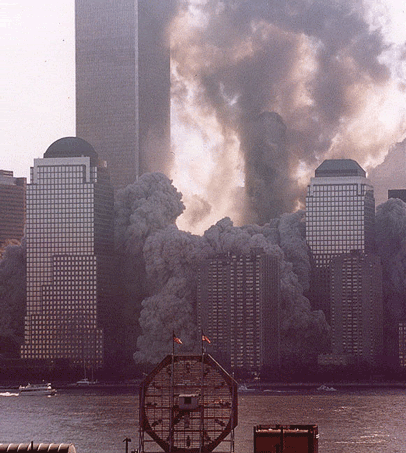
What does this picture tell you about what actually happened?
Does this photo show the that upper section crushed the lower section like you keep claiming in your idiotic examples using trucks and VWs? I thought you said the upper section completely crushed the lower section?
What does this picture tell you about what actually happened?

daws101
Diamond Member
- Banned
- #1,339
bahahahahahahahahahaha!I love it when you rationalize.Many other buildings were hit with tower debris, and burned as well yet no collapses, no FF. NIST has not shown substantiated proof to back up their collapse theory, and you haven't provided any reasons either.
Your belief in a theory you know nothing about speaks volumes...Still think the Bazant theory is a "steaming pile"? Loser?
as to the other lie you keep telling, I never said it was steaming pile.
what I did say was you need to prove the Bazant theory is a steaming pile.
you gain nothing by repeating that false interpretation.
wherever credibility or reputational damage you imagine it's done to me is just that imaginary.
There can be no reputation damage done to you anymore, as you have no credibility anyway.
btw: the Bazant hypothesis. is just that .
where are the test results to prove the hypothesis is fact not a steaming pile.
oh that's right! you have none.
BTW, the bazant hypothesis. is just that. (meaning it is indeed just a hypothesis)
where are the test results to prove the hypothesis is fact not a steaming pile.
(you are asking me where these tests results are that prove the hypothesis (Bazants hypothesis) are factual and not some steaming pile.
oh that's right you have none.
(that's right idiot, I have no test results that prove Bazants hypothesis is factual or plausible or reasonable and some would indeed call it a steaming pile)
http://www.usmessageboard.com/6822231-post894.html
You are an extreme idiot. You had no clue...Not even regarding the "jolt" that was mentioned...You thought it was from the plane....******* loser...get lost...
daws101
Diamond Member
- Banned
- #1,340
as already pointed out you have no proof that the collapse times were anything out of the ordinary.WTF? The towers withstood plane impacts, and the initial fireball consumed much of the fuel, within 15-20 minutes-per NIST.
I'm not disputing plane damage, or that there were fires...What the problem is that NIST does not explain how these massive buildings could possibly come down in such short times, They do not explain how these structures below the plane impacts, succumbed in under 15-20 seconds.
They don't explain the how the undamaged structure did not, halt the collapse fronts, or what removed the resistance to allow such rapid descents.
This happened to 3 buildings in one day, with NIST providing only assumptions with nothing to base them on.
That is the main problem. Now if you think you can provide an explanation that NIST failed to provide..have at it.
They were not felled in 15-20 seconds but rather after hours of damage from the fires. A 10 year old could grasp this fact.
And a 5 year old could grasp that we are referring to collapse times idiot, Now if you think you can provide an explanation that the NIST failed to provide.regaring these unusually fast times with regards to their mass, and energy .have at it.
it' a false statement.
Similar threads

- Replies
- 55
- Views
- 1K
- Replies
- 221
- Views
- 3K


- Replies
- 11
- Views
- 440

- Locked
- Replies
- 2
- Views
- 94


New Topics
-

-
 Are black people considered to be the most racist of all groups in America?
- Started by IM2
- Replies: 2
-
TX Democrat Defends Talarico: ‘We’re All Trans’ and ‘Gay Tofu-Eating Vegans’ Who Are ‘Going to Hell’
- Started by Hollie
- Replies: 0
-
 Rep chairman Brandon Gill magnificent take down of a democrat leader
- Started by Robert W
- Replies: 0


