I don't think you read the article very clearly. The sub-prime mortgage backed securities, were guaranteed by Freddie Mac... FIRST. Then they were given a AAA rating.
Who gave them a AAA rating?
Private rating agencies paid by investment banks?
Do you have any links?
Yeah, I linked it before. It was in my original post.
First Union Capital Markets Corp. Bear Stearns Co. Price Securities Offering... -- re CHARLOTTE N.C. Oct. 20 PRNewswire --
By the way, did you notice which two banks signed this deal with Freddie Mac to guarantee sub-prime mortgage backed securities?
Bear Stearns..... shocking.... and First Union, which was bought out by.... Wachovia. Interesting? If the mortgages by the GSEs were safe.... odd how the first two banks to sign up for the Freddie Fannie plan, were in the first few big failures.
Now you did bring up the point that rating agencies are paid by the person providing the security, rather than the person who is buying the security.
That's true.
Again, if you read the book:
The Financial Crisis and the Free Market Cure Why Pure Capitalism is the World Economy s Only Hope John A. Allison 9780071806770 Amazon.com Books
One of the historical details he covers is that issue. Because in the beginning of rating agencies, banks and sellers never paid to have their securities rated. Buyers did, because buyers are who cared.
So how did this change? Regulation. You knew that was coming.
See in the 1970s, government decided to create laws controlling how specifically pension funds worked. The funds could no longer buy securities off the market, unless they were rated.
It was actually the government, and union, and railroad pension funds themselves, that demanded the change. Why? Because this forced the sellers of securities to pay for their own rating. Why did it force them? Because without a rating, they could not be purchased by the biggest buyers of securities.... pension funds.
Now that seems counter intuitive. But there is a logic behind it. If all the securities are rated, at the cost of the sellers... guess who doesn't have to cough up the money? The pension funds

The Union Funds, Government Funds, and Railroad Funds, didn't want to have to pay rating agencies for ratings. So they had the law written to force sellers of securities, to pay to rate their own securities.
Also, have you ever wondered why there are only three big rating agencies? The law required that pension funds not only buy rated securities, but rated by Government approved agencies. There used to be dozens of rating agencies, but government only approved a few, and the first three were...... S&P, Moody's, and Fitch.
Again, it's amazing how it all circles back around to government.
Why would we believe your link from the free market apologists who created the MYTH that it was Gov't involvement in a WORLD WIDE CREDIT BUBBLE AND BUST? One cheered on by Dubya in the US?
Jun 16, 2005
What caused the financial crisis? The Big Lie goes viral
One group has been especially vocal about shaping a new narrative of the credit crisis and economic collapse: those whose bad judgment and failed philosophy helped cause the crisis.
Rather than admit the error of their ways — Repent! — these people are engaged in an active campaign to rewrite history. They are not, of course, exonerated in doing so. And beyond that, they damage the process of repairing what was broken. They muddy the waters when it comes to holding guilty parties responsible. They prevent measures from being put into place to prevent another crisis.
Here is the surprising takeaway: They are winning. Thanks to the endless repetition of the Big Lie.
A Big Lie is so colossal that no one would believe that someone could have the impudence to distort the truth so infamously. There are many examples: Claims that Earth is not warming, or that evolution is not the best thesis we have for how humans developed. Those opposed to stimulus spending have gone so far as to claim that the infrastructure of the United States is just fine, Grade A (not D, as the we discussed last month), and needs little repair.
Wall Street has its own version: Its Big Lie is that banks and investment houses are merely victims of
the crash.
You see, the entire boom and bust was caused by misguided government policies. It was not irresponsible lending or derivative or excess leverage or misguided compensation packages, but rather long-standing housing policies that were at fault.
Indeed, the arguments these folks make fail to withstand even casual scrutiny. But that has not stopped people who should know better from repeating them.
What caused the financial crisis The Big Lie goes viral - The Washington Post
Examining the big lie: How the facts of the economic crisis stack up
The boom and bust was global. Proponents of the Big Lie ignore the worldwide nature of the housing boom and bust.
A
McKinsey Global Institute report noted “from 2000 through 2007, a remarkable run-up in global home prices occurred.”
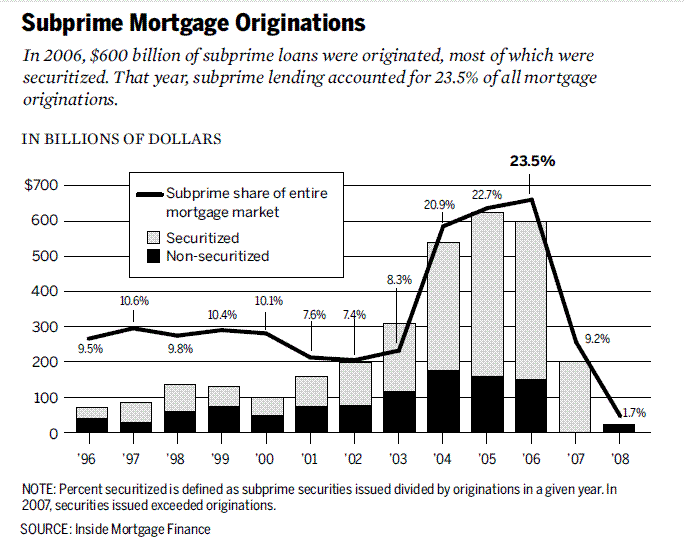
Nonbank mortgage underwriting exploded from 2001 to 2007, along with the private label securitization market, which eclipsed Fannie and Freddie during the boom.
Private lenders not subject to congressional regulations collapsed lending standards.
Examining the big lie How the facts of the economic crisis stack up - The Washington Post
Because they lied. F/F labeled sub-prime loans, as Alt-A loans. The rating agencies had no idea how many sub-prime mortgage backed securities were out there, because F/F was giving bad data.
"
The #1 Wall Street Journal Bestseller
“Required reading. . . . Shows how our economic crisis was a failure, not of the free market, but of government.”
—Charles Koch, Chairman and CEO, Koch Industries, Inc.
“
The Financial Crisis and the Free Market Cure is a sophisticated yet accessible analysis of the causes and solutions to America’s financial meltdown.”
—Ed Crane, President Emeritus of the Cato Institute"
Who lied?
The Financial Crisis and the Free Market Cure Why Pure Capitalism is the World Economy s Only Hope John A. Allison 9780071806770 Amazon.com Books
Freddie and Fannie. You just cited some of the data that shows this.
Performed 450% -600% better than the private markets. Weird right? lol
The Myth of Fannie Mae, Freddie Mac, Barney Frank, the Housing Bubble and the Recession
The Myth of Fannie Mae Freddie Mac Barney Frank the Housing Bubble and the Recession The Long Goodbye
Fannie, Freddie and the Right Wing Myth of a "Mortgage Meltdown"
"At the end of the day what really matters is losses," said Mark Zandi of Moody's Analytics. "Where are the losses?"
Zandi, speaking at a recent
American Enterprise Institute Book Forum that delved into the root causes of the financial crisis, took a position at odds with others on the panel. Everyone else embraced the research and analysis of AEI mortgage expert
Edward Pinto.
Pinto's infamous 27 million mortgages
According to
Pinto, the path to disaster was paved by the Federal Housing Enterprises Financial Safety and Soundness Act of 1992, which set affordable housing goals for the government sponsored enterprises. These goals, which were expanded over time, allegedly poisoned the well, and thereby caused a marketwide deterioration in credit standards.
By 2008 things got so bad that, according to Pinto, close to half of all U.S. mortgages were "subprime or otherwise high risk." And these subprime-equivalent mortgages made the financial meltdown inevitable. However Pinto and his disciples refuse to discuss how those 27 million mortgages performed after 2008.
The Financial Crisis Inquiry Commission reviewed Pinto's research extensively. But staffers could find no way to reconcile his risk categorizations to actual loan performance. The
FCIC's findings were soon echoed by the research of
David Min, then of the Center for American Progress.
Four years later, Zandi's updated analysis confirms and validates the earlier assessments made by Min, and almost all FCIC commissioners.
The one FCIC holdout, the Commissioner who wrote a
scathing rebuttal to the Majority Report, was Pinto's colleague at AEI, Peter Wallison.
"Whenever he had the opportunity, [FCIC Chair Phil] Angelides would point out that nine of the ten commissioners disagreed with my analysis," writes Wallison in his book,
Bad History, Worse Policy, published almost exactly two years ago. "Nevertheless, by the fall of 2011"virtually all the Republican candidates for president were saying in debates and elsewhere that the financial crisis was caused by government housing policy, with Fannie and Freddie at its heart."
Now, four years after the FCIC Report, Wallison can point to a long list of mortgage experts who wrote books based on Pinto's research. All of these authors, like Wallison, deem the FCIC analysis to be illegitimate and therefore unworthy of any direct response. As it happened, the recent AEI Book Forum was occasioned by the launch of Wallison's latest volume on the subject,
Hidden in Plain Sigh t, which covers the same ground as
Bad History.
Wallison follows in the footsteps of professors at the
University of Chicago,
Columbia, Stanford, and four professors
NYU. Other mortgage experts, at the
Hoover Institution, the
Discovery Institute, the
Mercatus Center, plus a former
member of Britain's Parliament, also wrote very similar tomes. The author of
Hidden in Plain Sigh t can cite at least ten other books that rely on Pinto's research to declare that the financial crisis was caused by affordable housing goals
.
All these authors claim that close to half of all U.S. mortgages, or 27 million, were subprime-equivalent. And none of them take Zandi's approach, which is to compare GSE loan performance with the rest of the market. In fact,
Paul Sperry, of the Hoover Institute, trashed the FCIC because it called Zandi to testify as a "star witness."
( If I didn't know better, I might think that there was some kind of coordinated messaging strategy, like that of a political campaign.)
But where are the losses?
As the one Pinto-skeptic in the room, Zandi proceeded to answer his own question, "Where are the losses?" As of year-end 2013, approximately $1 trillion in credit losses on pre-crisis loans had been realized. But the realized loss rate among different sectors varied considerably.
Best in class were Fannie and Freddie, with a realized loss rate of 3%. Then came depository institutions, like banks, which had a realized loss rate of 6%.
The strong outlier was private label mortgage securities, with a realized loss rate of 23%, seven times that of the GSEs.
lol
....These lopsided disparities are confirmed over and over from data going back two decades.
By any standard"--"delinquencies, defaults, loss severity"--"GSE mortgages perform exponentially better than the rest of the market, whereas private label mortgages perform exponentially worse. To state otherwise is to lie.
Article Fannie Freddie and the Right Wing Myth of a Mortgage Meltdown OpEdNews