P F Tinmore
Diamond Member
- Dec 6, 2009
- 86,727
- 4,921
- 1,815
The Zionist project was a colonial project. It was open knowledge at the time.1913 Seeds of Conflict is a huge hit in the U.S.
Yeah, but it's still way behind DanceMoms and America's Funniest Videos.. It was ALMOST objective -- but failed to make a case for the existence of any organized Palestinian state or government.
The objective of the documentary was to set the facts straight regarding pre-Mandate Palestine. The case for an independent state for the inhabitants of Palestine was made by the Covenant of the League of Nations, which was written and signed years later. Through rigorous research, as most of the reviewers have written, the film makes clear quite a number of facts some of which include the following:
1. Before the Europeans arrived, Palestine was inhabited by a large majority of Christian and Muslim and a small number of recently arrived Sephardic Jew Arab. (Arab culture and spoke Arabic.). And, they got along just fine.
2. The first conflicts were instigated by the Europeans and the first verifiable killing was of a local by a European.
3. The Europeans mistreated the locals.
4. Zionist propaganda was rampant. Using this photo as an example.

"It all depends on where the photographer aims the camera, right?," she asks the audience in the film. "You have the famous image of shareholders for what would become Tel Aviv in 1905 standing among the sand dunes. Well, the photographer was positioned to their south photographing them to the north in which there were in fact sand dunes. Had he turned 180 degrees to photograph himself behind them they would have seen vast orchard groves of Christian and Muslim landowners."
5. Asserts that it was a Zionist self-described colonial project, using the term colony in the film for the Zionist end-product.
I have been posting these facts and others (providing links to the source documentation much of which is the same used in the film) since I joined this forum and have received abuse, have been derided, have been threatened physically (by one poster who continues to do so), have been called a liar, have been called a propagandist and have been called every name in the book for posting these facts. That's why I feel vindicated.
Don't think I have a problem with your 5 points. I'd dispute "colony" because it's ambiguous. Can mean a cloistered and isolated group within in larger sovereign nation or the totally dominated product of Colonial adventurism. But you put way too much meaning into photos that isn't fully in evidence.
Perhaps this "propaganda picture" is correct in that THIS group of immigrants intended to CLAIM those sand dunes and make them productive. Much like the process went for the Arab/Christian land in front of them.
This picture says NOTHING about intent to take or steal others property..
And so --- the production crew left the picture to be interpreted as a ransacking horde of immoral foreigners.
Much like the producers never actually stated that there was no government or Palestinian rule of the land during this period of time..
Approximately 800,000 dunums have passed into Jewish hands since 1920. Long leases of State Domain have been granted to the colony of Petach-Tikvah, to the Township of Tel-Aviv and the Palestine Jewish Colonisation Association.
There are sealed armouries, for use by the colonists themselves in case of sudden attack, in every isolated Jewish colony. - See more at: Mandate for Palestine - Report of the Mandatory to the League of Nations 31 December 1930
There are sealed armouries, for use by the colonists themselves in case of sudden attack, in every isolated Jewish colony. - See more at: Mandate for Palestine - Report of the Mandatory to the League of Nations 31 December 1930
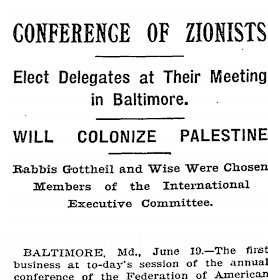
The Zionist project was not to have the Jews "live in Palestine" but to form colonies that would be bigger and more numerous with time to eventually take over the entire country. Those colonies were virtually separate from Palestine. That colonizing process continues today with more and bigger colonies in the West Bank.