Your guide to manmade climate disasters in the world today

Really.

Like
Dislike

Carbon dating is a scientifically validated method for estimating the age of organic materials up to about 50,000–60,000 years old.

How Carbon Dating Works​

Carbon dating, also known as radiocarbon dating, relies on the radioactive decay of carbon-14 (C-14), a naturally occurring isotope of carbon. C-14 is formed in the upper atmosphere when cosmic rays interact with nitrogen-14, and it becomes incorporated into living organisms through carbon dioxide in plants and the food chain. While an organism is alive, it maintains a constant ratio of C-14 to stable carbon-12 (C-12). After death, C-14 decays back into nitrogen-14 at a predictable rate, with a half-life of approximately 5,730 years. By measuring the remaining C-14 in a sample, scientists can estimate the time since the organism died biologyinsights.combiologyinsights.com+2.

Reliability and Validation​

Carbon dating is widely used in archaeology, geology, and environmental science and has been validated through cross-referencing with other dating methods, such as dendrochronology (tree-ring dating) and historically dated artifacts like the Dead Sea Scrolls. Calibration curves account for variations in atmospheric C-14 over time, improving accuracy. Modern laboratories also correct for contamination and other potential sources of error biologyinsights.combiologyinsights.com+2.

Limitations​

While carbon dating is reliable, it has limitations. It is effective only for organic materials up to roughly 50,000–60,000 years old; beyond this, the remaining C-14 is too low to measure accurately. It cannot date inorganic materials like rocks or metals, and results can be affected by contamination, reservoir effects, or unusual carbon sources in the organism’s environment scienceinsights.orgscienceinsights.org+1. These limitations are well understood and accounted for in scientific practice.

Conclusion​

Carbon dating is a proven and reliable scientific method for dating relatively recent organic materials. Its accuracy is supported by decades of research, cross-validation, and Nobel Prize–winning work by Willard Libby, who developed the technique in the late 1940s. While it has specific constraints, when applied correctly, it provides trustworthy chronological information for archaeology, geology, and related fields
If you are not ware of the facts that contradict secular dating assumptions are you also unaware that more than a dozen dinosaur bones were tested and found to be less than 50,000 years old?
 
If you are not ware of the facts that contradict secular dating assumptions are you also unaware that more than a dozen dinosaur bones were tested and found to be less than 50,000 years old?
Source

Must be Answers in genesis.
 
Really.

Like
Dislike

Carbon dating is a scientifically validated method for estimating the age of organic materials up to about 50,000–60,000 years old.

How Carbon Dating Works​

Carbon dating, also known as radiocarbon dating, relies on the radioactive decay of carbon-14 (C-14), a naturally occurring isotope of carbon. C-14 is formed in the upper atmosphere when cosmic rays interact with nitrogen-14, and it becomes incorporated into living organisms through carbon dioxide in plants and the food chain. While an organism is alive, it maintains a constant ratio of C-14 to stable carbon-12 (C-12). After death, C-14 decays back into nitrogen-14 at a predictable rate, with a half-life of approximately 5,730 years. By measuring the remaining C-14 in a sample, scientists can estimate the time since the organism died biologyinsights.combiologyinsights.com+2.

Reliability and Validation​

Carbon dating is widely used in archaeology, geology, and environmental science and has been validated through cross-referencing with other dating methods, such as dendrochronology (tree-ring dating) and historically dated artifacts like the Dead Sea Scrolls. Calibration curves account for variations in atmospheric C-14 over time, improving accuracy. Modern laboratories also correct for contamination and other potential sources of error biologyinsights.combiologyinsights.com+2.

Limitations​

While carbon dating is reliable, it has limitations. It is effective only for organic materials up to roughly 50,000–60,000 years old; beyond this, the remaining C-14 is too low to measure accurately. It cannot date inorganic materials like rocks or metals, and results can be affected by contamination, reservoir effects, or unusual carbon sources in the organism’s environment scienceinsights.orgscienceinsights.org+1. These limitations are well understood and accounted for in scientific practice.

Conclusion​

Carbon dating is a proven and reliable scientific method for dating relatively recent organic materials. Its accuracy is supported by decades of research, cross-validation, and Nobel Prize–winning work by Willard Libby, who developed the technique in the late 1940s. While it has specific constraints, when applied correctly, it provides trustworthy chronological information for archaeology, geology, and related fields
Since carbon dating is not really possible for ages of more than 100,000 years, if we want to rely on carbon dating methods to work, we must test subjects younger than 100,000 years. The problem is that almost nothing on earth has been found to be older than 100,000 years when applying carbon dating methods to samples.
 
Do the doctors involved (or anyone for that matter) not know what gender is?
How can anyone know what gender is who does not openly reject the claim made by a man who claimed he impregnated his boyfriend?
 
Since carbon dating is not really possible for ages of more than 100,000 years, if we want to rely on carbon dating methods to work, we must test subjects younger than 100,000 years. The problem is that almost nothing on earth has been found to be older than 100,000 years when applying carbon dating methods to samples.
Science uses radioisotope dating for that.
 
Where is the science before you run away climate toddler.

Post your attempt to debunk those facts.


Right here...


When you can find one single "top climate scientist" who can refute one word of it, let us know...

LOL!!!
 
Right here...


When you can find one single "top climate scientist" who can refute one word of it, let us know...

LOL!!!
Wow, an article from 2005.

Hilarious

Satellite and weather balloon data used to argue that climate models were wrong and that global warming isn't really happening turns out to be based on faulty analyses, according to three new studies.

You offered that.
 
Wow, an article from 2005.

Hilarious

Satellite and weather balloon data used to argue that climate models were wrong and that global warming isn't really happening turns out to be based on faulty analyses, according to three new studies.

You offered that.

He's a moron.
Whenever he posts actual data it always conflicts with his silly claims.
 
15th post
Is the english press screaming climate change?Because it's gonna be a hundred degrees, was it a hundred degrees?I don't know

Remember weather events don't count

Oh, wait.That's right, unless it's hot outside

What is a portable AC running yas? £1000 because it's all taxes and fees
You're totally getting the shaft

Yeah, I forgot it's england can you guys even afford your electric bill?
I mean you're poorer than alabama

Well go boil some plain chicken and potatoes and keep calm and carry on sir

get that spotted dick checked out
you can ever be too careful with venerial diseases...
 
That info was aired at an international

. Radiometric dating dinosaur bones using Carbon-14

Carbon-14-dated dinosaur bones are less than 40,000 years old


Censorship

Our researchers found a reason for the puzzling survival of soft tissue and DNA fragments in dinosaur bones - the bones are younger than anyone ever guessed. Carbon-14 (C-14) dating of multiple samples of bone from 8 dinosaurs found in Texas, Alaska, Colorado, and Montana revealed that they are only 22,000 to 39,000 years old.
Members of the Paleochronology group presented their findings at the 2012 Western Pacific Geophysics Meeting in Singapore, August 13-17, a conference of the American Geophysical Union (AGU) and the Asia Oceania Geosciences Society (AOGS).
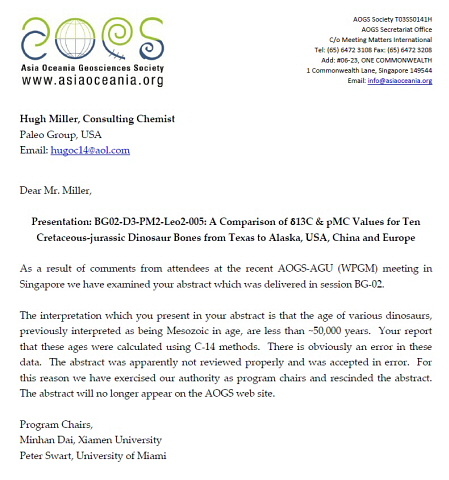
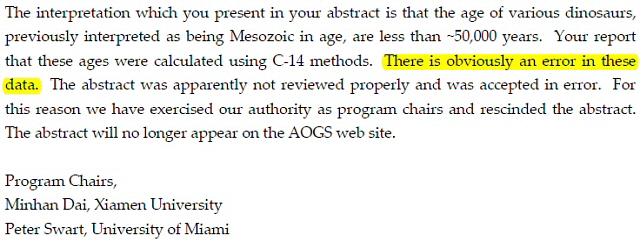
Since dinosaurs are thought to be over 65 million years old, the news was stunning - and more than some could tolerate. After the AOGS-AGU conference in Singapore, the abstract was removed from the conference website by two chairmen because they could not accept the findings. Unwilling to challenge the data openly, they erased the report from public view without a word to the authors. When the authors inquired, they received this letter:

Reject.jpg

Reject5.jpg
They did not look at the data and they never spoke with the researchers. They did not like the test results, so they censored them.
Carbon-14 is considered to be a highly reliable dating technique. It's accuracy has been verified by using C-14 to date artifacts whose age is known historically. The fluctuation of the amount of C-14 in the atmosphere over time adds a small uncertainty, but contamination by "modern carbon" such as decayed organic matter from soils poses a greater possibility for error.
Dr. Thomas Seiler, a physicist from Germany, gave the presentation in Singapore. He said that his team and the laboratories they employed took special care to avoid contamination. That included protecting the samples, avoiding cracked areas in the bones, and meticulous pre-cleaning of the samples with chemicals to remove possible contaminants. Knowing that small concentrations of collagen can attract contamination, they compared precision Accelerator Mass Spectrometry (AMS) tests of collagen and bioapatite (hard carbonate bone mineral) with conventional counting methods of large bone fragments from the same dinosaurs. "Comparing such different molecules as minerals and organics from the same bone region, we obtained concordant C-14 results which were well below the upper limits of C-14 dating. These, together with many other remarkable concordances between samples from different fossils, geographic regions and stratigraphic positions make random contamination as origin of the C-14 unlikely", he said.
 
Science uses radioisotope dating for that.
The labs that unwittingly tested the dinosaur bones guaranteed their test results were accurate and contamination-free. After finding out that the bones were from dinosaurs the labs said the results were inadmissible because everybody 'knows' dinosaur bones are too old to carbon date.

Go figure.
 

New Topics

Back
Top Bottom