Widening Of The Buffer Zone

Actually, the Palestine Delegation to London was composed of Christians and Muslim, the Christian Palestinians were the wealthiest and most influential Palestinians in those days. The Christians and Muslims had never agreed to cede their lands to Europeans. The Europeans decided to take their lands and give them to other Europeans they really did not like much, the Jews.


More incitement through ISLAMONAZI BLOOD LIBEL
 
P F Tinmore, et al,

Now we are just quibbling over derivative authority versus statutory authority.

In all matters relating to the Administration of Palestine, the authority was derivative; even the authority of the Mandatory (UK).

[

Where in your link does it say that the Jewish agency "had no authority inside the mandate and after the mandate left it had no right to stay in Palestine" ?
From Rocco's post:

The "Jewish Agency" (JA) was a prerequisite established under Article 4, The Mandate For Palestine; established in 1929. The JA had to be accredited by the World Zionist Organization (WZO) under the Article 4, "as a public body for the purpose of advising and co-operating with the Administration of Palestine in such economic, social and other matters as may affect the establishment of the Jewish national home."​

It was an advisory organization. It had no authority. It was a part of the mandate and had no function absent the mandate.
(COMMENT)

In January 1947, the Jewish Agency was unequivocally the designated representatives to assist the UN Palestine Commission in the establishment of an Independent State. This was completely outside the scope of the Mandate. That is because it was amid the transition.

Your argument is now convoluted. With regard to True Authority, you are correct. The Jewish Agency had no true authority any more than the Arab Higher Committee had any authority. All authority was administered and delegated to the Mandatory. That does not diminish that contributions made by the Jewish Agency in the utimate establishment of the Jewish National Home.

In terms of authority to exercise the right of self-determination, the Jewish Agency, had all the authority required to complete the Steps Preparatory to Independence for the Provisional Government to Declare Independence; much much more than that of the Arab Palestinian; this is self evident in the face of the fact that it was accomplished. A goal towards nationalism which the Arab Palestinian were unable to attain.

You want to call it "advisory" --- so be it. In reality --- they built a nation that endures to this day and is self-governing and economically stable and sound. What did the Arab Palestinian accomplish?

You as a proPalestinian can criticize the Israeli all you want, but in the end, they have a nation working towards peace. In contrast, the Arab Palestinian has a dysfunctional operations that is monetarily parasitic and Jihadist in nature working towards the continuation of conflict.

Most Respectfully,
R
Indeed, and all of that was in violation of the inalienable rights of the native population.

You know, the Palestinians, that the lying sacks of shit in Israel have always claimed did not exist.


Not as they were applied in 1920 when the Mandate was undertaken, and the only Palestinians at that time were the Jews. The arab muslims called themselves Syrians.
Where do you keep getting all of your lies? (link?)

Drawing up the framework of nationality, Article 30 of the Treaty of Lausanne stated:

“Turkish subjects habitually resident in territory which in accordance with the provisions of the present Treaty is detached from Turkey will become ipso facto, in the conditions laid down by the local law, nationals of the State to which such territory is transferred.”​

Article 30 is of a great significance. It constituted a declaration of existing international law and the standard practice of states. This was despite the absence of a definite international law rule of state succession under which the nationals of predecessor state could ipso facto acquire the nationality of the successor.129 “As a rule, however, States have conferred their nationality on the former nationals of the predecessor State.”130 In practice, almost all peace treaties concluded between the Allies and other states at the end of World War I embodied nationality provisions similar to those of the Treaty of Lausanne. The inhabitants of Palestine, as the successors of this territory, henceforth acquired Palestinian nationality even if there was no treaty with Turkey.

The Treaty confirmed the previous practice whereby inhabitants were effectively regarded as Palestinians. To be sure, most of the Treaty’s nationality rules were later embodied in the 1925 Palestinian Citizenship Order and became part of the country’s law.

Genesis of Citizenship in Palestine and Israel

It simply said "Turkish subjects" without specifying any religion. Most of those subjects were Muslim, then Christians, then Jews respectively. They were all Palestinians.


MANDATE FOR PALESTINE citizens, not nation, state or country of Palestine. The arab muslims called the Jews Palestinians ( more correctly balestinians because they could not pronounce the P ) as a derogatory name as they had done since 627 C.E. when Mohamed declared a fatwah on them. Read the MANDATE FOR PALESTINE that sets out special treatment for the Jews and sets them higher than the arab muslims.[/QUOTE]
It is a typical mistake to believe that the mandate was a place, It was not. It was a temporarily assigned administration that held Palestine in trust.

The mandate charter, itself, called Palestine a country numerous times.
 
P F Tinmore, et al,

It is even a bigger mistake to think that you, and you alone, understand the intent and purpose of the Mandate for Palestine.

It is a typical mistake to believe that the mandate was a place, It was not. It was a temporarily assigned administration that held Palestine in trust.

The mandate charter, itself, called Palestine a country numerous times.
(COMMENT)

Calling a plot of land, a territory --- by the name of "country" does not infer any special quality to it or the people associated with it. To imply that it does, is an exercise in foolishness.

Palestine was a subsection of territory, a geopolitical space, within the overall land that the Ottoman Empire remanded to the Allied Powers at the end of the War. It was a territory defined at the discretion --- and for the convenience of --- the Allied Powers; and not a specific land that was formerly autonomous, self-governing, or a former political subdivision of the Empire. Any such suggestion that "Palestine" (within such boundaries as may be determined by the Principal Allied Powers) had some special status conferred upon it by the previous sovereign --- or the --- successor government, is more than ridiculous. The territory (formerly under the Mandate) was historically contained within the Vilayet of Syria, under the Imperial hand of the Provincial Government in Damascus.

At no time during the 800 years of Ottoman Control, prior to the umbrella of the Mandate, did this territory have sovereignty unto itself or demonstrate independence. And nothing in the Treaties of Sevres or Lausanne altered that status. In fact, the Treaty of Lausanne does not confer any special recognition upon "Palestine." None at all.

Most Respectfully,
R
 
P F Tinmore, et al,

It is even a bigger mistake to think that you, and you alone, understand the intent and purpose of the Mandate for Palestine.

It is a typical mistake to believe that the mandate was a place, It was not. It was a temporarily assigned administration that held Palestine in trust.

The mandate charter, itself, called Palestine a country numerous times.
(COMMENT)

Calling a plot of land, a territory --- by the name of "country" does not infer any special quality to it or the people associated with it. To imply that it does, is an exercise in foolishness.

Palestine was a subsection of territory, a geopolitical space, within the overall land that the Ottoman Empire remanded to the Allied Powers at the end of the War. It was a territory defined at the discretion --- and for the convenience of --- the Allied Powers; and not a specific land that was formerly autonomous, self-governing, or a former political subdivision of the Empire. Any such suggestion that "Palestine" (within such boundaries as may be determined by the Principal Allied Powers) had some special status conferred upon it by the previous sovereign --- or the --- successor government, is more than ridiculous. The territory (formerly under the Mandate) was historically contained within the Vilayet of Syria, under the Imperial hand of the Provincial Government in Damascus.

At no time during the 800 years of Ottoman Control, prior to the umbrella of the Mandate, did this territory have sovereignty unto itself or demonstrate independence. And nothing in the Treaties of Sevres or Lausanne altered that status. In fact, the Treaty of Lausanne does not confer any special recognition upon "Palestine." None at all.

Most Respectfully,
R
We have heard that Israeli bullshit a gazillion times.

Palestine, as the mandate clearly showed, was a subject under international law. While she could not conclude international conventions, the mandatory Power, until further notice, concluded them on her behalf, in virtue of Article 19 of the mandate. The mandate, in Article 7, obliged the Mandatory to enact a nationality law, which again showed that the Palestinians formed a nation, and that Palestine was a State, though provisionally under guardianship. It was, moreover, unnecessary to labour the point; there was no doubt whatever that Palestine was a separate political entity.
- See more at: Mandate for Palestine - League of Nations 32nd session - Minutes of the Permanent Mandates Commission 18 August 1937
 
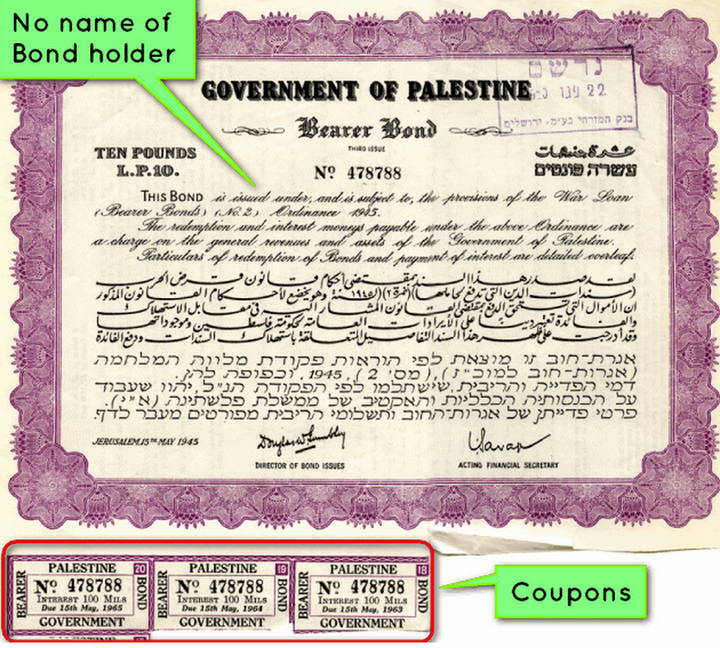
Bearer-Bonds-with-coupens.jpg
 
P F Tinmore, et al,

One cannot "cherry-pick" a strategy from a single Meeting Session and then spread it around as if it were policy.

P F Tinmore, et al,

It is even a bigger mistake to think that you, and you alone, understand the intent and purpose of the Mandate for Palestine.

It is a typical mistake to believe that the mandate was a place, It was not. It was a temporarily assigned administration that held Palestine in trust.

The mandate charter, itself, called Palestine a country numerous times.
(COMMENT)

Calling a plot of land, a territory --- by the name of "country" does not infer any special quality to it or the people associated with it. To imply that it does, is an exercise in foolishness.

Palestine was a subsection of territory, a geopolitical space, within the overall land that the Ottoman Empire remanded to the Allied Powers at the end of the War. It was a territory defined at the discretion --- and for the convenience of --- the Allied Powers; and not a specific land that was formerly autonomous, self-governing, or a former political subdivision of the Empire. Any such suggestion that "Palestine" (within such boundaries as may be determined by the Principal Allied Powers) had some special status conferred upon it by the previous sovereign --- or the --- successor government, is more than ridiculous. The territory (formerly under the Mandate) was historically contained within the Vilayet of Syria, under the Imperial hand of the Provincial Government in Damascus.

At no time during the 800 years of Ottoman Control, prior to the umbrella of the Mandate, did this territory have sovereignty unto itself or demonstrate independence. And nothing in the Treaties of Sevres or Lausanne altered that status. In fact, the Treaty of Lausanne does not confer any special recognition upon "Palestine." None at all.

Most Respectfully,
R
We have heard that Israeli bullshit a gazillion times.

Palestine, as the mandate clearly showed, was a subject under international law. While she could not conclude international conventions, the mandatory Power, until further notice, concluded them on her behalf, in virtue of Article 19 of the mandate. The mandate, in Article 7, obliged the Mandatory to enact a nationality law, which again showed that the Palestinians formed a nation, and that Palestine was a State, though provisionally under guardianship. It was, moreover, unnecessary to labour the point; there was no doubt whatever that Palestine was a separate political entity.
- See more at: Mandate for Palestine - League of Nations 32nd session - Minutes of the Permanent Mandates Commission 18 August 1937
(COMMENT)

In any complex issue over an extended period, it will be easy to find conflicting ideas expressed. And it will be easy to cherry-pick those ideas and formulate an argument. Having said that, and from the very same LoN 32d Session, one might find this having been stated:

"The aim is the termination of the mandate in respect of Trans-Jordan and the greater part of Palestine, with a view to the creation of two new independent sovereign States--the one Arab and the other Jewish--and the reservation of certain places in Palestine, some permanently, others possibly only temporarily, under British mandate, such mandate involving modifications of the existing mandate." - See more at: Mandate for Palestine - League of Nations 32nd session - Minutes of the Permanent Mandates Commission 18 August 1937

I believe that on the basis of partition and the establishment of a Jewish State, small as that is, it will be possible to find accommodation for far more refugees than by a continuation of the present mandatory regime. For under that regime every move to introduce more refugees will be met with resistance on the part of the Arabs. On the other hand, if a Jewish State is set up under a Jewish Government, which I believe would be a good and tolerant Government, it will, if the Arabs and the rest of the country are granted independent freedom, be easier to induce the Arabs to allow Jews even to enter their areas. I believe that, if this question is once settled in a clear and definite manner, the relations between the Arabs and the Jews will begin to improve. I am therefore quite satisfied in my own mind that, looking at the Palestine question as a possible solution to the world Jewish problem, there is more hope for the Jews in partition than by a continuation of the system in operation during the last few years. - See more at: Mandate for Palestine - League of Nations 32nd session - Minutes of the Permanent Mandates Commission 18 August 1937

Neither your quote, nor the one I just posted, represent a hard policy decision. Merely they represent the various aspects to which the developments of the Middle East Question of Palestine were covered, and the open dialog on the issues as seen at that time (1937).

Most Respectively,
R
 
P F Tinmore, et al,

One cannot "cherry-pick" a strategy from a single Meeting Session and then spread it around as if it were policy.

P F Tinmore, et al,

It is even a bigger mistake to think that you, and you alone, understand the intent and purpose of the Mandate for Palestine.

It is a typical mistake to believe that the mandate was a place, It was not. It was a temporarily assigned administration that held Palestine in trust.

The mandate charter, itself, called Palestine a country numerous times.
(COMMENT)

Calling a plot of land, a territory --- by the name of "country" does not infer any special quality to it or the people associated with it. To imply that it does, is an exercise in foolishness.

Palestine was a subsection of territory, a geopolitical space, within the overall land that the Ottoman Empire remanded to the Allied Powers at the end of the War. It was a territory defined at the discretion --- and for the convenience of --- the Allied Powers; and not a specific land that was formerly autonomous, self-governing, or a former political subdivision of the Empire. Any such suggestion that "Palestine" (within such boundaries as may be determined by the Principal Allied Powers) had some special status conferred upon it by the previous sovereign --- or the --- successor government, is more than ridiculous. The territory (formerly under the Mandate) was historically contained within the Vilayet of Syria, under the Imperial hand of the Provincial Government in Damascus.

At no time during the 800 years of Ottoman Control, prior to the umbrella of the Mandate, did this territory have sovereignty unto itself or demonstrate independence. And nothing in the Treaties of Sevres or Lausanne altered that status. In fact, the Treaty of Lausanne does not confer any special recognition upon "Palestine." None at all.

Most Respectfully,
R
We have heard that Israeli bullshit a gazillion times.

Palestine, as the mandate clearly showed, was a subject under international law. While she could not conclude international conventions, the mandatory Power, until further notice, concluded them on her behalf, in virtue of Article 19 of the mandate. The mandate, in Article 7, obliged the Mandatory to enact a nationality law, which again showed that the Palestinians formed a nation, and that Palestine was a State, though provisionally under guardianship. It was, moreover, unnecessary to labour the point; there was no doubt whatever that Palestine was a separate political entity.
- See more at: Mandate for Palestine - League of Nations 32nd session - Minutes of the Permanent Mandates Commission 18 August 1937
(COMMENT)

In any complex issue over an extended period, it will be easy to find conflicting ideas expressed. And it will be easy to cherry-pick those ideas and formulate an argument. Having said that, and from the very same LoN 32d Session, one might find this having been stated:

"The aim is the termination of the mandate in respect of Trans-Jordan and the greater part of Palestine, with a view to the creation of two new independent sovereign States--the one Arab and the other Jewish--and the reservation of certain places in Palestine, some permanently, others possibly only temporarily, under British mandate, such mandate involving modifications of the existing mandate." - See more at: Mandate for Palestine - League of Nations 32nd session - Minutes of the Permanent Mandates Commission 18 August 1937

I believe that on the basis of partition and the establishment of a Jewish State, small as that is, it will be possible to find accommodation for far more refugees than by a continuation of the present mandatory regime. For under that regime every move to introduce more refugees will be met with resistance on the part of the Arabs. On the other hand, if a Jewish State is set up under a Jewish Government, which I believe would be a good and tolerant Government, it will, if the Arabs and the rest of the country are granted independent freedom, be easier to induce the Arabs to allow Jews even to enter their areas. I believe that, if this question is once settled in a clear and definite manner, the relations between the Arabs and the Jews will begin to improve. I am therefore quite satisfied in my own mind that, looking at the Palestine question as a possible solution to the world Jewish problem, there is more hope for the Jews in partition than by a continuation of the system in operation during the last few years. - See more at: Mandate for Palestine - League of Nations 32nd session - Minutes of the Permanent Mandates Commission 18 August 1937

Neither your quote, nor the one I just posted, represent a hard policy decision. Merely they represent the various aspects to which the developments of the Middle East Question of Palestine were covered, and the open dialog on the issues as seen at that time (1937).

Most Respectively,
R
Mandate for Palestine

Yet you continuously imply that the Palestinians have no say in what happens in their country.

The Treaty of Lausanne required the newly created states that acquired the territory to pay annuities on the Ottoman public debt, and to assume responsibility for the administration of concessions that had been granted by the Ottomans. A dispute regarding the status of the territories was settled by an Arbitrator appointed by the Council of the League of Nations. It was decided that Palestine and Transjordan were newly created states according to the terms of the applicable post-war treaties. In its Judgment No. 5, The Mavrommatis Palestine Concessions, the Permanent Court of International Justice also decided that Palestine was responsible as the successor state for concessions granted by Ottoman authorities. The Courts of Palestine and Great Britain decided that title to the properties shown on the Ottoman Civil list had been ceded to the government of Palestine as an allied successor state.[16]

State of Palestine - Wikipedia the free encyclopedia

In fact it is the foreigners who have no legitimate say in Palestine. Everything you post is about foreigners.
 
P F Tinmore, et al.

Oh ---- for heavens sakes. Please go the the actual ICJ Judgment #5 26 March 1925. (The Mavrommatis - Jerusalem Concessions File E.c. V. Docket VI.a. Then go straight to page #51 (the last page).

Mandate for Palestine

Yet you continuously imply that the Palestinians have no say in what happens in their country.

The Treaty of Lausanne required the newly created states that acquired the territory to pay annuities on the Ottoman public debt, and to assume responsibility for the administration of concessions that had been granted by the Ottomans. A dispute regarding the status of the territories was settled by an Arbitrator appointed by the Council of the League of Nations. It was decided that Palestine and Transjordan were newly created states according to the terms of the applicable post-war treaties. In its Judgment No. 5, The Mavrommatis Palestine Concessions, the Permanent Court of International Justice also decided that Palestine was responsible as the successor state for concessions granted by Ottoman authorities. The Courts of Palestine and Great Britain decided that title to the properties shown on the Ottoman Civil list had been ceded to the government of Palestine as an allied successor state.[16]

State of Palestine - Wikipedia the free encyclopedia

In fact it is the foreigners who have no legitimate say in Palestine. Everything you post is about foreigners.

(OBSERVATION)

FOR THESE REASONS, The Court, having heard both Parties, gives judgment as follows :

I. That the concessions granted to M Mavroniniatis under the Agreements signed on January 27th, 1914, between him and the City of Jerusalem, regarding certain works to be carried out at Jerusalem, are valid;

That the existence, for a certain space of time, of a right on the part of M. Rutenberg to require the annulment of the aforesaid concessions of M. Mavrommatis was not in conformity with the international obligations accepted by the Mandatory for Palestine;

That no loss to M. Mavrommatis, resulting from this circumstance, has been proved;

That therefore the Greek Government's claim for an indemnity must be dismissed ;

2. That Article 4 of the Protocol signed at 1, Lausanne on July 23rd, 1923, concerning certain concessions granted in the Ottoman Empire, is applicable to the above-mentioned concessions granted to M. Mavromniatis.​

(COMMENT)

This was a commerical claim made on the basis of a debt. In the final analysis --- the International Court of Justice (ICJ) held in Judgment #5, that the "Mandatory for Palestine" was the successor government for Palestine and therefore Jerusalem; and responsible for the debt payment.

I have seen a number of pro-Palestinians try to use this hat trick. It simply is not applicable.

Judgment #5 does not set a precedent for a Government of Palestine. In this case, on the title page, you can quite clearly see that the Applicant is the Government of Greece and the Respondent is the Government of Great Britain (the Mandatory Power). You can again quite see that the ICJ (on Page 7) quite clearly states that the Government of Palestine is the Great Britain:

This application concludes with a request that the Court may be pleased to give judgment to the effect that the Government of Palestine and consequently also the Government of His Britannic Majesty have, since 1921, wrongfully refused to recognize to their full extent the rights acquired by M. Mavrc~mmatis under the contracts and agreements concluded by him with the Ottoman authorities in regard to the works specified above, and that the Government of His Britannic Majesty shall make reparation for the consequent loss incurred by the said Greek subject, a loss which is estimated at £234.339 together with interest at six percent.​

The was no other Government other than UK/GB.

Most Respectfully,
R
 
P F Tinmore, et al.

Oh ---- for heavens sakes. Please go the the actual ICJ Judgment #5 26 March 1925. (The Mavrommatis - Jerusalem Concessions File E.c. V. Docket VI.a. Then go straight to page #51 (the last page).

Mandate for Palestine

Yet you continuously imply that the Palestinians have no say in what happens in their country.

The Treaty of Lausanne required the newly created states that acquired the territory to pay annuities on the Ottoman public debt, and to assume responsibility for the administration of concessions that had been granted by the Ottomans. A dispute regarding the status of the territories was settled by an Arbitrator appointed by the Council of the League of Nations. It was decided that Palestine and Transjordan were newly created states according to the terms of the applicable post-war treaties. In its Judgment No. 5, The Mavrommatis Palestine Concessions, the Permanent Court of International Justice also decided that Palestine was responsible as the successor state for concessions granted by Ottoman authorities. The Courts of Palestine and Great Britain decided that title to the properties shown on the Ottoman Civil list had been ceded to the government of Palestine as an allied successor state.[16]

State of Palestine - Wikipedia the free encyclopedia

In fact it is the foreigners who have no legitimate say in Palestine. Everything you post is about foreigners.

(OBSERVATION)

FOR THESE REASONS, The Court, having heard both Parties, gives judgment as follows :

I. That the concessions granted to M Mavroniniatis under the Agreements signed on January 27th, 1914, between him and the City of Jerusalem, regarding certain works to be carried out at Jerusalem, are valid;

That the existence, for a certain space of time, of a right on the part of M. Rutenberg to require the annulment of the aforesaid concessions of M. Mavrommatis was not in conformity with the international obligations accepted by the Mandatory for Palestine;

That no loss to M. Mavrommatis, resulting from this circumstance, has been proved;

That therefore the Greek Government's claim for an indemnity must be dismissed ;

2. That Article 4 of the Protocol signed at 1, Lausanne on July 23rd, 1923, concerning certain concessions granted in the Ottoman Empire, is applicable to the above-mentioned concessions granted to M. Mavromniatis.​

(COMMENT)

This was a commerical claim made on the basis of a debt. In the final analysis --- the International Court of Justice (ICJ) held in Judgment #5, that the "Mandatory for Palestine" was the successor government for Palestine and therefore Jerusalem; and responsible for the debt payment.

I have seen a number of pro-Palestinians try to use this hat trick. It simply is not applicable.

Judgment #5 does not set a precedent for a Government of Palestine. In this case, on the title page, you can quite clearly see that the Applicant is the Government of Greece and the Respondent is the Government of Great Britain (the Mandatory Power). You can again quite see that the ICJ (on Page 7) quite clearly states that the Government of Palestine is the Great Britain:

This application concludes with a request that the Court may be pleased to give judgment to the effect that the Government of Palestine and consequently also the Government of His Britannic Majesty have, since 1921, wrongfully refused to recognize to their full extent the rights acquired by M. Mavrc~mmatis under the contracts and agreements concluded by him with the Ottoman authorities in regard to the works specified above, and that the Government of His Britannic Majesty shall make reparation for the consequent loss incurred by the said Greek subject, a loss which is estimated at £234.339 together with interest at six percent.​

The was no other Government other than UK/GB.

Most Respectfully,
R
As the temporarily assigned administration I can understand that Britain would be responsible party but I don't see where it changes the original party to the case. If Palestine was not the successor state then the mandate would not have that responsibility.

So I don't understand the point of your post.

Also, you did not address the other points.
 
The only real deal with the Palestinians is the death or removal of Israel................

They will not have it any other way.
 
Hamas, Hez, Muslim Brotherhood.........etc................

So, no peace and no nation for Palestine........
 
P F Tinmore, et al,

Please don't play dumb.

As the temporarily assigned administration I can understand that Britain would be responsible party but I don't see where it changes the original party to the case. If Palestine was not the successor state then the mandate would not have that responsibility.
(COMMENT)

You are using the wrong term: Not Successor State --- Use Successor Government. (There was no successor state.)

The Successor government to the Ottoman Territory in the ICJ Complaint was the Mandatory for Palestine; acting as the Government for the territory.

So I don't understand the point of your post.
(COMMENT)

You are asserting that the Judgment inferred some sort of "State of Palestine" in which there were Palestinians exercising some measure of autonomy and self-government. That is not the case at all. In fact, the Judgment show the exact opposite. Even the infrastructure project in the Mavroniniatis Case had to be assumed by the Mandatory.


Also, you did not address the other points.
(COMMENT)

The Judgment concluded that the territorial property passed from the Ottoman Empire to the Successor Government (the Mandatory).

Most Respectfully,
R
 
P F Tinmore, et al,

Please don't play dumb.

As the temporarily assigned administration I can understand that Britain would be responsible party but I don't see where it changes the original party to the case. If Palestine was not the successor state then the mandate would not have that responsibility.
(COMMENT)

You are using the wrong term: Not Successor State --- Use Successor Government. (There was no successor state.)

The Successor government to the Ottoman Territory in the ICJ Complaint was the Mandatory for Palestine; acting as the Government for the territory.

So I don't understand the point of your post.
(COMMENT)

You are asserting that the Judgment inferred some sort of "State of Palestine" in which there were Palestinians exercising some measure of autonomy and self-government. That is not the case at all. In fact, the Judgment show the exact opposite. Even the infrastructure project in the Mavroniniatis Case had to be assumed by the Mandatory.


Also, you did not address the other points.
(COMMENT)

The Judgment concluded that the territorial property passed from the Ottoman Empire to the Successor Government (the Mandatory).

Most Respectfully,
R
You are not being honest again, Rocco. The mandate never took possession of any land.
 
P F Tinmore, et al,

I don't believe that I addressed any real estate issues at all (taking "possession of any land").

P F Tinmore, et al,

Please don't play dumb.

As the temporarily assigned administration I can understand that Britain would be responsible party but I don't see where it changes the original party to the case. If Palestine was not the successor state then the mandate would not have that responsibility.
(COMMENT)

You are using the wrong term: Not Successor State --- Use Successor Government. (There was no successor state.)

The Successor government to the Ottoman Territory in the ICJ Complaint was the Mandatory for Palestine; acting as the Government for the territory.

So I don't understand the point of your post.
(COMMENT)

You are asserting that the Judgment inferred some sort of "State of Palestine" in which there were Palestinians exercising some measure of autonomy and self-government. That is not the case at all. In fact, the Judgment show the exact opposite. Even the infrastructure project in the Mavroniniatis Case had to be assumed by the Mandatory.


Also, you did not address the other points.
(COMMENT)

The Judgment concluded that the territorial property passed from the Ottoman Empire to the Successor Government (the Mandatory).

Most Respectfully,
R
You are not being honest again, Rocco. The mandate never took possession of any land.
(COMMENT)

What the ICJ was taking about was that the Mandatory for Palestine was acting, in effect, as the Government for Palestine (as defined by the Allied Powers), and assumed the responsibilities and obligations of that role. And I agree that the ICJ made a good and fair call. The Mandatory, for better of worse, assumed that role when it assume the duties of the Mandatory.

Again, we are not talking about any "possession of real estate" of the establishment of "sovereignty" as a state. What we are talking about are the assumption of governance. There was no Arab Palestinian entity that had any competence or potential to assume the role and duties of self-governance, even to cover this one small case (The Mavroniniatis Case), let alone nation building.

Most Respectfully,
R
 
15th post
P F Tinmore, et al,

I don't believe that I addressed any real estate issues at all (taking "possession of any land").

P F Tinmore, et al,

Please don't play dumb.

As the temporarily assigned administration I can understand that Britain would be responsible party but I don't see where it changes the original party to the case. If Palestine was not the successor state then the mandate would not have that responsibility.
(COMMENT)

You are using the wrong term: Not Successor State --- Use Successor Government. (There was no successor state.)

The Successor government to the Ottoman Territory in the ICJ Complaint was the Mandatory for Palestine; acting as the Government for the territory.

So I don't understand the point of your post.
(COMMENT)

You are asserting that the Judgment inferred some sort of "State of Palestine" in which there were Palestinians exercising some measure of autonomy and self-government. That is not the case at all. In fact, the Judgment show the exact opposite. Even the infrastructure project in the Mavroniniatis Case had to be assumed by the Mandatory.


Also, you did not address the other points.
(COMMENT)

The Judgment concluded that the territorial property passed from the Ottoman Empire to the Successor Government (the Mandatory).

Most Respectfully,
R
You are not being honest again, Rocco. The mandate never took possession of any land.
(COMMENT)

What the ICJ was taking about was that the Mandatory for Palestine was acting, in effect, as the Government for Palestine (as defined by the Allied Powers), and assumed the responsibilities and obligations of that role. And I agree that the ICJ made a good and fair call. The Mandatory, for better of worse, assumed that role when it assume the duties of the Mandatory.

Again, we are not talking about any "possession of real estate" of the establishment of "sovereignty" as a state. What we are talking about are the assumption of governance. There was no Arab Palestinian entity that had any competence or potential to assume the role and duties of self-governance, even to cover this one small case (The Mavroniniatis Case), let alone nation building.

Most Respectfully,
R
The Palestinians were not allowed to exercise sovereignty because they would change immigration and other policies that they opposed.
 
P F Tinmore, et al,

You are making a statement of latent intent; a judgment. I don't know that there is a direct link between the Arab Palestinian self-governance and immigration (alla 1925 thru 1930). The link is between the stated intent (the establishment of a Jewish National Home) and the immigration policy of those Jews willing to assist in building the national home.

The Palestinians were not allowed to exercise sovereignty because they would change immigration and other policies that they opposed.
(COMMENT)

I honestly believe that the assessment of the Arab Palestinian was such that the Allied Powers did not think of them as very capable for self-governance.

Most Respectfully,
R
 
P F Tinmore, et al,

You are making a statement of latent intent; a judgment. I don't know that there is a direct link between the Arab Palestinian self-governance and immigration (alla 1925 thru 1930). The link is between the stated intent (the establishment of a Jewish National Home) and the immigration policy of those Jews willing to assist in building the national home.

The Palestinians were not allowed to exercise sovereignty because they would change immigration and other policies that they opposed.
(COMMENT)

I honestly believe that the assessment of the Arab Palestinian was such that the Allied Powers did not think of them as very capable for self-governance.

Most Respectfully,
R
Do you have a link for that?

I think that the mandate's stupid policies would go down the toilet if the Palestinians were allowed to vote on them.
 
P F Tinmore, et al,

You are making a statement of latent intent; a judgment. I don't know that there is a direct link between the Arab Palestinian self-governance and immigration (alla 1925 thru 1930). The link is between the stated intent (the establishment of a Jewish National Home) and the immigration policy of those Jews willing to assist in building the national home.

The Palestinians were not allowed to exercise sovereignty because they would change immigration and other policies that they opposed.
(COMMENT)

I honestly believe that the assessment of the Arab Palestinian was such that the Allied Powers did not think of them as very capable for self-governance.

Most Respectfully,
R
Do you have a link for that?

I think that the mandate's stupid policies would go down the toilet if the Palestinians were allowed to vote on them.

I'm just curious as to why you bother asking for links? Even if Rocco were to provide a link that indisputably proved his point, you would still argue against it (not necessarily this example, I'm talking in general)
 
Back
Top Bottom