answer me 1 question
If this yellow cake was just sitting around from the 80s or early 90s. Why did it take until 2008 to get it out of there?
The yellowcake was in Iraq in a monitored location and under IAEA seal. It wasn't removed because it didn't have to be, if one ounce of it had been removed the IAEA would have known. It had been monitored for twelve years and was still totally intact in 2003 when Saddam let inspectors back into Iraq. It only went missing when the US failed to secure the site it was at after we invaded.
And of course it's irrelevant anyway because, as I just pointed out, even the Bush administration finally admitted that Saddam didn't have any WMD programme.
Do you have a link to that, and answer me this
why does the department of defense go to congress in 2006 and provide proof that there are over 500 munitions that meet the criteria as a WMD just so GWB can later say thats a lie?
this is called a link and a passage from the link'
ASHINGTON, June 29, 2006 The 500 munitions discovered throughout Iraq since 2003 and discussed in a National Ground Intelligence Center report meet the criteria of weapons of mass destruction, the center's commander said here today.
"These are chemical weapons as defined under the Chemical Weapons Convention, and yes ... they do constitute weapons of mass destruction," Army Col. John Chu told the House Armed Services Committee
that would be the passage
The armed service committee would be congress
here comes the link
Defense.gov News Article: Munitions Found in Iraq Meet WMD Criteria, Official Says
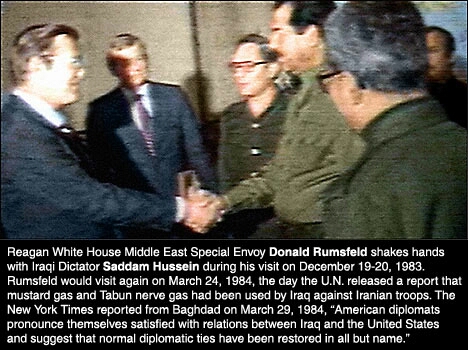
OK, I'll answer both your posts here. Firstly the number of people Saddam killed. However you break the number down, the vast majority of the people he killed including the genocide against the kurds at Halabja were from when he seized power until the beginning of the Gulf War, a period during which we supported him the whole time. So don't you think it's hypocritical of war supporters to use those deaths as a reason to invade Iraq when America supported and armed Saddam during the preiod when most of those deaths occurred.
Secondly the WMD thing. A press release by the DOD from during the Iraq war period is meaningless. What they actually found were a bunch of old artillery shells from the Iran-Iraq war. These shells were battlefield munitions, limited to a specific area and weren't very effective when they asctually were used twenty years before they were found. Saddam's chemical weapons had a shelf life of a few days at best so they were completely useless decades after they were made. Useless battlefield munitions can only be described as WMD if you've come up with nothing and are desperate to back up your original claims, which is something you and the DOD have in common here.
Here are some links for you :
The U.S. Defense Departments Militarily Critical Technologies List (MCTL) is a detailed compendium of technologies" that the department advocates as critical to maintaining superior US military capabilities. It applies to all mission areas, especially counter-proliferation. Written in 1998, it was recently re-published with updates for 2002.
So what is the MCTLs opinion of Iraq's chemical weapons program? In making its chemical nerve agents, The Iraqis . . . produce[d] a . . . mixture which was inherently unstable, says the report. When the Iraqis produced chemical munitions they appeared to adhere to a make and use regimen. Judging by the information Iraq gave the United Nations, later verified by on-site inspections, Iraq had poor product quality for their nerve agents. This low quality was likely due to a lack of purification. They had to get the agent to the front promptly or have it degrade in the munition.
Furthermore, says this Defense Department report, The chemical munitions found in Iraq after the [first] Gulf War contained badly deteriorated agents and a significant proportion were visibly leaking. The shelf life of these poorly made agents were said to be a few weeks at best -- hardly the stuff of vast chemical weapons stores.
There was some talk shortly before the first Gulf War that the Iraqis had been creating binary chemical weapons, in which the relatively non-toxic ingredients of the agent remain unmixed until just before the weapon is used; this allows the user to bypass any worry about shelf life or toxicity. But according to the MCTL, The Iraqis had a small number of bastardized binary munitions in which some unfortunate individual was to pour one ingredient into the other from a Jerry can prior to use -- an action few soldiers were willing to perform.
Lies About Iraq’s Weapons Are Past Expiration Date | | AlterNet
The IAEA team is visiting the Tuwaitha site, which is 50 kilometres (30 miles) south of Baghdad, under close American guard.
The visit was agreed after weeks of pleading by the IAEA, which has kept the radiological materials at the site safely under UN seal for 12 years.
BBC NEWS | Middle East | Missing Iraq uranium 'secured'
At a warehouse about 400 yards outside Tuwaitha, the Marines secured what they called the "Yellow Cake" facility. Named "Location C" by international inspectors, the building had been placed under seal by investigators in 1991 to keep fissionable material from being reused in Iraq's atomic weapons program.
The Marines, who insist they never broke the IAEA's seals, discovered high levels of radioactivity behind an open steel door, where blue barrels of uranium water filled the storeroom.
Fate of Al-Tuwaitha nuclear material unclear - Pittsburgh Tribune-Review
And here's the Bush administration saying the same thing :
MR. FLEISCHER: Well, the IAEA is different. The IAEA is going in, that's the International Atomic Energy --
Q: Right.
MR. FLEISCHER: They're going in to look at the nuclear facility.
Q: Right. Just to make certain that the facility is intact?
MR. FLEISCHER: That's correct. The search for WMD involves biological and chemical, which was not headed by IAEA.
Q: Well, why not have the other agency go in and be able to work without any --
MR. FLEISCHER: Because IAEA is going in to take a look at actual inventoried items that they, themselves, knew precisely where they were, what their status was, because they inventoried them. That wasn't the case with the chemical and biological. What the United Nations concluded about the chemical and biological is he had tons of it -- anthrax, VX, sarin -- but it was not accounted for. They had accounted for these nuclear materials. And that's why the difference.
http://usinfo.state.gov/cgi-bin/was...p;amp;amp;t=/products/washfile/newsitem.shtml