The age of the Earth is irrelevent?
To any discussion of contemporary climate, yes.
Yes, really.
Yes, it is irrelevant.
Yes, that is honestly what I'm saying here. But I suspect you're misunderstanding me. I am not saying that 15-30 years is sufficient to show the entire span of AGW. I am saying that 15-30 years is sufficient to show a change in climate trends.
I have a large collection of graphics and just grabbed the first one that showed temperatures. The graph is actually temperature anomalies color coded to indicate La Nina / El Nino status. The values of the bars ARE mean temperatures, they just aren't using 0C as a baseline.
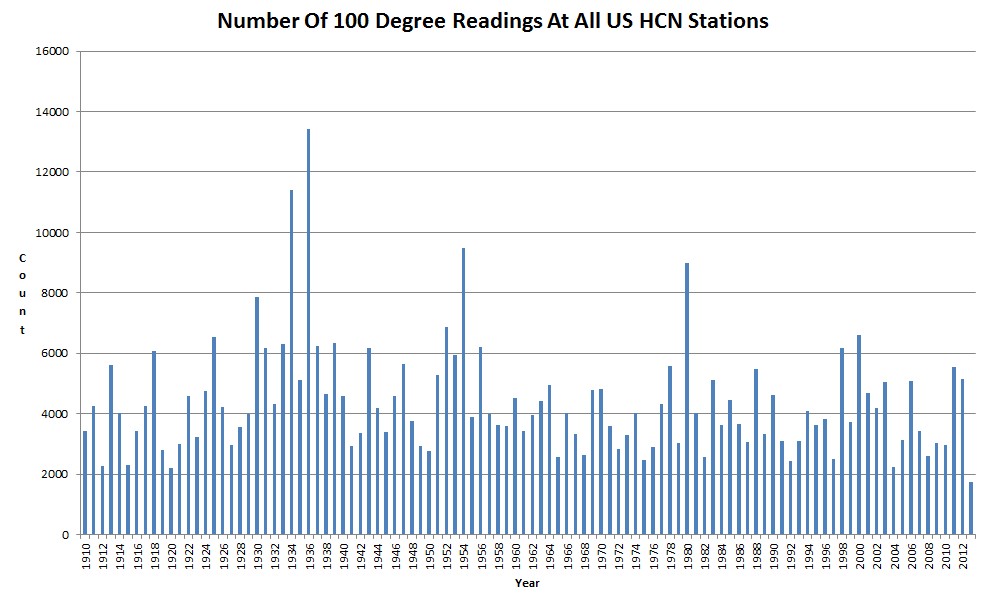
You need to slow down and try to get a better handle on this stuff before you try to jump anyone. The graph I presented far, far more clearly shows mean temperature than does a graph that indicates the number of days in a year that gets over 100F.
Yes.
Now the following quoted paragraphs are from the Wiki link you provided. It includes a brief discussion on ENSO that includes the obligatory tribute to global warming that Wiki writers will insert every time in these articles. But it does appear to be adequately referenced. (I will not take the time to check the references cited.) But at least it was honest enough to admit that there is insufficient data to know much for certain, the computer models are all over the place, and there is a possibility that the Earth's climate will stabilize itself over time as it has done for the entire history of the Earth.
That all needs to be part of the debate too, don't you think?
During the last several decades, the number of El Niño events increased, and the number of La Niña events decreased,[47] although observation of ENSO for much longer is needed to detect robust changes.[48] The question is whether this is a random fluctuation or a normal instance of variation for that phenomenon or the result of global climate changes toward global warming.
The studies of historical data show the recent El Niño variation is most likely linked to global warming. For example, one of the most recent results, even after subtracting the positive influence of decadal variation, is shown to be possibly present in the ENSO trend,[49] the amplitude of the ENSO variability in the observed data still increases, by as much as 60% in the last 50 years.[50]
The exact changes happening to ENSO in the future is uncertain:[51] Different models make different predictions.[52] It may be that the observed phenomenon of more frequent and stronger El Niño events occurs only in the initial phase of the global warming, and then (e.g., after the lower layers of the ocean get warmer, as well), El Niño will become weaker than it was.[53] It may also be that the stabilizing and destabilizing forces influencing the phenomenon will eventually compensate
Whatever you may think, this does not show you to be open minded.
Due to recent research, it is now believed that global warming has altered the historical behavior of the ENSO (El Nino, Southern Oscillation) pseudo cycle. It is this change that has caused warm surface waters to be driven into the deep ocean. It is suggested that this is what has stopped atmospheric and land warming and caused the ocean's temperatures - particularly the deep ocean's - to rise precipitously.
Did you see the graph of global heat content recently posted? It was produced by Nuccitelli and the rest of the gang at Skeptical Science. I think it was PMZ that posted it. I'll try to find it. I thought it resembled the graphs produced by Foster and Rahmstorff showing the global warming signal devoid of aerosol, vulcanism, TSI and ENSO effects.
Until you can identify what caused the temperature trends of the last 150 years, you can't say it's stopped. Do you understand? Westwall and FCT and the rest keep crowing that global warming has stopped, but since they reject AGW, they don't have a cause for the warming in the first place and can only guess that whatever it might have been, it now has stopped. Do you see their problem?