Westwall -
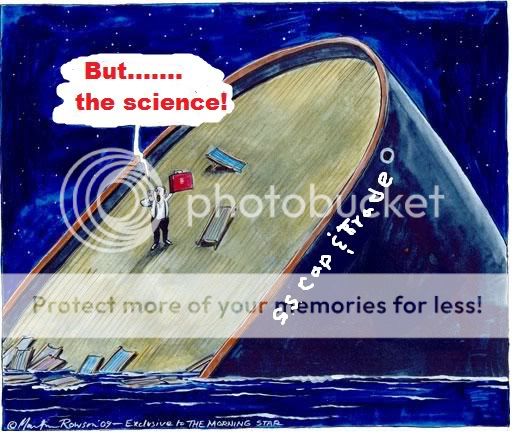
I'll "wake up" when I see climate scpetics present a convincing case.
I find most conspiracy theories (holocaust denial, 9/11 truthers) can ask some powerful questions, but what they utterly unable to do is to present a sound narrative that explains the physical evidence.
When climate sceptics present a case which explains, for instance, why 97% of the worlds glaciers are in retreat, and retreating at what seems to be an ever-increasing pace, plus explanatiosn for melting arctic ice, increased storm patterns, desertification etc - I'll absolutely look at it.
I strongly doubt we'll ever see such a case presented.
Why wait?
The warming we are now experiencing is occurring at about the same pace today as it has for the last 400 or so years. This predates the Industrial Revolution which you cite as the cause of the warming.
The warming started before the cause you cite and so the cause you cite, while it might be contributor to the array of causes, is not the prime cause.
The reason climate science is political is that charlatans are trying to produce the effect of picking the pockets of the citizenry. They are using as the cause the rise of CO2.
Like the warming itself, the pocket picking was also occurring before this cause was invented.
When you can explain why the warming started in the first place, you will have gone a long way in explaining why it is continuing today.
http://www.globalwarmingart.com/images/c/c1/2000_Year_Temperature_Comparison.png
This link takes you to the graph of proxies of temperature increase. The research to develop this graph was done by these folks:
Reconstructions
The reconstructions used, in order from oldest to most recent publication are:
(dark blue 1000-1991):
[abstract] [DOI] Jones, P.D., K.R. Briffa, T.P. Barnett, and S.F.B. Tett (1998). "High-resolution Palaeoclimatic Records for the last Millennium: Interpretation, Integration and Comparison with General Circulation Model Control-run Temperatures". The Holocene 8: 455-471.
(blue 1000-1980):
[abstract] [full text] Mann, M.E., R.S. Bradley, and M.K. Hughes (1999). "Northern Hemisphere Temperatures During the Past Millennium: Inferences, Uncertainties, and Limitations". Geophysical Research Letters 26 (6): 759-762.
(light blue 1000-1965):
[abstract] Crowley, Thomas J. and Thomas S. Lowery (2000). "Northern Hemisphere Temperature Reconstruction". Ambio 29: 51-54. ; Modified as published in [abstract] [DOI] Crowley (2000). "Causes of Climate Change Over the Past 1000 Years". Science 289: 270-277.
(lightest blue 1402-1960):
[abstract] [DOI] Briffa, K.R., T.J. Osborn, F.H. Schweingruber, I.C. Harris, P.D. Jones, S.G. Shiyatov, and E.A. Vaganov (2001). "Low-frequency temperature variations from a northern tree-ring density network". J. Geophys. Res. 106: 2929-2941.
(light green 831-1992):
[abstract] [DOI] Esper, J., E.R. Cook, and F.H. Schweingruber (2002). "Low-Frequency Signals in Long Tree-Ring Chronologies for Reconstructing Past Temperature Variability". Science 295 (5563): 2250-2253.
(yellow 200-1980):
[abstract] [full text] [DOI] Mann, M.E. and P.D. Jones (2003). "Global Surface Temperatures over the Past Two Millennia". Geophysical Research Letters 30 (15): 1820.
(orange 200-1995):
[abstract] [full text] [DOI] Jones, P.D. and M.E. Mann (2004). "Climate Over Past Millennia". Reviews of Geophysics 42: RG2002.
(red-orange 1500-1980):
[abstract] [DOI] Huang, S. (2004). "Merging Information from Different Resources for New Insights into Climate Change in the Past and Future". Geophys. Res Lett. 31: L13205.
(red 1-1979):
[abstract] [full text] [DOI] Moberg, A., D.M. Sonechkin, K. Holmgren, N.M. Datsenko and W. Karlén (2005). "Highly variable Northern Hemisphere temperatures reconstructed from low- and high-resolution proxy data". Nature 443: 613-617.
(dark red 1600-1990):
[abstract] [DOI] Oerlemans, J.H. (2005). "Extracting a Climate Signal from 169 Glacier Records". Science 308: 675-677.
(black 1856-2004): Instrumental data was jointly compiled by the Climatic Research Unit and the UK Meteorological Office Hadley Centre. Global Annual Average data set TaveGL2v was used. Documentation for the most recent update of the CRU/Hadley instrumental data set appears in:
[abstract] Jones, P.D. and A. Moberg (2003). "Hemispheric and large-scale surface air temperature variations: An extensive revision and an update to 2001". Journal of Climate 16: 206-223.
This group of folks belongs to a larger group known as scientists. Presenting data is what scientists do. Picking pockets is what politicians do.




 You know these mental cases are just the most miserable mofu's on the planet.


