Goodie, ALEC says so *shaking head*
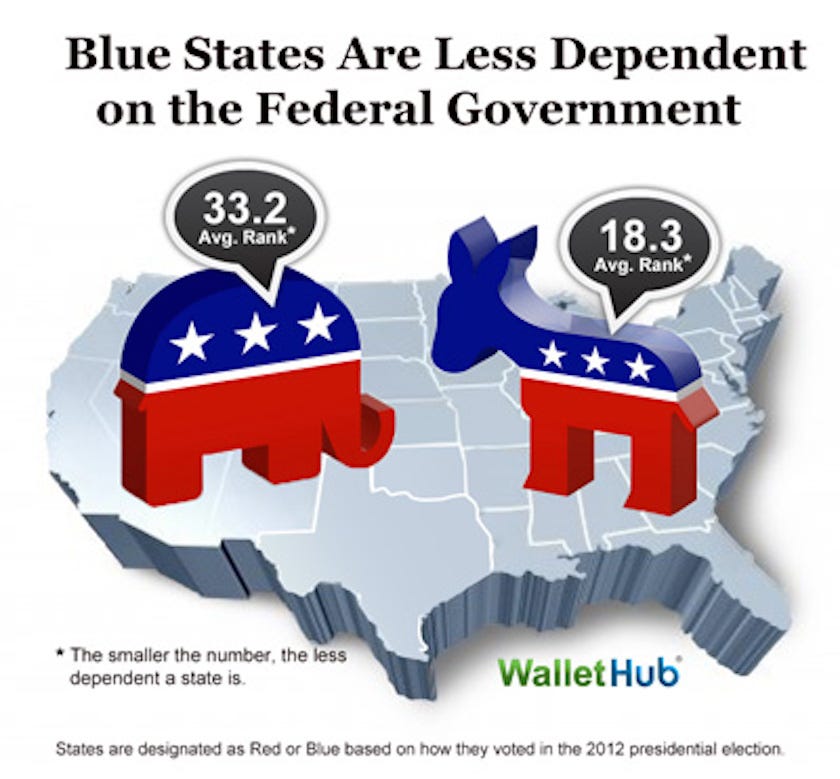
The states most dependent on the federal government are who you'd least expect
Red states more dependent on federal government - Business Insider
Moocher Red States Still Don’t Want Free Healthcare Money With Obama’s Name On It
Five years after passage of the Affordable Care Act, some red states are still debating, or outright refusing, free money
because they just really REALLY hate President Obama:
Twenty-four states and the District of Columbia said yes to Medicaid expansion when the law went into effect. Since then, just six more have signed on. States that say yes get billions of additional federal dollars, but many Republican lawmakers are loathe to say yes to the Obama administration.
The expansion enables adults with incomes up to 138% of the poverty level to receive Medicaid. The federal government picks up the whole tab for their care through 2016, then tapers its support down to 90% of the costs.
It would be HI-larious, if the consequences weren’t so severe and even fatal,
that states who’ve happily sucked off the government teat for years are all of a sudden uninterested in federal dollars for poor people to be able to go to the doctor.
Moocher Red States Still Don’t Want Free Healthcare Money With Obama’s Name On It
There NEVER was a health care crisis as there NEVER were 46 million uninsured Americans just as there never were 155 million americans with Pre-existing conditions that prevented them from getting health insurance.
There IS a plan to destroy 1,400 companies that pay $100 billion a year in taxes and putting 450,000 people out of work!
This from the person that KNEW that fools like you could be easily swayed by falsehoods!
So much so Obama TOLD you he was fooling you and he even hired a guy who said people like you make up the "Stupidity of American Voter" to pass Obamacare!
NOW for the FACTS supporting these above STATEMENTS!
Obama once said:
“I don’t have to explain to you that nearly 46 million Americans don’t have health insurance coverage today. In the wealthiest nation on Earth, 46 million of our fellow citizens have no coverage.”
Even Obama admitted 10 million were illegals not eligible so he AFTER he repeated the above lie and when ACA passed HE said there were 36 million!
1) 10 million Obama counted were not Americans... not citizens per the Census:
Proof:
Income, Poverty and Health Insurance Coverage in the United States: 2009 - Income & Wealth - Newsroom - U.S. Census Bureau
2) Obama failed to get 14 million people eligible for Medicaid enrolled. That's all that is needed. That leaves 22 million.
http://coverageforall.org/pdf/BC-BS_Uninsured-America.pdf
3) 18 million under 34 don't NEED insurance. Can afford employers' plans as they make over $50k. That leaves 4 million.
CRISIS OF THE UNINSURED: 2009
There have never been 46 million UNINSURED AMERICANS but less then 4 million!
Obama has said "I prefer a single payer health care system". Well logic would state "single payer" means no other PAYERS!
So what happens to the 1,400 insurance companies?
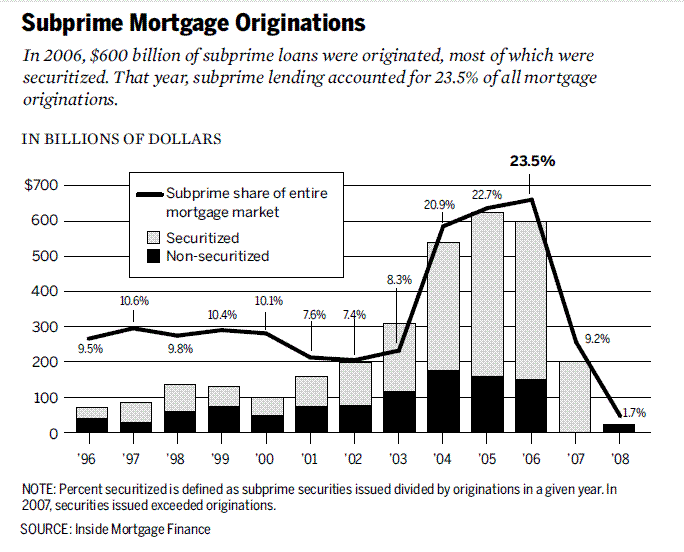
Bubba, I'm TIRED of spanking YOU and your bullshit right wing memes. Until you man up on Dubya's subprime bubble, go fuk yourself!
So your ignorant selective editing LEFT OUT these MAJOR CLINTON contributors to the housing bubble crash!
HEY did you know YOUR link
HUD Scandals Shows this:
The Cisneros Years, 1993–1997
In the Clinton administration, a primary mission of HUD was to increase home ownership rates, especially among minorities and low-income families.
That mission was carried out through HUD subsidy programs and through the two government-connected mortgage finance giants, Fannie Mae and Freddie Mac. In 1992, HUD was given regulatory authority over these government-sponsored enterprises, and it began pushing the two firms into the subprime lending business.
We now know that these political decisions on housing that were made in the 1990s helped fuel the housing bubble and subsequent crash in the early 21st century, so it is worth looking into the leadership of HUD during those years.
Henry Cisneros served as President Bill Clinton's HUD secretary from 1993 to 1997, when he resigned to deal with allegations that he lied to the FBI about payments he made to a former mistress. Cisneros plead guilty in 1999 and was fined $10,000, avoiding a possible prison sentence.
A key weapon in the Cisneros arsenal was the Clinton administration's changes to the Community Reinvestment Act. The CRA was passed in 1977 and updated in 1995 to pressure lenders into making more loans to moderate-income borrowers by allowing regulators to deny merger approvals for banks with low CRA ratings. Even complaints brought by activists, such as the leftist group ACORN, were now counted against a bank's CRA rating. The result was that banks began issuing more loans to otherwise uncreditworthy borrowers while purchasing more CRA mortgage-backed securities.28 As housing finance expert Peter Wallison noted, "The most important fact associated with the CRA is the effort to reduce underwriting standards. … Once those standards were relaxed … they spread rapidly to the prime market and to subprime markets where loans were made by lenders other than insured banks."29 -
The Cuomo Years, 1997-2001
During the Cuomo years, mortgage industry officials and housing advocates wanted Fannie Mae and Freddie Mac to purchase higher volumes of riskier loans that were offered to less credit-worthy borrowers.
Cuomo's HUD continued to pressure Fannie and Freddie to increase the portion of their portfolios consisting of loans to moderate-income borrowers.
Cuomo applied pressure by having HUD publicly "investigate" whether Fannie and Freddie were sufficiently in compliance with government fair-lending standards designed to prevent discrimination.
Cuomo also supported efforts to have home sellers funnel money to nonprofit groups to help pay for buyers' down payments and closing costs. These "down payment assistance" loans ended up having default rates twice that of standard FHA-insured mortgages.51 Cuomo portrayed his efforts as helping to increase homeownership rates for minorities, but he also had an interest in not upsetting mortgage industry officials who would later help finance his gubernatorial campaign.
He also worked hard to receive support from leftist housing advocate groups, such as ACORN.
We know now that Fannie and Freddie's expansion into low-quality mortgages was a huge mistake. A decade ago, numerous financial analysts saw the problems coming, but policymakers ignored their concerns and did not change their policy course. Here is a prescient observation by a New York Times reporter in 1999:
In moving, even tentatively, into this new area of lending, Fannie Mae is taking on significantly more risk, which may not pose any difficulties during flush economic times. But the government-subsidized corporation may run into trouble in an economic downturn, prompting a government rescue similar to that of the savings and loan industry in the 1980s.54
Unfortunately, the housing and financial debacles of 2008 and 2009 were far larger than the savings and loan mess. But with Cuomo, fiscally prudent policies took a backseat to his political aspirations.
See more at:
HUD Scandals
It’s true that key Democrats opposed the
Federal Housing Enterprise Regulatory Reform Act of 2005, which would have established a single, independent regulatory body with jurisdiction over Fannie and Freddie – a move that the Government Accountability Office had recommended in a
2004 report. Current House Banking Committee chairman Rep. Barney Frank of Massachusetts
opposed legislation to reorganize oversight in 2000 (when Clinton was still president), 2003 and 2004, saying of the 2000 legislation that concern about Fannie and Freddie was "overblown." Just last summer, Senate Banking Committee chairman Chris Dodd
called a Bush proposal for an independent agency to regulate the two entities "ill-advised."
Now here is factcheck.org on the assignment of blame INCLUDING Bush
Here’s a partial list of those alleged to be at fault:
- The Federal Reserve, which slashed interest rates after the dot-com bubble burst, making credit cheap.
- Home buyers, who took advantage of easy credit to bid up the prices of homes excessively.
- Congress, which continues to support a mortgage tax deduction that gives consumers a tax incentive to buy more expensive houses.
- Real estate agents, most of whom work for the sellers rather than the buyers and who earned higher commissions from selling more expensive homes.
- The Clinton administration, which pushed for less stringent credit and downpayment requirements for working- and middle-class families.
- Mortgage brokers, who offered less-credit-worthy home buyers subprime, adjustable rate loans with low initial payments, but exploding interest rates.
- Former Federal Reserve chairman Alan Greenspan, who in 2004, near the peak of the housing bubble, encouraged Americans to take out adjustable rate mortgages.
- Wall Street firms, who paid too little attention to the quality of the risky loans that they bundled into Mortgage Backed Securities (MBS), and issued bonds using those securities as collateral.
- The Bush administration, which failed to provide needed government oversight of the increasingly dicey mortgage-backed securities market.
- An obscure accounting rule called mark-to-market, which can have the paradoxical result of making assets be worth less on paper than they are in reality during times of panic.
- Collective delusion, or a belief on the part of all parties that home prices would keep rising forever, no matter how high or how fast they had already gone up.
Who Caused the Economic Crisis?
NOW that I've agreed Bush as well as all the above were to blame does that meet your totally biased dishonest opinion?