Who Are The Palestinians?

Status
Not open for further replies.
"Cubana de Aviación Flight 455 was a Cuban flight from Barbados to Jamaica that was brought down on October 6, 1976 by a bomb attack. All 73 people on board the Douglas DC-8 aircraft were killed. Two time bombs were used, variously described as dynamite or C-4.

Several CIA-linked anti-Castro Cuban exiles and members of the Venezuelan secret police DISIP were implicated by the evidence. Political complications quickly arose when Cuba accused the US government of being an accomplice to the attack. CIA documents released in 2005 indicate that the agency "had concrete advance intelligence, as early as June 1976, on plans by Cuban exile terrorist groups to bomb a Cubana airliner." Former CIA terrorist operative Luis Posada Carriles denies involvement but provides many details of the incident in his book Caminos del Guerrero (Way of the Warrior).[1][2]

Four men were arrested in connection with the bombing, and a trial was held in Venezuela. Freddy Lugo and Hernán Ricardo Lozano were each sentenced to 20-year prison terms. Orlando Bosch was acquitted and later moved to Miami, Florida, where he lived until his death on April 27, 2011. Luis Posada Carriles was held for eight years while awaiting a final sentence but eventually fled. He later entered the United States, where he was held on charges of entering the country illegally, but was released on April 19, 2007...Among the dead were all 24 members of the 1975 national Cuban fencing team that had just won all the gold medals in the Central American and Caribbean Championships; many were teenagers. Several officials of the Cuban government were also aboard the plane.

http://en.wikipedia.org/wiki/Cubana_de_Aviación_Flight_455


Several officials of the Cuban government were also aboard the plane.

So the targets were the Cuban Gov officials?? The same ones who ordered the murder and torture of thousands of Cubans??

Greg
 
Sirhan Bishara Sirhan (Arabic: سرحان بشارة سرحان‎, Sirḥān Bishārah Sirḥān; born March 19, 1944) is a Palestinian of Jordanian citizenship who was convicted of the 1968 assassination of United States Senator Robert F. Kennedy. He is currently serving a life sentence at the Richard J. Donovan Correctional Facility in San Diego County, California.

Sirhan was born in British-ruled Jerusalem and is a strong opponent of Israel. In 1989, he told David Frost, "My only connection with Robert Kennedy was his sole support of Israel and his deliberate attempt to send those 50 bombers to Israel to obviously do harm to the Palestinians."[1] Some scholars believe that the assassination was the first major incident of political violence in the United States stemming from the Arab–Israeli conflict in the Middle East.[2]

Killing a US President in waiting didn't get the chair?? Now that's CHARITY!!!

PLUS!!!

Understanding RFK s assassination as Palestinian terror - Blogs - Jerusalem Post


The USA was attacked and it's most wonderful future murdered by a Pal terrorist!!! It's only natural that all anti-Americans support the terrorists in Palestine!!

Greg
 
Sirhan Bishara Sirhan (Arabic: سرحان بشارة سرحان‎, Sirḥān Bishārah Sirḥān; born March 19, 1944) is a Palestinian of Jordanian citizenship who was convicted of the 1968 assassination of United States Senator Robert F. Kennedy. He is currently serving a life sentence at the Richard J. Donovan Correctional Facility in San Diego County, California.

Sirhan was born in British-ruled Jerusalem and is a strong opponent of Israel. In 1989, he told David Frost, "My only connection with Robert Kennedy was his sole support of Israel and his deliberate attempt to send those 50 bombers to Israel to obviously do harm to the Palestinians."[1] Some scholars believe that the assassination was the first major incident of political violence in the United States stemming from the Arab–Israeli conflict in the Middle East.[2]

Killing a US President in waiting didn't get the chair?? Now that's CHARITY!!!

PLUS!!!

Understanding RFK s assassination as Palestinian terror - Blogs - Jerusalem Post


The USA was attacked and it's most wonderful future murdered by a Pal terrorist!!! It's only natural that all anti-Americans support the terrorists in Palestine!!

Greg

So true that enemies of Israel are also enemies of the USA.
 
Joan Peters passed away today. Her book should be a must read but there are some points that are in question. Overall the book brings a well researched perspective of the situation. Like everything written about the middle east, you should do your own research and read what others say with a pinch of salt, especially things with a strong perspective. Facts might be correct but opinions from both sides usually are somewhere in the middle. Either way the book should be a staple for anyone interested in the situation. I used to have quite the library that I used for reference, Peter's book was just one among them. When the book came out there was quite the discussion about it.

From Time ImmemorialThe Origins of the Arab-Jewish Conflict Over Palestine
danielpipes.org/1110/from-time-immemorial

by Joan Peters
Reviewed by Daniel Pipes
Commentary
July 1984


Joan Peters began this book planning to write about the Arabs who fled Palestine in 1948-49, when armies of the Arab states attempted to destroy the fledgling state of Israel. In the course of research on this subject, she came across a "seemingly casual" discrepancy between the standard definition of a refugee and the definition used for the Palestinian Arabs. In other cases, a refugee is someone forced to leave a permanent or habitual home. In this case, however, it is someone who had lived in Palestine for just two years before the flight that began in 1948.


This discrepancy made little impression on her at first, Miss Peters recounts. But as she continued, the anomaly of the Palestinians "began to nag and unravel" the outline of her book. Why a separate definition for the Palestinians? What was it about them that had to be incorporated in the official description of eligibility for refugee status? Reading historical materials about Palestine in the years before 1948, Miss Peters came across a statement by Winston Churchill that she says opened her eyes to the situation in Palestine. In 1939 Churchill challenged the common notion that Jewish immigration into Palestine had uprooted its Arab residents. To the contrary, according to him, "So far from being persecuted, the Arabs have crowded into the country and multiplied till their population has increased more than even all world Jewry could lift up the Jewish population."


Arabs crowded into Palestine? As Miss Peters pursued this angle she found a fund of obscure information that confirmed Churchill's observation. Drawing on census statistics and a great number of contemporary accounts, she pieced together the dimensions of Arab immigration into Palestine before 1948. Although others have noted this phenomenon, she is the first to document it, to attempt to quantify it, and to draw conclusions from it. Her historical detective work has produced startling results, which should materially influence the future course of the debate about the Palestinian problem.

Before entering into the statistics and reports Miss Peters uses to put forward her argument, however, I should enter a word of caution about From Time Immemorial. The author is not a historian or someone practiced in writing on politics, and she tends to let her passions carry her away. As a result, the book suffers from chaotic presentation and an excess of partisanship, faults which seriously mar its impact. But they do not diminish the importance of the facts presented. Despite its drawbacks. From Time Immemorial contains a wealth of information, which is well worth the effort to uncover.
Making use of work done by Kemal Karpat in the Ottoman records, Miss Peters ascertains the non-Jewish population in 1893 of the area that would later form Palestine under the British Mandate. She then divides this area into three parts: one without Jewish settlement, one with light Jewish settlement, and one with heavy Jewish settlement. She compares the non-Jewish population of each of these parts in 1893 and 1947, on the eve of Israel's independence. In the area of no Jewish settlement, the non-Jewish population stood in 1893 at 337,200; in 1947 it was 730,000, a growth of 116 percent. In the area of light Jewish settlement, the non-Jewish population grew in the same period from 38,900 to 110,900 or 185 percent. Finally, in the area of heavy Jewish settlement, the non-Jewish population grew from 92,300 in 1893 to 462,000 in 1947—or 401 percent. From these figures Miss Peters concludes that "the Arab population appears to have increased in direct proportion to the Jewish presence."


The great variance in the figures usually gets obscured because the three regions are lumped together and counted as a single unit. Population in the whole area of Mandatory Palestine grew 178 percent in fifty-four years. This increase can be accounted for through natural reproduction alone; it therefore raises few questions. But 401 percent cannot be explained in this way, much less the vast difference in growth rates among the three divisions.


How, then, to account for the varying rates? By the movement of peoples. Although the Jews alone moved to Palestine for ideological reasons, they were not alone in emigrating there. Arabs joined them in large numbers, from the first aliyah in 1882 to the creation of Israel in 1948. "The Arabs were moving into the very areas where Jewish settlement had preceded them and was luring them." Arab immigration received much less attention because both the Turkish and British administrators (before and after 1917, respectively) took little interest in them. Under the latter, for instance, "there was not even a serious gauge for considering the incidence of Arab immigration into Palestine." The return of Zionists to the land of their ancestors was a topic of nearly universal fascination, both positive and negative. Arabs crossing newly-established and artificial boundaries caught no one's interest.


As a result, officials in Palestine counted only a small percentage of the Arab immigrants. British records for 1934 show only 1,734 non-Jews as legal immigrants and about 3,000 as illegals. Yet, according to a newspaper interview in August 1934 with the governor of the Hauran district in Syria, "In the last few months from 30,000 to 36,000 Hauranese had entered Palestine and settled there." In 1947, British officials had counted only 37,000 Arabs as the aggregate of non-Jewish immigrants in Palestine since 1917—hardly more than had come from one district of Syria in less than one year alone.


Non-Jewish immigrants came from all parts of the Middle East, including Turkey, Syria, Iraq, Lebanon, Transjordan (as Jordan was once known), Saudi Arabia, the Yemens, Egypt, Sudan, and Libya. Thanks to British unconcern, Arab immigrants were generally left alone and allowed to settle in Mandatory Palestine. So many Arabs came, Miss Peters estimates, that "if all those Jews and all those Arabs who arrived in ... Palestine between 1893 and 1948 had remained, and if they were forced to leave now, a dual exodus of at least equal proportion would in all probability take place. Palestine would be depopulated once again."


Some British administrators complained about the laxness toward Arab immigration, but to little avail. The author devotes sixteen pages to the memoranda sent in the latter part of 1937 by the British consul in Damascus, Colonel Gilbert MacKereth, in which he urges a more effective patrolling of Palestine's borders. MacKereth failed in this because British concern with immigration remained always focused on the Jews.


What took hundreds of thousands of Arabs to Palestine? Economic opportunity. The Zionists brought the skills and resources of Europe. Like other Europeans settling scarcely populated areas in recent times—in Australia, Southern Africa, or the American West—the Jews in Palestine initiated economic activities that created jobs and wealth on a level far beyond that of the indigenous peoples. In response, large numbers of Arabs moved toward the settlers to find employment.


The conventional picture has it that Jewish immigrants bought up Arab properties, forcing the former owners into unemployment. Miss Peters argues exactly the contrary, that the Jews created new opportunities, which attracted emigrants from distant places. To the extent that there was unemployment among the Arabs, it was mostly among the recent arrivals.


This reversal of the usual interpretation implies a wholly different way of seeing the Arab position in Mandatory Palestine. As C. S.Jarvis, governor of the Sinai in 1923-36, [DP: this corrects the 1984 text, which wrongly ascribed the following quote to Winston Churchill] observed, "It is very difficult to make a case out for the misery of the Arabs if at the same time their compatriots from adjoining states could not be kept from going in to share that misery." The data unearthed by Joan Peters indicate that Arabs benefited economically so much by the presence of Jewish settlers from Europe that they traveled hundreds of miles to get closer to them.


In turn, this explains why the definition of a refugee from Palestine in 1948 is a person who lived there for just two years: because many Arab residents in 1948 had immigrated so recently. The usual definition would have cut out a substantial portion of the persons who later claimed to be refugees from Palestine.


Thus, the "Palestinian problem" lacks firm grounding. Many of those who now consider themselves Palestinian refugees were either immigrants themselves before 1948 or the children of immigrants. This historical fact reduces their claim to the land of Israel; it also reinforces the point that the real problem in the Middle East has little to do with Palestinian-Arab rights.


Letter to the Editor
by Daniel Pipes
New York Review of Books
March 27, 1986


Joan Peters, author of "From Time Immemorial."

Joan Peters's From Time Immemorial has, broadly speaking, been received in two ways at two times. Early reviews treated her book as a serious contribution to the study of the Arab-Israeli conflict and late ones dismissed it as propaganda. Coming almost two years after the book's publication, Professor Yehoshua Porath's review in your January 16, 1986 issue probably closes the second round. As one of those who reviewed the book when it first appeared—and who was referred to for this reason in Professor Porath's review—I should at this time like to comment on the debate.
The difference between the two rounds is not hard to explain. Most early reviewers, including myself, focused on the substance of Miss Peters's central thesis; the later reviewers, in contrast, emphasized the faults—technical, historical, and literary—in Miss Peters's book.


I would not dispute the existence of those faults. From Time Immemorial quotes carelessly, uses statistics sloppily, and ignores inconvenient facts. Much of the book is irrelevant to Miss Peters's central thesis. The author's linguistic and scholarly abilities are open to question. Excessive use of quotation marks, eccentric footnotes, and a polemical, somewhat hysterical undertone mar the book. In short, From Time Immemorial stands out as an appallingly crafted book.


Granting all this, the fact remains that the book presents a thesis that neither Professor Porath nor any other reviewer has so far succeeded in refuting. Miss Peters's central thesis is that a substantial immigration of Arabs to Palestine took place during the first half of the twentieth century. She supports this argument with an array of demographic statistics and contemporary accounts, the bulk of which have not been questioned by any reviewer, including Professor Porath.


Nonetheless, Professor Porath dismisses her argument as "fanciful." He says that "the main reason" for Arab population growth is that Arab births remained steady while infant mortality decreased. He concludes that the movement of population was not significant in comparison with natural increase.


Now, there can be no question that improvements in medical conditions contributed to the increase in Arab population. But it is not immediately clear that declining infant mortality was more important than immigration. Professor Porath asserts this but he does not provide the evidence necessary to convince a reader.


The disproof of Miss Peters's thesis requires a detailed inquiry into birth and death records, immigration and emigration registers, employment rolls, nomadic settlement patterns, and so forth. She may be wrong; but this will be proven only when another researcher goes through the evidence and shows that immigration was unimportant. The existence or absence of large-scale Arab immigration to Palestine has nothing to do, of course, with Miss Peters's motives or the obvious short-comings of her book. The facts about population change will not be established by heaping scorn on Miss Peters, only by going back to the archives.


Faulty presentation notwithstanding, Miss Peters's hypothesis is on the table; it is incumbent on her critics to cease the name-calling and make a serious effort to show her wrong by demonstrating that many thousands of Arabs did not emigrate to Palestine in the period under question.


Until such happens, what is one to think? Is there reason to accept Miss Peters's version of events? I believe so: even though From Time Immemorial does not place Arab immigration to Palestine in a historical context, it is not hard to find a rationale for their movement. The Arabs who went to Palestine sought economic opportunity created by the Zionists. As Europeans, the Zionists brought with them to Palestine resources and skills far in advance of anything possessed by the local population. Jews initiated advanced economic activities that created jobs and wealth and drew Arabs. Zionists resembled the British, Germans, and other Europeans of modern times who settled in sparsely populated areas—Australia, southern Africa, or the American West—and then attracted the indigenous people to themselves.


There is really nothing surprising in all this; and because it makes such good sense, I put credence in the argument that substantial numbers of Arabs moved to Palestine. I will adjust my views, of course, should compelling evidence be found to show otherwise. But this will require that Miss Peters's critics go beyond polemics and actually prove her thesis wrong.


Jan. 1, 2003 update: For a slimmed-down and more reliable version of the Peters' thesis, see Fred M. Gottheil, "The Smoking Gun: Arab Immigration into Palestine, 1922-1931," Middle East Quarterly, Winter 2003.


Belated mention should also be made of the important study by Aryeh L. Avneri, The Claim of Dispossession: Jewish land-Settlement and the Arabs, 1878-1948. First published in Hebrew in 1980, it appeared in English translation from Transaction Books in 1984, the same years as Peters' analysis.


Aug. 20, 2009 update: In "The lost Palestinian Jews," David Shamah of the Jerusalem Post tells about the unlikel work of Tsvi Misinai. In sum:


After years of research, Misinai says that he can declare with certainty that nearly 90 percent of all Palestinians are descended from the Jews. "And what's more, about half of them know it," he says.


For details, read the fascinating article.


June 7, 2011 update: David P. Goldman notes in "Israel, Ireland and the peace of the aging" that the pattern of Arabs huddling for economic reasons with Jews continues as much as ever:


5,800 Palestinians are working at technology companies on the West Bank, and the booming Israeli software sector is outsourcing to the West Bank, with a third of Palestinian software companies filling orders for Israeli firms, Bloomberg News reported March 15.


And the top school for Palestinian computer science students is Ariel University in Samaria, in the midst of a settlement near Nablus. "Administrators at the Ariel University Center are proud to have the Arab students, saying their enrollment is an example of loyalty and equality among Israeli citizens. For their part, the Arab students seem not to feel uncomfortable attending the college despite its reputation and location," wrote the Chronicle of Higher Education.


"On campus the fact that we are in occupied territory is irrelevant - it doesn't affect us at all. We leave all the politics outside," the Chronicle quoted Manar Dewany, a 20-year-old student in math and computer science who commutes each day from the Israeli Arab town of Taybeh. "I never even considered it a reason for not coming here," Ms Dewany added. "I have no problem with it. Why not come here? This place is full of Arabs."


No one outsources computer technology to Egypt, where very few of each year's crop of 700,000 college graduates meets world standards. The education that young Arabs receive at the settlers' university on the West Bank is better than anything available among Israel's Arab neighbors. In a quiet way, the settlers of Samaria may do more for peace than the diplomats.


Apr. 1, 2013 update: A Ḥamas leader, Fathi Ḥammad, said on March 23, 2012, that "half of the Palestinians are Egyptian and the other half are Saudis," providing Gideon M. Kressel and the late Reuven Aharoni with a proof text for their brave and original study, Egyptian Émigrés in the Levant of the 19th and 20th Centuries. In it, they establish that many "Palestinians" in fact came from Egypt. Indeed, "the Egyptian population is a very large component that, relatively speaking, only recently arrived in Palestine."
 
Mindful, P F Tinmore, et al,

It is merely a territorial reference name; ---- its meaning buried in the context of the historical association.

(COMMENT)

The entire basis of the discussion is about the historical connection established. The question of --- "Who are the Palestinians" --- is an argument that has little or no bearing on the issues of the day. Who they are today, is defined by what they manage to control today (which is a deeper question - that may have an answer that they are not proud of). In the 20th century, we've seen two dozen Empires and Dynasties change; one of which was the Ottoman Empire --- the origins of which can be traced back to the late 11th century and the Turkic Emirates of Anatolian Beyliks. At the turn of the 19th-to-20th Century, much of what we call "Palestine" today was under the administration of the Mutasarrifate of Jerusalem --- a Sanjak within the Syria Vilayet [(Damsacus) of the Ottoman Empire]. There was no political subdivision known as "Palestine" with the Ottoman Empire --- not for 500 years. "Palestine" was a "regional" name denoting the administrative divisions covered by the Sanjak of Nablus, Sanjak of Acre, and the Mutasarrfate of Jerusalem (Special Ottoman District). (Note: This is historically why today, both the State of Israel (circa 1967) and the State of Palestine (circa 1988) each claim Jerusalem as their respective capitals.)
Mutasarrifate of Jerusalem

The Mutasarrifate of Jerusalem (Ottoman Turkish: Kudüs-i Şerif Mutasarrıflığı; Arabic: متصرفية القدس الشريف‎), also known as the Sanjak of Jerusalem was an Ottoman district with special administrative status established in 1872. The district encompassed Jerusalem as well as the other major cities of Gaza, Jaffa, Hebron, Bethlehem and Beersheba. During the late Ottoman period, the Mutasarrifate of Jerusalem, together with the Sanjak of Nablus and Sanjak of Acre, formed the region that was commonly referred to as "Southern Syria" or "Palestine".​

The pro-Jihadists that wish to turn the question into an argument over the sovereign rights to the territory are merely attempting to grasp at straws to suggest there is a moral and historical obligation to recognize the Palestinians as a people and a nation. It has nothing to do with the evolution over time of the territorial control over the land parcel. Historically, there are very - very - few territories in the world that have not undergone an evolutionary change in sovereignty and the complexion of governmental control. The area, formerly known as the territory under the Mandate for Palestine, is a land parcel that has changed sovereign control many - many times.

Today, we are discussing the consequences to the evolution of territorial control in the last half century (since 1948). While I find it interesting at how some might re-interpret the historical connections, it has nothing to do with the evolution as viewed today in terms of recognition of sovereignty and control. No matter how the contemporary Palestinian might view history, or whether they recognize the legitimacy of the State of Israel --- it exists.

The issue of the day is not whether there is a historical connection --- it is not a matter of recognition --- it is not a matter of legitimacy... It is a matter of reestablishing regional peace and the neutralization of radical Islamic influences and Jihadist activity.

Most Respectfully,
R
Palestine is Palestine by law. Its international borders were defined by post war treaties.

Palestinians are Palestinians by law.
-----------------
Drawing up the framework of nationality, Article 30 of the Treaty of Lausanne stated:
“Turkish subjects habitually resident in territory which in accordance with the provisions of the present Treaty is detached from Turkey will become ipso facto, in the conditions laid down by the local law, nationals of the State to which such territory is transferred.”​

The automatic, ipso facto, change from Ottoman to Palestinian nationality was dealt with in Article 1, paragraph 1, of the Citizenship Order, which declared:
“Turkish subjects habitually resident in the territory of Palestine upon the 1st day of August, 1925, shall become Palestinian citizens.”​


The only borders are those of the MANDATE FOR PALESTINE, not the nation of Palestine. This falls at the first hurdle of any court if used to claim Palestine as a nation existed before 1988.

WRONG again as they became BRITISH Palestinian citizens, an interim measure to allow them to travel freely on valid passports and have valid I.D. papers.

As your first paragraph states " nationals of the state to which territory is transferred" this was Britain as no state of Palestine existed until 1988.
Palestine, as the mandate clearly showed, was a subject under international law. While she could not conclude international conventions, the mandatory Power, until further notice, concluded them on her behalf, in virtue of Article 19 of the mandate. The mandate, in Article 7, obliged the Mandatory to enact a nationality law, which again showed that the Palestinians formed a nation, and that Palestine was a State, though provisionally under guardianship. It was, moreover, unnecessary to labour the point; there was no doubt whatever that Palestine was a separate political entity.
- See more at: Mandate for Palestine - League of Nations 32nd session - Minutes of the Permanent Mandates Commission 18 August 1937


Just the MANDATE FOR PALESTINE, and the truth is that the people were granted a watered down version of British citizenship. They did not issue their own passports in the name of Palestine, apart from a short period in the 1930's
Where do you keep getting all of your lies? Seriously, give me some links?
-------------------
With regard to nationality of the inhabitants of mandated territories, in general, the Council of the League of Nations adopted the following resolution on 23 April 1923:
“(1) The status of the native inhabitants of a Mandated territory is distinct from that of the nationals of the Mandatory Power....
(2) The native inhabitants of a Mandated territory are not invested with the nationality of the Mandatory Power by means of the protection extended to them…”92

Genesis of Citizenship in Palestine and Israel


Which is a watered down version of British citizenship, otherwise they would be stateless people. What other government was in evidence, who was its leader, what was its currency, where was its capital, what was its GDP. The other parts of Palestine and the mandates were ruled by Jordan, Syria, Iraq etc. who ruled palestine
 
Joan Peters passed away today. Her book should be a must read but there are some points that are in question. Overall the book brings a well researched perspective of the situation. Like everything written about the middle east, you should do your own research and read what others say with a pinch of salt, especially things with a strong perspective. Facts might be correct but opinions from both sides usually are somewhere in the middle. Either way the book should be a staple for anyone interested in the situation. I used to have quite the library that I used for reference, Peter's book was just one among them. When the book came out there was quite the discussion about it.

From Time ImmemorialThe Origins of the Arab-Jewish Conflict Over Palestine
danielpipes.org/1110/from-time-immemorial
by Joan Peters
Reviewed by Daniel Pipes
Commentary
July 1984


Joan Peters began this book planning to write about the Arabs who fled Palestine in 1948-49, when armies of the Arab states attempted to destroy the fledgling state of Israel. In the course of research on this subject, she came across a "seemingly casual" discrepancy between the standard definition of a refugee and the definition used for the Palestinian Arabs. In other cases, a refugee is someone forced to leave a permanent or habitual home. In this case, however, it is someone who had lived in Palestine for just two years before the flight that began in 1948.


This discrepancy made little impression on her at first, Miss Peters recounts. But as she continued, the anomaly of the Palestinians "began to nag and unravel" the outline of her book. Why a separate definition for the Palestinians? What was it about them that had to be incorporated in the official description of eligibility for refugee status? Reading historical materials about Palestine in the years before 1948, Miss Peters came across a statement by Winston Churchill that she says opened her eyes to the situation in Palestine. In 1939 Churchill challenged the common notion that Jewish immigration into Palestine had uprooted its Arab residents. To the contrary, according to him, "So far from being persecuted, the Arabs have crowded into the country and multiplied till their population has increased more than even all world Jewry could lift up the Jewish population."


Arabs crowded into Palestine? As Miss Peters pursued this angle she found a fund of obscure information that confirmed Churchill's observation. Drawing on census statistics and a great number of contemporary accounts, she pieced together the dimensions of Arab immigration into Palestine before 1948. Although others have noted this phenomenon, she is the first to document it, to attempt to quantify it, and to draw conclusions from it. Her historical detective work has produced startling results, which should materially influence the future course of the debate about the Palestinian problem.

Before entering into the statistics and reports Miss Peters uses to put forward her argument, however, I should enter a word of caution about From Time Immemorial. The author is not a historian or someone practiced in writing on politics, and she tends to let her passions carry her away. As a result, the book suffers from chaotic presentation and an excess of partisanship, faults which seriously mar its impact. But they do not diminish the importance of the facts presented. Despite its drawbacks. From Time Immemorial contains a wealth of information, which is well worth the effort to uncover.
Making use of work done by Kemal Karpat in the Ottoman records, Miss Peters ascertains the non-Jewish population in 1893 of the area that would later form Palestine under the British Mandate. She then divides this area into three parts: one without Jewish settlement, one with light Jewish settlement, and one with heavy Jewish settlement. She compares the non-Jewish population of each of these parts in 1893 and 1947, on the eve of Israel's independence. In the area of no Jewish settlement, the non-Jewish population stood in 1893 at 337,200; in 1947 it was 730,000, a growth of 116 percent. In the area of light Jewish settlement, the non-Jewish population grew in the same period from 38,900 to 110,900 or 185 percent. Finally, in the area of heavy Jewish settlement, the non-Jewish population grew from 92,300 in 1893 to 462,000 in 1947—or 401 percent. From these figures Miss Peters concludes that "the Arab population appears to have increased in direct proportion to the Jewish presence."


The great variance in the figures usually gets obscured because the three regions are lumped together and counted as a single unit. Population in the whole area of Mandatory Palestine grew 178 percent in fifty-four years. This increase can be accounted for through natural reproduction alone; it therefore raises few questions. But 401 percent cannot be explained in this way, much less the vast difference in growth rates among the three divisions.


How, then, to account for the varying rates? By the movement of peoples. Although the Jews alone moved to Palestine for ideological reasons, they were not alone in emigrating there. Arabs joined them in large numbers, from the first aliyah in 1882 to the creation of Israel in 1948. "The Arabs were moving into the very areas where Jewish settlement had preceded them and was luring them." Arab immigration received much less attention because both the Turkish and British administrators (before and after 1917, respectively) took little interest in them. Under the latter, for instance, "there was not even a serious gauge for considering the incidence of Arab immigration into Palestine." The return of Zionists to the land of their ancestors was a topic of nearly universal fascination, both positive and negative. Arabs crossing newly-established and artificial boundaries caught no one's interest.


As a result, officials in Palestine counted only a small percentage of the Arab immigrants. British records for 1934 show only 1,734 non-Jews as legal immigrants and about 3,000 as illegals. Yet, according to a newspaper interview in August 1934 with the governor of the Hauran district in Syria, "In the last few months from 30,000 to 36,000 Hauranese had entered Palestine and settled there." In 1947, British officials had counted only 37,000 Arabs as the aggregate of non-Jewish immigrants in Palestine since 1917—hardly more than had come from one district of Syria in less than one year alone.


Non-Jewish immigrants came from all parts of the Middle East, including Turkey, Syria, Iraq, Lebanon, Transjordan (as Jordan was once known), Saudi Arabia, the Yemens, Egypt, Sudan, and Libya. Thanks to British unconcern, Arab immigrants were generally left alone and allowed to settle in Mandatory Palestine. So many Arabs came, Miss Peters estimates, that "if all those Jews and all those Arabs who arrived in ... Palestine between 1893 and 1948 had remained, and if they were forced to leave now, a dual exodus of at least equal proportion would in all probability take place. Palestine would be depopulated once again."


Some British administrators complained about the laxness toward Arab immigration, but to little avail. The author devotes sixteen pages to the memoranda sent in the latter part of 1937 by the British consul in Damascus, Colonel Gilbert MacKereth, in which he urges a more effective patrolling of Palestine's borders. MacKereth failed in this because British concern with immigration remained always focused on the Jews.


What took hundreds of thousands of Arabs to Palestine? Economic opportunity. The Zionists brought the skills and resources of Europe. Like other Europeans settling scarcely populated areas in recent times—in Australia, Southern Africa, or the American West—the Jews in Palestine initiated economic activities that created jobs and wealth on a level far beyond that of the indigenous peoples. In response, large numbers of Arabs moved toward the settlers to find employment.


The conventional picture has it that Jewish immigrants bought up Arab properties, forcing the former owners into unemployment. Miss Peters argues exactly the contrary, that the Jews created new opportunities, which attracted emigrants from distant places. To the extent that there was unemployment among the Arabs, it was mostly among the recent arrivals.


This reversal of the usual interpretation implies a wholly different way of seeing the Arab position in Mandatory Palestine. As C. S.Jarvis, governor of the Sinai in 1923-36, [DP: this corrects the 1984 text, which wrongly ascribed the following quote to Winston Churchill] observed, "It is very difficult to make a case out for the misery of the Arabs if at the same time their compatriots from adjoining states could not be kept from going in to share that misery." The data unearthed by Joan Peters indicate that Arabs benefited economically so much by the presence of Jewish settlers from Europe that they traveled hundreds of miles to get closer to them.


In turn, this explains why the definition of a refugee from Palestine in 1948 is a person who lived there for just two years: because many Arab residents in 1948 had immigrated so recently. The usual definition would have cut out a substantial portion of the persons who later claimed to be refugees from Palestine.


Thus, the "Palestinian problem" lacks firm grounding. Many of those who now consider themselves Palestinian refugees were either immigrants themselves before 1948 or the children of immigrants. This historical fact reduces their claim to the land of Israel; it also reinforces the point that the real problem in the Middle East has little to do with Palestinian-Arab rights.


Letter to the Editor
by Daniel Pipes
New York Review of Books
March 27, 1986


Joan Peters, author of "From Time Immemorial."

Joan Peters's From Time Immemorial has, broadly speaking, been received in two ways at two times. Early reviews treated her book as a serious contribution to the study of the Arab-Israeli conflict and late ones dismissed it as propaganda. Coming almost two years after the book's publication, Professor Yehoshua Porath's review in your January 16, 1986 issue probably closes the second round. As one of those who reviewed the book when it first appeared—and who was referred to for this reason in Professor Porath's review—I should at this time like to comment on the debate.
The difference between the two rounds is not hard to explain. Most early reviewers, including myself, focused on the substance of Miss Peters's central thesis; the later reviewers, in contrast, emphasized the faults—technical, historical, and literary—in Miss Peters's book.


I would not dispute the existence of those faults. From Time Immemorial quotes carelessly, uses statistics sloppily, and ignores inconvenient facts. Much of the book is irrelevant to Miss Peters's central thesis. The author's linguistic and scholarly abilities are open to question. Excessive use of quotation marks, eccentric footnotes, and a polemical, somewhat hysterical undertone mar the book. In short, From Time Immemorial stands out as an appallingly crafted book.


Granting all this, the fact remains that the book presents a thesis that neither Professor Porath nor any other reviewer has so far succeeded in refuting. Miss Peters's central thesis is that a substantial immigration of Arabs to Palestine took place during the first half of the twentieth century. She supports this argument with an array of demographic statistics and contemporary accounts, the bulk of which have not been questioned by any reviewer, including Professor Porath.


Nonetheless, Professor Porath dismisses her argument as "fanciful." He says that "the main reason" for Arab population growth is that Arab births remained steady while infant mortality decreased. He concludes that the movement of population was not significant in comparison with natural increase.


Now, there can be no question that improvements in medical conditions contributed to the increase in Arab population. But it is not immediately clear that declining infant mortality was more important than immigration. Professor Porath asserts this but he does not provide the evidence necessary to convince a reader.


The disproof of Miss Peters's thesis requires a detailed inquiry into birth and death records, immigration and emigration registers, employment rolls, nomadic settlement patterns, and so forth. She may be wrong; but this will be proven only when another researcher goes through the evidence and shows that immigration was unimportant. The existence or absence of large-scale Arab immigration to Palestine has nothing to do, of course, with Miss Peters's motives or the obvious short-comings of her book. The facts about population change will not be established by heaping scorn on Miss Peters, only by going back to the archives.


Faulty presentation notwithstanding, Miss Peters's hypothesis is on the table; it is incumbent on her critics to cease the name-calling and make a serious effort to show her wrong by demonstrating that many thousands of Arabs did not emigrate to Palestine in the period under question.


Until such happens, what is one to think? Is there reason to accept Miss Peters's version of events? I believe so: even though From Time Immemorial does not place Arab immigration to Palestine in a historical context, it is not hard to find a rationale for their movement. The Arabs who went to Palestine sought economic opportunity created by the Zionists. As Europeans, the Zionists brought with them to Palestine resources and skills far in advance of anything possessed by the local population. Jews initiated advanced economic activities that created jobs and wealth and drew Arabs. Zionists resembled the British, Germans, and other Europeans of modern times who settled in sparsely populated areas—Australia, southern Africa, or the American West—and then attracted the indigenous people to themselves.


There is really nothing surprising in all this; and because it makes such good sense, I put credence in the argument that substantial numbers of Arabs moved to Palestine. I will adjust my views, of course, should compelling evidence be found to show otherwise. But this will require that Miss Peters's critics go beyond polemics and actually prove her thesis wrong.


Jan. 1, 2003 update: For a slimmed-down and more reliable version of the Peters' thesis, see Fred M. Gottheil, "The Smoking Gun: Arab Immigration into Palestine, 1922-1931," Middle East Quarterly, Winter 2003.


Belated mention should also be made of the important study by Aryeh L. Avneri, The Claim of Dispossession: Jewish land-Settlement and the Arabs, 1878-1948. First published in Hebrew in 1980, it appeared in English translation from Transaction Books in 1984, the same years as Peters' analysis.


Aug. 20, 2009 update: In "The lost Palestinian Jews," David Shamah of the Jerusalem Post tells about the unlikel work of Tsvi Misinai. In sum:


After years of research, Misinai says that he can declare with certainty that nearly 90 percent of all Palestinians are descended from the Jews. "And what's more, about half of them know it," he says.


For details, read the fascinating article.


June 7, 2011 update: David P. Goldman notes in "Israel, Ireland and the peace of the aging" that the pattern of Arabs huddling for economic reasons with Jews continues as much as ever:


5,800 Palestinians are working at technology companies on the West Bank, and the booming Israeli software sector is outsourcing to the West Bank, with a third of Palestinian software companies filling orders for Israeli firms, Bloomberg News reported March 15.


And the top school for Palestinian computer science students is Ariel University in Samaria, in the midst of a settlement near Nablus. "Administrators at the Ariel University Center are proud to have the Arab students, saying their enrollment is an example of loyalty and equality among Israeli citizens. For their part, the Arab students seem not to feel uncomfortable attending the college despite its reputation and location," wrote the Chronicle of Higher Education.


"On campus the fact that we are in occupied territory is irrelevant - it doesn't affect us at all. We leave all the politics outside," the Chronicle quoted Manar Dewany, a 20-year-old student in math and computer science who commutes each day from the Israeli Arab town of Taybeh. "I never even considered it a reason for not coming here," Ms Dewany added. "I have no problem with it. Why not come here? This place is full of Arabs."


No one outsources computer technology to Egypt, where very few of each year's crop of 700,000 college graduates meets world standards. The education that young Arabs receive at the settlers' university on the West Bank is better than anything available among Israel's Arab neighbors. In a quiet way, the settlers of Samaria may do more for peace than the diplomats.


Apr. 1, 2013 update: A Ḥamas leader, Fathi Ḥammad, said on March 23, 2012, that "half of the Palestinians are Egyptian and the other half are Saudis," providing Gideon M. Kressel and the late Reuven Aharoni with a proof text for their brave and original study, Egyptian Émigrés in the Levant of the 19th and 20th Centuries. In it, they establish that many "Palestinians" in fact came from Egypt. Indeed, "the Egyptian population is a very large component that, relatively speaking, only recently arrived in Palestine."

I don't see how anyone who knows anything of the Middle East can deny that Muslim Palestinians are not indigenous to the land they stole & are still stealing.
 
MJB12741, et al,

On this single point I have to agree.

I don't see how anyone who knows anything of the Middle East can deny that Muslim Palestinians are not indigenous to the land they stole & are still stealing.
(COMMENT)

I look at it more as the "Arab Palestinian" as opposed to "Muslim Palestinians;" as the "Arab" (the Semitic peoples originated on the Arabian Peninsula) pre-dates the 7th Century "Muslims" by more than a millennium.

The questions becomes:
  • How long do a people have to live in a region before they become "indigenous?"
  • Is the term "indigenous" a relative term?
27738-ad03485328a7acf506e18392d7874d02.jpg


Most Respectfully,
R
 

Attachments

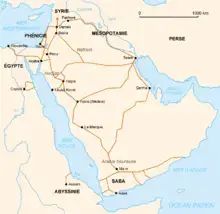
  • 220px-NabateensRoutes.webp
    220px-NabateensRoutes.webp
    5.2 KB · Views: 83
MJB12741, et al,

On this single point I have to agree.

I don't see how anyone who knows anything of the Middle East can deny that Muslim Palestinians are not indigenous to the land they stole & are still stealing.
(COMMENT)

I look at it more as the "Arab Palestinian" as opposed to "Muslim Palestinians;" as the "Arab" (the Semitic peoples originated on the Arabian Peninsula) pre-dates the 7th Century "Muslims" by more than a millennium.

The questions becomes:
  • How long do a people have to live in a region before they become "indigenous?"
  • Is the term "indigenous" a relative term?
27738-ad03485328a7acf506e18392d7874d02.jpg


Most Respectfully,
R

As always your point is valid. However we know the Israelites occupied the land for thousands of years before Islam began in the 7th century AD. Therefore how can Muslim Palestinians be indigenous to the land except for a possible small percentage of Jews who converted?
 
MJB12741, et al,

Yes, this is often confusing.


MJB12741, et al,

On this single point I have to agree.

I don't see how anyone who knows anything of the Middle East can deny that Muslim Palestinians are not indigenous to the land they stole & are still stealing.
(COMMENT)

I look at it more as the "Arab Palestinian" as opposed to "Muslim Palestinians;" as the "Arab" (the Semitic peoples originated on the Arabian Peninsula) pre-dates the 7th Century "Muslims" by more than a millennium.

The questions becomes:
  • How long do a people have to live in a region before they become "indigenous?"
  • Is the term "indigenous" a relative term?
27738-ad03485328a7acf506e18392d7874d02.jpg


Most Respectfully,
R

As always your point is valid. However we know the Israelites occupied the land for thousands of years before Islam began in the 7th century AD. Therefore how can Muslim Palestinians be indigenous to the land except for a possible small percentage of Jews who converted?
(COMMENT)

The "Arab" people is referring to the greater heterogeneous cultural (a panethnic group) that is not divided by religious affiliation. When one talks of "Arab Muslims" --- you have restricted yourself to describing a portion of the culture that come post-Islam and temporally after the rise of the following to the Word of the Supreme Being as revealed to the Islamic prophet Muhammad (PBUH) (7th Century and forward to present day).

I find it entirely impractical to discuss the Arab People (inhabitants to the Arabian plate) of the Levant (all the Middle East of today) and the Hebrew People (semi-nomadic Habiru people) as separate and distinct --- especially ten centuries BCE (nearly three thousand years ago).

Most Respectfully,
R
 
Joan Peters passed away today. Her book should be a must read but there are some points that are in question. Overall the book brings a well researched perspective of the situation. Like everything written about the middle east, you should do your own research and read what others say with a pinch of salt, especially things with a strong perspective. Facts might be correct but opinions from both sides usually are somewhere in the middle. Either way the book should be a staple for anyone interested in the situation. I used to have quite the library that I used for reference, Peter's book was just one among them. When the book came out there was quite the discussion about it.

From Time ImmemorialThe Origins of the Arab-Jewish Conflict Over Palestine
danielpipes.org/1110/from-time-immemorial

by Joan Peters
Reviewed by Daniel Pipes
Commentary
July 1984


This is awesome, however, most pro-pali's claim that Daniel Pipes is not to be trusted and will discount everything he has said or touched out of hand.
 
Joan Peters passed away today. Her book should be a must read but there are some points that are in question. Overall the book brings a well researched perspective of the situation. Like everything written about the middle east, you should do your own research and read what others say with a pinch of salt, especially things with a strong perspective. Facts might be correct but opinions from both sides usually are somewhere in the middle. Either way the book should be a staple for anyone interested in the situation. I used to have quite the library that I used for reference, Peter's book was just one among them. When the book came out there was quite the discussion about it.

From Time ImmemorialThe Origins of the Arab-Jewish Conflict Over Palestine
danielpipes.org/1110/from-time-immemorial

by Joan Peters
Reviewed by Daniel Pipes
Commentary
July 1984

This is awesome, however, most pro-pali's claim that Daniel Pipes is not to be trusted and will discount everything he has said or touched out of hand.
That's because they aren't literate.
 
The Palestinians have been used as pawns in the political game that the Arabs have been playing since 1948 to try to destroy and discredit Israel.

What if the USA did not allow any refugees to assimilate? What if they were all kept in refugee camps? The Vietnamese come to mind since we did have a war there parallels could be seen in that conflict to this one.

What if the USA allowed the south Vietnamese into the US and put them in refugee camps "until we go back and get your homes back". Maybe the US should have. As a publicity/political ploy to defeat the Viet Kong in the court of world public opinion. sound familiar?

But we didn't. We are not that cruel. It is time that the Palestinians learn from history and quit playing the victim card and make something for themselves right where they are. The Israelis are not going anywhere. EVER!

You cannot unscramble eggs.
 
The Palestinians have been used as pawns in the political game that the Arabs have been playing since 1948 to try to destroy and discredit Israel.

What if the USA did not allow any refugees to assimilate? What if they were all kept in refugee camps? The Vietnamese come to mind since we did have a war there parallels could be seen in that conflict to this one.

What if the USA allowed the south Vietnamese into the US and put them in refugee camps "until we go back and get your homes back". Maybe the US should have. As a publicity/political ploy to defeat the Viet Kong in the court of world public opinion. sound familiar?

But we didn't. We are not that cruel. It is time that the Palestinians learn from history and quit playing the victim card and make something for themselves right where they are. The Israelis are not going anywhere. EVER!

You cannot unscramble eggs.

It is indeed so sad what the surrounding Arab countries have done to their Palestinians massacring them by the tens of thousands & leaving tens of thousands of others as refugees. But hey, anyone ever hear any Palestinian or Palestinian supporter complaint about it? Yet they sure blame Israel for their peace offerings, security fence & land concessions so they can remain in Israel. It's called Palestinian mentality.
 
15th post
The Palestinians have been used as pawns in the political game that the Arabs have been playing since 1948 to try to destroy and discredit Israel.

What if the USA did not allow any refugees to assimilate? What if they were all kept in refugee camps? The Vietnamese come to mind since we did have a war there parallels could be seen in that conflict to this one.

What if the USA allowed the south Vietnamese into the US and put them in refugee camps "until we go back and get your homes back". Maybe the US should have. As a publicity/political ploy to defeat the Viet Kong in the court of world public opinion. sound familiar?

But we didn't. We are not that cruel. It is time that the Palestinians learn from history and quit playing the victim card and make something for themselves right where they are. The Israelis are not going anywhere. EVER!

You cannot unscramble eggs.


Maybe the west should be doing this with all the muslims living there now, and telling the rest of the world this is how Islamic nations operate with impunity and without censure so why cant we.
 
The Palestinians have been used as pawns in the political game that the Arabs have been playing since 1948 to try to destroy and discredit Israel.

What if the USA did not allow any refugees to assimilate? What if they were all kept in refugee camps? The Vietnamese come to mind since we did have a war there parallels could be seen in that conflict to this one.

What if the USA allowed the south Vietnamese into the US and put them in refugee camps "until we go back and get your homes back". Maybe the US should have. As a publicity/political ploy to defeat the Viet Kong in the court of world public opinion. sound familiar?

But we didn't. We are not that cruel. It is time that the Palestinians learn from history and quit playing the victim card and make something for themselves right where they are. The Israelis are not going anywhere. EVER!

You cannot unscramble eggs.


Maybe the west should be doing this with all the muslims living there now, and telling the rest of the world this is how Islamic nations operate with impunity and without censure so why cant we.

I certainly hope the USA will make some revisions to our easy immigration policy after what the Western nations have witnessed from raduical Islamists.
 
If the Europeans had not colonized Palestine, there wouldn't be Palestinian refugee camps.

As a Christian nation, only Christians should be allowed to immigrate to the U.S., right?
 
If the Europeans had not colonized Palestine, there wouldn't be Palestinian refugee camps.

As a Christian nation, only Christians should be allowed to immigrate to the U.S., right?
Who told you all that folderol? Europeans didn't colonize Israel. There wasn't anything there.
 
Status
Not open for further replies.

New Topics

Back
Top Bottom