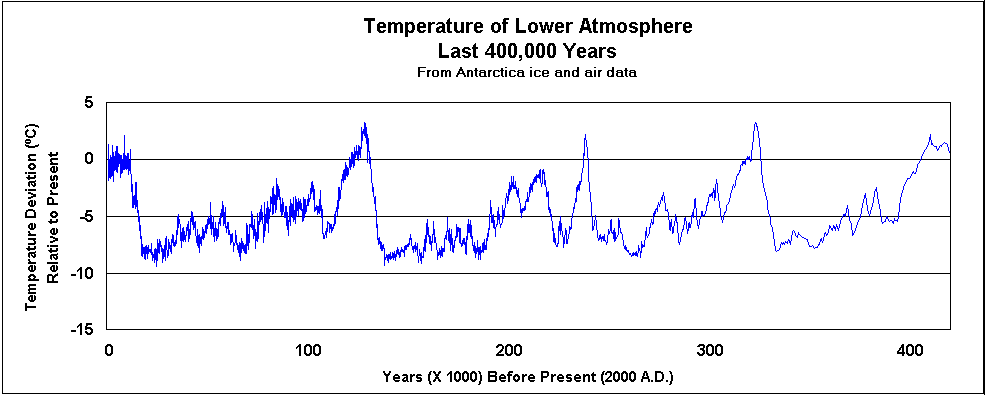
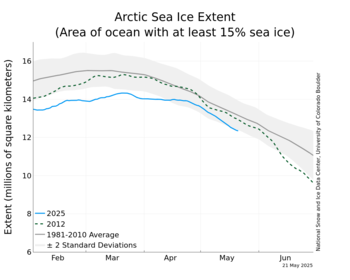
I am a retired physicist and therefore understand how anomalies work and why scientists use anomalies to give ACCURATE trend data. You might try picking up a book so you would know whether your "links" are misleading you or not.
Start with the definition of an anomaly:
a·nom·a·ly
əˈnäməlē/
noun
plural noun: anomalies
1.
something that deviates from what is standard, normal, or expected.
Then move to its use in the handling of temperature data:
https://www.ncdc.noaa.gov/monitoring-references/faq/anomalies.php
Background Information - FAQ
What is a temperature anomaly?
The term temperature anomaly means a departure from a reference value or long-term average. A positive anomaly indicates that the observed temperature was warmer than the reference value, while a negative anomaly indicates that the observed temperature was cooler than the reference value.
What can the mean global temperature anomaly be used for?
This product is a global-scale climate diagnostic tool and provides a big picture overview of average global temperatures compared to a reference value.
snip/
Why use temperature anomalies (departure from average) and not absolute temperature measurements?
Absolute estimates of global average surface temperature are difficult to compile for several reasons. Some regions have few temperature measurement stations (e.g., the Sahara Desert) and interpolation must be made over large, data-sparse regions. In mountainous areas, most observations come from the inhabited valleys, so the effect of elevation on a region's average temperature must be considered as well. For example, a summer month over an area may be cooler than average, both at a mountain top and in a nearby valley, but the absolute temperatures will be quite different at the two locations. The use of anomalies in this case will show that temperatures for both locations were below average.
Using reference values computed on smaller [more local] scales over the same time period establishes a baseline from which anomalies are calculated. This effectively normalizes the data so they can be compared and combined to more accurately represent temperature patterns with respect to what is normal for different places within a region.
For these reasons, large-area summaries incorporate anomalies, not the temperature itself. Anomalies more accurately describe climate variability over larger areas than absolute temperatures do, and they give a frame of reference that allows more meaningful comparisons between locations and more accurate calculations of temperature trends.
How is the average global temperature anomaly time-series calculated?
The global time series is produced from the Smith and Reynolds blended land and ocean data set (Smith et al., 2008). This data set consists of monthly average temperature anomalies on a 5° x 5° grid across land and ocean surfaces. These grid boxes are then averaged to provide an average global temperature anomaly. An area-weighted scheme is used to reflect the reality that the boxes are smaller near the poles and larger near the equator. Global-average anomalies are calculated on a monthly and annual time scale. Average temperature anomalies are also available for land and ocean surfaces separately, and the Northern and Southern Hemispheres separately. The global and hemispheric anomalies are provided with respect to the period 1901-2000, the 20th century average.
Why do some of the products use different reference periods?
The national maps show temperature anomalies relative to the 19812010 base period. This period is used in order to comply with a recommended World Meteorological Organization (WMO) Policy, which suggests using the latest decade for the 30-year average. For the global-scale averages (global land and ocean, land-only, ocean-only, and hemispheric time series), the reference period is adjusted to the 20th Century average for conceptual simplicity (the period is more familiar to more people, and establishes a longer-term average). The adjustment does not change the shape of the time series or affect the trends within it.