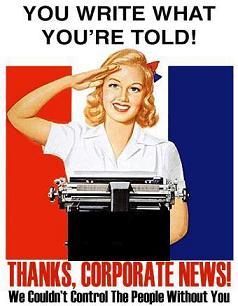
I have a question about the dismissal of sources. Now, let's just agree, for the sake of argument, that "Addicting Info", "Mother Jones", "PoliticusUSA", and similar progressive leaning sites are "bad". On the other hand, if we're going to concede that, then "Brietbart", "Drudge Report", "Judicial Watch", and other
right leaning sources are
equally bad.
Now, given that premise, there seem to be a plethora of people, on both sides who regularly slam the "Lamestream Media", corporate media, pretty much any traditional news source is "evil", and corrupt:
And that's fine. If you want to discuss a topic, simply bring it in from some alternative news source. The problem is, whenever I, or anyone else tries to do that, with, say, Opposing Views, Blaster News, Examiner, or some similar alternative source, the immediate response, particularly if it is saying something that is uncomfortable for one side, or the other is "Well, all you got is some hack story from some unrealiable source, so it isn't real"
So, my question is this. If information from "legitimate" traditional sources is automatically suspect, merely by the nature of those sources being "corporate owned", and information gleaned from alternative sources is suspect, because it is from a source that has not been vetted by the traditional sources, then just what
is considered a reliable source?
1. Frequently a post on the message board includes either a link, quote, or reference to World Net Daily, or Rupert Murdoch, or Ann Coulter, Drudge, or some other right-thinker, and rather than admit that the item is dispositive for the thread or question under discussion, too often the folks with the alternate view:
a. refuse to address the issue, because the citation is on the opposite side.
b. resort to an emoticon of laughter, or some sort of sign of disrespect, or the use of ‘lol.’
c. feel that some sort of “there you go again” response, rather than an actual refutation.
d. Attack the referred item with an Ad Hominem jab, pointing to an imagined physical or mental defect, or alter the name in some absurd manner.
2. What we have here is the kind of defense against opposing ideas that is indolent at best, and intellectually cowardly at worst. Rather than offering alternative or surrogate ideas, the above are faulty because:
a. To refuse to address the issue may mean that one has no faith in the argument of his side, or that the poster is not intellectually equipped to counter same. Nor does a citations political orientation ostensibly prove falsity.
b. The emoticon response, akin to ‘talk to the hand,’ is both rude and shows an inability to be articulate, a necessary skill for the board to retain interest.
c. Indicates that one is too lazy to state, or, possibly, re-state a position. But, then, one should say that, or find a succinct way to explain their position.
d. Possibly the most common, the ad hominem, combines both the lack of ability to argue, and contempt for the opponent. This exposes the weakness both in one’s perspective, and one’s upbringing.
My thesis is that we should all be able to express our differences coherently in a public forum, and using the above methods is the hallmark of a loser.
3. For example.....
FrontPage, the online Internet magazine has received more than one billion ‘hits.’ It has interviewed leading intellectuals, politicians and human rights activists such as Bat Ye’or, Vladimir Bukovsky, Christopher Hitchens, Khaleel Mohammed, Daniel Pipes, Natan Sharanky and Andrew Sullivan. It has therefore had both left, liberal voices (Stanley Aronowitz, Susan Estrich, Michael Lerner) and right-wing voices (Tammy Bruce, Ann Coulter, James Woolsey).
To dismiss a source or author because they promulgate an alternative or even a hated perspective, without consideration of the truth of their premise lacks integrity. Or even efficacy: since the perpetrators of 9/11 were of the Arabic persuasion, should we forswear the use of Arabic numerals?
Deal with the message....not the messenger.