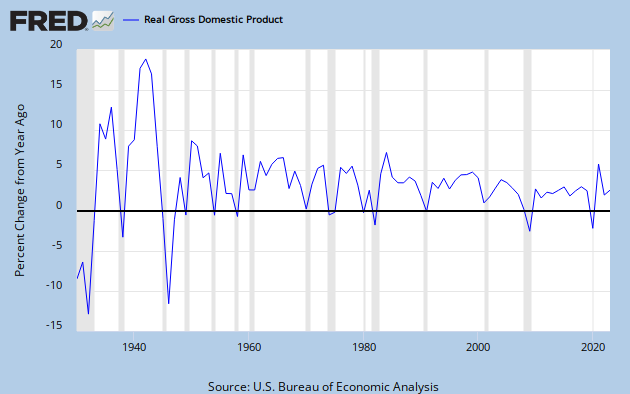
What impact did the Bush tax cuts have on economic growth?
The evidence is not favorable. For example, according to this Census report (see table A1), median household income in 2007, adjusted for inflation, was lower than it was in 2000. And as the non-partisan Center on Budget and Policy Priorities reports, based upon data from the Bureau of Labor Statistics, employment growth was particularly weak, “with employment and wage and salary growth … lower than in any previous post-World War II expansion. Employment grew at an average annual rate of only 0.9 percent from November 2001 to September 2007, as compared with an average of 2.5 percent for the comparable periods of other post-World War II expansions. In addition, real wages and salaries grew at a 1.8 percent average annual rate in the 2001-2007 expansion, as compared with a 3.8 percent average annual rate for the comparable periods of other post-World War II expansions.”
Thus, there is little evidence to support that the Bush tax cuts had a significant effect on growth. In addition, contrary to the argument that the tax cuts would pay for themselves being made at the time the tax cuts were enacted, the deficit ballooned as a result of the tax cuts.