Should we help the poor and jobless with charity or welfare ?
There remain homeless and hungry people in the U.S., yet we have both welfare and charity. It's not clear to me that the "one or the other" approach has any hope of working better than the "both" approach we currently have in place.
It depends largely on how the Charity is setup. And beyond that, it depends on the individual.
What people refuse to accept is that at some level, an individual that has his needs met, simply won't improve their lives if they don't want to.
When people are actually starving, is when they will actually change in some cases.
Several years back there was a blog about a lady who ended up in a messy divorce, and had no skills. She ended up on welfare and public housing for just a few weeks. The reason she was only on it for a few weeks, was because she met people in the public housing, who had no desire, no will, no motivation, no self-worth that caused them to want to change their situation.
This terrified her, and she got a job as quickly as she could and fled from the public housing, because she knew if she stayed there, she would end up with the same mentality.
Now she has a nursing degree, and a stable job.
The one good thing about most Charities, is that they push people to move forward with their lives. The shelter I was at, required that you meet with counselors to move forward with your life. Now you could still live there, and eat there, but you had a specific amount of time, and you had to meet with potential employers. If you refused to do anything, then you had to leave.
Government generally doesn't care about that.
As long as you vote for Democrats which hand out free goodies, they don't care how long you are on the government dole. You can waste your life away in poverty and misery, so long as you vote for Democrats.
Red:
??? Say what? What "depends?" I wrote that in a nation where both charity and state sponsored/run welfare exist, there remain homeless and hungry people. That doesn't "depend." It is so.
If you want to make the case that the preponderance of those people are voluntarily destitute, by all means do so. I don't think that such an argument will be convincing for a quick visit to any homeless shelter to ask the people there and who depend on the shelter's largess will find few, if any, folks who have chosen homelessness and hunger as the state of their existence and who have cast off their financial resources to be so.
Green:
Perhaps that explains why all those "working poor" folks don't do what it takes to boost their financial fortunes so they can become working middle class or working "better off than middle class." I'll be sure to point
JimBowie1958 to your post. He'll find it most informative regarding his great concern for folks who find themselves underemployed, or at least paid less than they are accustomed to being paid. I'm sure it never crossed his mind (nor mine) that those folks are contentedly living their lives because "their needs are met" and don't really deserve, need or want his advocacy. That should be a load off his mind; now that you've spoken and pronounced their circumstances as being willful, there's no need for him to press on with his UBI ideas.
I don't agree with Jim's overall conclusions about the UBI, but I don't agree with you either because one implication of your remark as presented is that the needs one must have met can be satiated in a static way. Well that's just not so. For example, I could stop working and I would still have housing, food, entertainment, etc.; however, I would have those things only until the money runs out. Then I'd have to change dwellings, pare back on some of my expenditures. Eventually, I could be in a position where my needs aren't met.
Additionally, needs come in varying degrees. The types of needs we are discussing in this thread are the most basic sort of needs there are.
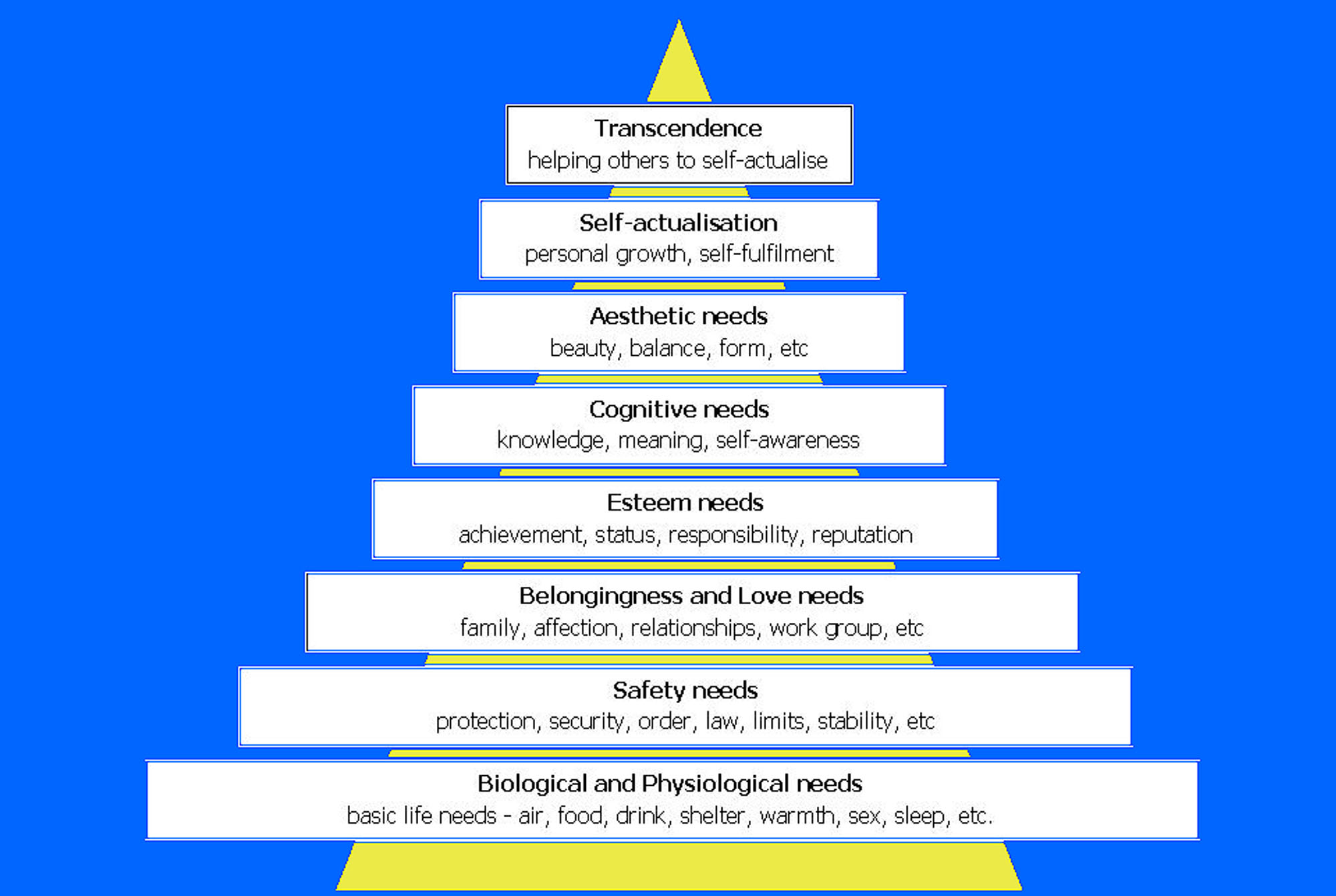
Of the needs at the base of the "pyramid," folks will generally do whatever they have to in order to have them met. People don't just stop striving to fill the needs superior to biological/physiological needs merely because they have food and shelter.
Blue:
That makes no sense at all given that Democrats are the champions of the idea that government can solve the ills of the people governed. If voting Democratic were to foist one surely into poverty and destitution, there'd be no viable tax base that can fund the government.