-------------------------------- and so called LARGE capacity magazines are simply NORMAL Capacity magazine that were designed for the Gun .There is nothing in the Constitution the delineates weapons of war from weapons.
But I think for the most part in the modern day discussion its' automatic weapons, large capacity magazines, large caliber weapons, hand grenades RPG's, Mortars and up.....ect.
Define large capacity magazine....since most people have no idea what those might be, and the anti gunners keep lying about them.
Navigation
Install the app
How to install the app on iOS
Follow along with the video below to see how to install our site as a web app on your home screen.
Note: This feature may not be available in some browsers.
More options
Style variation
You are using an out of date browser. It may not display this or other websites correctly.
You should upgrade or use an alternative browser.
You should upgrade or use an alternative browser.
Weapons of war in civilian hands
- Thread starter Stormy Daniels
- Start date

Bootney Lee Farnsworth
Diamond Member
No honest reading of the 2nd Amendment can result in a construction that makes membership in a militia a necessary requisite of gun ownership. It is the most dishonest interpretation of any part of the constitution other than the general welfare and commerce clauses.They never made it because all citizens were expected to participate in their States Militia. They never expected to have a large standing National Army either.
Clearly the 2nd Amendment was tied to the Well-Trained Militia's, until the liberal courts separated and ignored the Militia aspect of what the founder wrote.
I don't disagree with the courts mind you, I just think we need a new Amendment to replace the Second that clearly defines the rights of citizens to own these weapons.
This lame meme is still VERY accurate:

The true reading of the 2nd Amendment is a limit on the federal government. That's all. I could be read to mean that congress shall make no law regarding arms, that such a power is left to the States. This new federal government that the founders were constructing was to be limited to specific, enumerated powers. Arms regulation was NOT one of them, and was even SPECIFICALLY restricted by the 2nd.
Why that concept is so difficult for some just blows my mind. I can only conclude that those advocating the militia requisite are either stupid or dishonest.
But, I agree. We do need a revised amendment to clarify the founder's meaning and intent in such a way that communists cannot remove the right to bear arms. While we are at it, we should also clarify the commerce and general welfare clauses. That would be great. We can undo 80 years of communist policy.

BlindBoo
Diamond Member
- Sep 28, 2010
- 59,317
- 17,937
- 2,250
That's a distinction the founders never made. At the time, civilians owned cannons and bombs.But I think for the most part in the modern day discussion its' automatic weapons, large capacity magazines, large caliber weapons, hand grenades RPG's, Mortars and up.....ect.
If there is a constitutional amendment to clarify the meaning of "arms" and "the People" and "shall not be infringed" then fine, but States still have the power. The 2nd is a restriction on the federal government, making the BATF and all fed gun laws illegal and unconstitutional. We simply have had people on the Court without the guts or integrity to force the government to do it the right way.
They never made it because all citizens were expected to participate in their States Militia. They never expected to have a large standing National Army either.
Clearly the 2nd Amendment was tied to the Well-Trained Militia's, until the liberal courts separated and ignored the Militia aspect of what the founder wrote.
I don't disagree with the courts mind you, I just think we need a new Amendment to replace the Second that clearly defines the rights of citizens to own these weapons.
No...the 2nd Amendment was not tied to militia duty, read D.C. v. Heller because they go through that lie completely and thoroughly.....
I disagree. If it wasn't tied to it, why mention the militia's at all. Why not just state plainly that the peoples right to own weapons shall not be infringed?
Bootney Lee Farnsworth
Diamond Member
I didn't read it that way. Could you point out the text that brings you to that conclusion.No...Heller and McDonald, the two Supreme Court cases defined the states as being under the 2nd Amendment......
To my knowledge, every SCOTUS holding has fallen short of applying the privileges and immunities clause of the 14th to the 2nd.

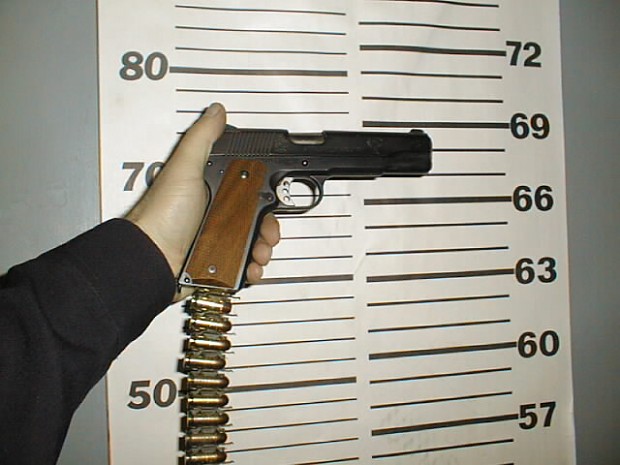
Here's a new military grade, belt fed 1911.
Bootney Lee Farnsworth
Diamond Member
They did. They simply stated the reason they would not infringe.I disagree. If it wasn't tied to it, why mention the militia's at all. Why not just state plainly that the peoples right to own weapons shall not be infringed?

Again, "the right of the people to keep and bear arms shall not be infringed" is plain, unambiguous language. The Federal Government shall not make laws restricting arms. Simple.
States can do it. See Presser v. Illinois

OldLady
Diamond Member
- Nov 16, 2015
- 69,568
- 19,620
- 2,220
60% Bootney, and that's the smallest percentage. Eventually that will make a difference.Guns work too.Wake up. We live in a democracy; eventually it will work.
And you need a civics class.
Bootney Lee Farnsworth
Diamond Member
So, constitutional rights are up for popular vote?60% Bootney, and that's the smallest percentage. Eventually that will make a difference.

miketx
Diamond Member
- Dec 25, 2015
- 121,555
- 70,674
- 2,645
- Banned
- #89
Classic troll!Oh, so you beg for gun control without using those bad military type words used to describe a gun. Ok. Actually, we need to eliminate more gun laws. We have too many that are infringing on the second. We don't need more. Thats ludicrous.
Where did I say I want new gun control laws?
Right here:
"I don't use that kind of language to beg for gun control, so there's no need for me to have an answer."
You may need a refresher course in reading comprehension.
Regressive liberal ROE
1. Demand a link or an explanation of the truth they are objecting to.
2. Promptly reject all explanations as right wing lies. Smoke spin deflect
3. Ignore any facts presented.
4. Ridicule spelling and typos, punctuation.
5. Attack the person as being juvenile, ie: "are you 12 years old", question their education, intelligence.
6. Employ misdirection,
6a. smear people
6b. attack religion
6c. attack their rationality.
7. Lie, make false assumptions
8. Play race/gender card/misogynist card
9. Play gay/lesbian card
10. Play the Nazi/Fascist/bigot card
11. Make up stuff/So you got nothing?
12. Deny constantly
13. Reword and repeat
14. Pretending not to understand, playing ignorant/what did I lie about
15. When losing, resort to personal attacks.
16. Russia
17. Fox News/Alex Jones/Brietbart/infowars/Stormfront/Gateway/hannity
18. You can’t read.
BlindBoo
Diamond Member
- Sep 28, 2010
- 59,317
- 17,937
- 2,250
No honest reading of the 2nd Amendment can result in a construction that makes membership in a militia a necessary requisite of gun ownership. It is the most dishonest interpretation of any part of the constitution other than the general welfare and commerce clauses.They never made it because all citizens were expected to participate in their States Militia. They never expected to have a large standing National Army either.
Clearly the 2nd Amendment was tied to the Well-Trained Militia's, until the liberal courts separated and ignored the Militia aspect of what the founder wrote.
I don't disagree with the courts mind you, I just think we need a new Amendment to replace the Second that clearly defines the rights of citizens to own these weapons.
This lame meme is still VERY accurate:
The true reading of the 2nd Amendment is a limit on the federal government. That's all. I could be read to mean that congress shall make no law regarding arms, that such a power is left to the States. This new federal government that the founders were constructing was to be limited to specific, enumerated powers. Arms regulation was NOT one of them, and was even SPECIFICALLY restricted by the 2nd.
Why that concept is so difficult for some just blows my mind. I can only conclude that those advocating the militia requisite are either stupid or dishonest.
But, I agree. We do need a revised amendment to clarify the founder's meaning and intent in such a way that communists cannot remove the right to bear arms. While we are at it, we should also clarify the commerce and general welfare clauses. That would be great. We can undo 80 years of communist policy.
If it wasn't tied to the security of a Free State why put that in the sentence at all?
Bootney Lee Farnsworth
Diamond Member
Stating a purpose.If it wasn't tied to the security of a Free State why put that in the sentence at all?
"The reason we are limiting the power of this new government is because states need militias to remain free."
Nothing about their stated purpose qualifies what they actually did---restrict the federal government.
OldLady
Diamond Member
- Nov 16, 2015
- 69,568
- 19,620
- 2,220
I agree, soldier; boots are required. I can't imagine everyone jumping around yelling OW OW OW OW with a big old M-16's swinging around firing haphazardly after stepping on a discarded Spam tin.I look at my feet.Absolutely. I definitely wouldn't want to have to look at your feet.Just don't ask me to give up my boots.And pants! Let's make this interesting!The military uses pistols. We should ban them too. Right Oregon?
Think they use machetes and knives too! Holy shit!
What about shirts?
Nothing wrong with my feet.
My Drill instructor made it clear that it is a necessity to take care of my feet.
I told him I knew that, and that my Mother taught me that.
My feet are clean, dry and servicable.
But my boots make my feet look good.

LordBrownTrout
Diamond Member
60% Bootney, and that's the smallest percentage. Eventually that will make a difference.Guns work too.Wake up. We live in a democracy; eventually it will work.
And you need a civics class.
That's a distinction the founders never made. At the time, civilians owned cannons and bombs.But I think for the most part in the modern day discussion its' automatic weapons, large capacity magazines, large caliber weapons, hand grenades RPG's, Mortars and up.....ect.
If there is a constitutional amendment to clarify the meaning of "arms" and "the People" and "shall not be infringed" then fine, but States still have the power. The 2nd is a restriction on the federal government, making the BATF and all fed gun laws illegal and unconstitutional. We simply have had people on the Court without the guts or integrity to force the government to do it the right way.
They never made it because all citizens were expected to participate in their States Militia. They never expected to have a large standing National Army either.
Clearly the 2nd Amendment was tied to the Well-Trained Militia's, until the liberal courts separated and ignored the Militia aspect of what the founder wrote.
I don't disagree with the courts mind you, I just think we need a new Amendment to replace the Second that clearly defines the rights of citizens to own these weapons.
No...the 2nd Amendment was not tied to militia duty, read D.C. v. Heller because they go through that lie completely and thoroughly.....
I disagree. If it wasn't tied to it, why mention the militia's at all. Why not just state plainly that the peoples right to own weapons shall not be infringed?
It states that in the second. The feds should make no laws about guns, religion, speech. It really is quite simple.
OldLady
Diamond Member
- Nov 16, 2015
- 69,568
- 19,620
- 2,220
For the 3,789,462nd time, no one is taking away the Constitutional right to be armed.So, constitutional rights are up for popular vote?60% Bootney, and that's the smallest percentage. Eventually that will make a difference.
Bootney Lee Farnsworth
Diamond Member
For the 3,789,463rd time, we don't believe you. Bullshit. You are lying. Okay? Get it? We don't trust you or believe you. Why? Gun-Control advocates have lied in the past.For the 3,789,462nd time, no one is taking away the Constitutional right to be armed.
If you don't want to take away the constitutional right to be armed, stop doing it.

Stormy Daniels
Gold Member
- Mar 19, 2018
- 7,570
- 2,817
- 265
- Thread starter
- #96
No, its a simple logical deduction that is implied. You don't use that language SO, you do use some type of language to beg for gun control
Jesus you're a ******* idiot. That's like saying "I don't use guns to kill people, therefore I must use something else to kill people." Since you brought up logical deductions let's have a lesson in logic.
First, we must recast your argument into standard form categorical syllogisms.
Some "Weapons of war" statements are used by some people to beg for gun control.
No "Weapons of war" statements are used by me to beg for gun control.
Therefore, some other statements are used by me beg for gun control.
No "Weapons of war" statements are used by me to beg for gun control.
Therefore, some other statements are used by me beg for gun control.
This gives the logical form:
Some S is P
No R is P
Therefore some O is P
No R is P
Therefore some O is P
This is known as the fallacy of four terms. You have concocted a fourth term and assumed it is true, claiming that it is a deduction. But as we see here, deductive reasoning does not allow for such a conclusion.
We can further see the logical invalidity of your argument by using an opposition square. We could also recast your argument with the following standard form propositions:
Some statements are not used by me to beg for gun control.
Therefore, some statements are used by me to beg for gun control.
Therefore, some statements are used by me to beg for gun control.
That is to say:
Some S is not P
Therefore some S is P.
Therefore some S is P.
The only method to directly deduce the truth of one proposition from another (i.e. draw an immediate conclusion from a single premise), is through application of an opposition square. "Some S is not P" is known as a particular negative or an "O statement." As long as there is at least one instance of S that is not P, then the statement is true. It's possible that all instances of S are not P. But that is not necessary; the statement becomes true with only a single instance. "Some S is P" is known as a particular affirmative, or an "I statement." Similar to the O statement, it becomes true so long as there is at least once instance in the universe where an S is also a P; if all S are P then it is true that at least some S is P.
The oppositional relationship between I and O statements is called subcontrary. That is to say, the statements are each other's subcontrary. The relationship between subcontraries does not allow for the deduction of truth from one based on the truth of the other. We can take the example "Some dogs are not 10 feet tall." The subcontrary of that statement, "Some dogs are 10 feet tall" cannot be determined just because we have found at least one dog that is shorter than 10 feet tall.
In an opposition square, no true statements can be deduced if an O statement proves true. True A statements (All S is P, the universal affirmative) provide one way deduction which allow us to deduce that the corresponding I statement (some S is P) is true. And a true E statement (No S is P, the universal negative) provides the same one way deduction. This is called the subaltern relationship. Simply put, we can deduce that a particular is true if we already know that the corresponding universal is true. But we cannot deduce a universal statement is true based on a particular statement being true.
There is also the contrary relationship, which exists between A and E statements. In this relationship, both statements cannot true, however both could be false. So the statements "All dogs are 2 feet tall, no dogs are 2 feet tall" could both be false. However, they can't both be true. There is one other relationship found in an opposition square, called contradictories. This describes the A to O statement relationship, and the E to I statement relationship. Contradictories are statements where one must be true, and one must be false. So determine a universal affirmative is true ( ex: "All dogs are mammals") we immediately know that the corresponding particular negative ("Some dogs are not mammals") is false.
Glad we could clear that up.
LordBrownTrout
Diamond Member
No, its a simple logical deduction that is implied. You don't use that language SO, you do use some type of language to beg for gun control
Jesus you're a ******* idiot. That's like saying "I don't use guns to kill people, therefore I must use something else to kill people." Since you brought up logical deductions let's have a lesson in logic.
First, we must recast your argument into standard form categorical syllogisms.
Some "Weapons of war" statements are used by some people to beg for gun control.
No "Weapons of war" statements are used by me to beg for gun control.
Therefore, some other statements are used by me beg for gun control.
This gives the logical form:
Some S is P
No R is P
Therefore some O is P
This is known as the fallacy of four terms. You have concocted a fourth term and assumed it is true, claiming that it is a deduction. But as we see here, deductive reasoning does not allow for such a conclusion.
We can further see the logical invalidity of your argument by using an opposition square. We could also recast your argument with the following standard form propositions:
Some statements are not used by me to beg for gun control.
Therefore, some statements are used by me to beg for gun control.
That is to say:
Some S is not P
Therefore some S is P.
The only method to directly deduce the truth of one proposition from another (i.e. draw an immediate conclusion from a single premise), is through application of an opposition square. "Some S is not P" is known as a particular negative or an "O statement." As long as there is at least one instance of S that is not P, then the statement is true. It's possible that all instances of S are not P. But that is not necessary; the statement becomes true with only a single instance. "Some S is P" is known as a particular affirmative, or an "I statement." Similar to the O statement, it becomes true so long as there is at least once instance in the universe where an S is also a P; if all S are P then it is true that at least some S is P.
The oppositional relationship between I and O statements is called subcontrary. That is to say, the statements are each other's subcontrary. The relationship between subcontraries does not allow for the deduction of truth from one based on the truth of the other. We can take the example "Some dogs are not 10 feet tall." The subcontrary of that statement, "Some dogs are 10 feet tall" cannot be determined just because we have found at least one dog that is shorter than 10 feet tall.
In an opposition square, no true statements can be deduced if an O statement proves true. True A statements (All S is P, the universal affirmative) provide one way deduction which allow us to deduce that the corresponding I statement (some S is P) is true. And a true E statement (No S is P, the universal negative) provides the same one way deduction. This is called the subaltern relationship. Simply put, we can deduce that a particular is true if we already know that the corresponding universal is true. But we cannot deduce a universal statement is true based on a particular statement being true.
There is also the contrary relationship, which exists between A and E statements. In this relationship, both statements cannot true, however both could be false. So the statements "All dogs are 2 feet tall, no dogs are 2 feet tall" could both be false. However, they can't both be true. There is one other relationship found in an opposition square, called contradictories. This describes the A to O statement relationship, and the E to I statement relationship. Contradictories are statements where one must be true, and one must be false. So determine a universal affirmative is true ( ex: "All dogs are mammals") we immediately know that the corresponding particular negative ("Some dogs are not mammals") is false.
Glad we could clear that up.
You can copy and paste what logical deduction is all day long. You still dont know what it is. You're just a hack. You're upset because you're a troll that has been busted and now you're lashing out.
OldLady
Diamond Member
- Nov 16, 2015
- 69,568
- 19,620
- 2,220
Assault weapons were banned for ten years. Did anyone take all your guns? What makes you say anyone lied?For the 3,789,463rd time, we don't believe you. Bullshit. You are lying. Okay? Get it? We don't trust you or believe you. Why? Gun-Control advocates have lied in the past.For the 3,789,462nd time, no one is taking away the Constitutional right to be armed.
If you don't want to take away the constitutional right to be armed, stop doing it.
BlindBoo
Diamond Member
- Sep 28, 2010
- 59,317
- 17,937
- 2,250
Stating a purpose.If it wasn't tied to the security of a Free State why put that in the sentence at all?
"The reason we are limiting the power of this new government is because states need militias to remain free."
Nothing about their stated purpose qualifies what they actually did---restrict the federal government.
The various State Militia's were under the command of and could be called to duty by the President. It is only recently that the courts held that an individual has the right to own a gun for protection. That could be taken away by another court decision in the future. Which is why I'd liken to see a new amendment to clearly define those rights.
Stormy Daniels
Gold Member
- Mar 19, 2018
- 7,570
- 2,817
- 265
- Thread starter
- #100
You can copy and paste what logical deduction is all day long. You still dont know what it is. You're just a hack. You're upset because you're a troll that has been busted and now you're lashing out.
You're not making any sense. The entire point of this thread is to challenge liberals to explain what allegedly make one weapon "military grade" instead of another. You're fantasizing. Granted, I'm used to people fantasizing about me, but you're still an idiot.
In the future refrain from imbibing copious quantities of alcohol before posting so you don't look like an idiot.
Similar threads

- Replies
- 7
- Views
- 154


- Replies
- 15
- Views
- 239

- Replies
- 80
- Views
- 840

- Replies
- 41
- Views
- 502

- Replies
- 2
- Views
- 99

New Topics
-

-
 Israel Day Parade in New York Proceeds Peacefully, Without the Mayor
- Started by Zincwarrior
- Replies: 0
-

-


