Economists Use “Fuzzy Graphs” to Challenge Data on the Human Cost of Trump Sanctions on Venezuela
"In our paper, '
Sanctions as Collective Punishment: The Case of Venezuela,' we looked at some of the ways in which the sanctions on Venezuela imposed by the US government curtail access to essential and life-saving imports, and some of the data on impacts such as mortality. We concluded that US economic sanctions since August 2017 have likely caused a dire rise in mortality and a grave aggravation of Venezuela’s economic crisis"
So let's have a lesson in "Lies, damned lies, and statistics.".
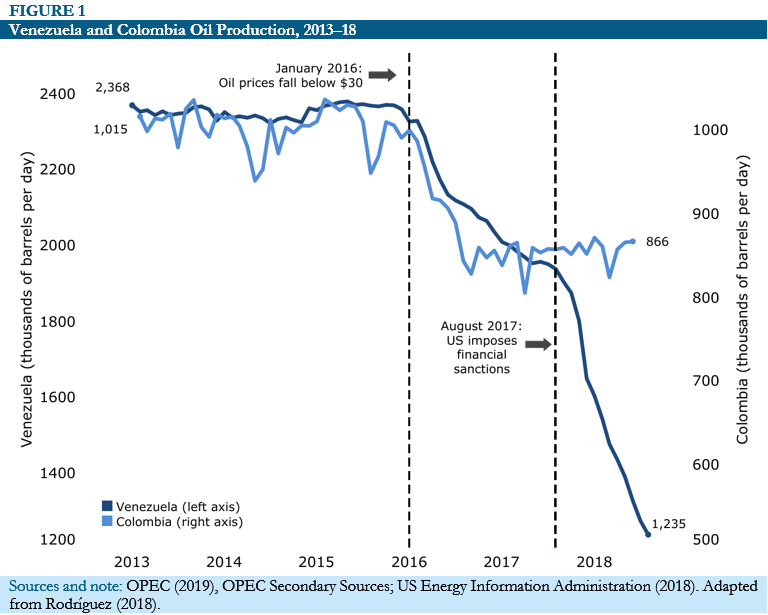
Look at the chart you posted. It looks as though Colombian oil production closely matches Venezuelan production. That the two were following the same pattern.
But then notice the range. The Venezuelan oil production goes from 1200 barrels to 2400 barrels. The range is 1200. The Colombian range goes from 500 to 1000. A range of 500. So they screwed with the ranges to make the two graphs fit together.
Moreover, when you look at the actual decline in oil production, the real start of the decline was around 2003 to 2007.
Charting The Decline Of Venezuela's Oil Industry
During that time Chavez fired 19,000 oil workers, and replaced them with loyalists to his government. Loyal to Chavez, but not experienced in the oil industry.
In 2007 with the rise of prices, the oil companies operating in Venezuela, began increasing production. Instead of enjoying the added income, Chavez demanded more money from oil, and the companies refused. He then expropriated their assets by force.
Now understand why.... Venezuela's oil is heavy crude, which is super difficult to refine. Thus it requires tons and tons of capital investment. That's why the government of Venezuela invited foreign investment to begin with, because their oil is difficult to deal with, and extremely expensive to refine.
Chavez, expropriated their assets, which of course made all the companies abandon the investing in the country. (why would you invest, if the government just steals it?). Not only that, but Chavez diverted all that money to his social programs, which made him popular, but.... without capital investment, it was impossible to maintain oil production on extremely difficult heavy crud oil that Venezuela produces.
As a result oil production in the US, was increasing year over year, during the exact same time that Venezuela's production was falling year over year.
So looking at 2009 on... you can see that US production went up even though oil prices were falling. And equally Venezuela's production was going down.
Even if you could say that the sanctions hurt exports, which they clearly have.... that doesn't explain why production has fallen.
Even if you can't export the oil.... they could use that oil to keep the lights on in Venezuela. In a country that has nation wide black outs, certainly having a few diesel generators keeping the power on would be a wise use of the vast oil wealth in the country.
I mean after all, isn't it the left-wing that constantly complains that the US steals the resources of other countries? Well here's a case where the country can keep the resource for themselves. So why don't they produce more oil for their own use?
Again, because Chavez stole all the capital investment money, and spent it on social programs. So as the NPR reported, even their existing investments have fallen into disrepair.
The Fallout From A Seemingly Sweet Oil Deal For Venezuela's Neighbors
There are a several reasons for this. First, Venezuela oil industry is in turmoil. Venezuela's oil rigs, which had been producing nearly 3 million barrels of crude a day in 2014, are now producing just a fraction of that.
Much of the oil that they are extracting is now going straight on to tankers bound for Russia or China to pay off Venezuela's debts to those countries.
So notice, existing oil rigs, that used to produce 3 million barrels a day, are not producing very little. Capitalist investment is vital in all industry. If you take away the profits..... the industry dies. This is why socialism the world over has failed.
However, it is true that US Sanctions do hinder the oil industry.
But you need to also understand exactly why the US did this. We have clear documented proof, that the state run oil company in Venezuela, is being used by those in power, to load up off shore banks accounts.
The money from the oil exports isn't going to feed people anyway. We already know this for a fact. The companies endless corruption, and Maduro cronies moving cash out of the country, has not been used to help the poor.
This idea that somehow if sanctions didn't exist, that money would flow to stock the shelves is ridiculous, especially given that food shortages started before the sanctions did.





 )
)