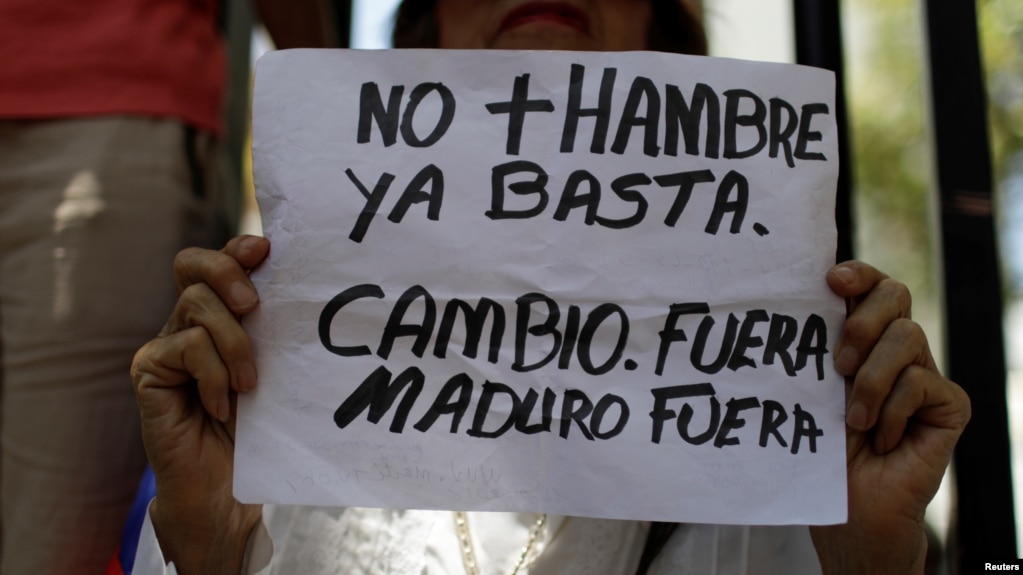
Venezuela's inflation rate, which already is the world's highest, is expected to rise to a staggering 1,660% next year, the International Monetary Fund predicts. The opposition-led National Assembly has voted to open a "political trial" against President Nicolas Maduro, a move which the president dismissed as "illegitimate". Each side has accused the other of coup-mongering. Here, we look more in depth at the problems facing Venezuela and its president.
Why is Venezuela so divided?
Venezuela is split into Chavistas, the name given to the followers of the socialist policies of the late President Hugo Chavez, and those who cannot wait to see an end to the 17 years in power of his United Socialist Party (PSUV). After the socialist leader died in 2013, Nicolas Maduro, also of the PSUV, was elected president on a promise to continue Mr Chavez's policies. Chavistas praise the two men for using Venezuela's oil riches to markedly reduce inequality and for lifting many Venezuelans out of poverty.
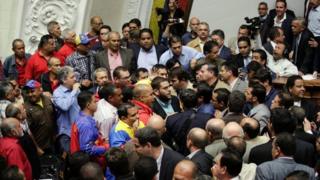
Deputies of the Venezuelan coalition of opposition parties (MUD) and of the Venezuela's United Socialist Party (PSUV) scuffle during a session of the National Assembly in Caracas, Venezuela
But the opposition says that since it came to power in 1999, the PSUV has eroded Venezuela's democratic institutions and mismanaged its economy. Chavistas in turn accuse the opposition of being elitist and of exploiting poor Venezuelans to increase their own riches. They also allege that opposition leaders are in the pay of the United States, a country with which Venezuela has had fraught relations in recent years.
Why has Mr Maduro's popularity plummeted?
Mr Maduro has not been able to inspire Chavistas in the same way his predecessor did. His government has furthermore been hampered by falling oil prices. Oil accounts for about 95% of Venezuela's export revenues and was used to finance some of the government's generous social programmes which, according to official figures, have provided more than one million poor Venezuelans with homes.
The lack of oil revenue has forced the government to curtail its social programmes, leading to an erosion of support among its core backers. A recent poll by firm Datanalisis suggested that more than 75% of Venezuelans were unhappy with the way Mr Maduro governed the country.
What does the opposition want?