The WSJ seems to agree with the OP and thinks that the Phase 1 deal isn't a that big of a deal. The Phase 2 agreement will be a much harder climb:
U.S., China Sign Deal Easing Trade Tensions
- Buying American: Beijing will ramp up purchases of U.S. goods and services by $200 billion over the next two years, using 2017 as a benchmark. This includes increased purchases of manufactured goods by $77.7 billion over the two-year period. The category of tech services, which includes charges for cloud computing-related services and the use of intellectual property, is projected to grow by $37.9 billion. Energy purchases will increase by $52.4 billion under the deal.
- Agriculture Purchases: The much-touted agriculture purchases have smaller goals for increased trade under the deal than energy, manufacturing and services, with an increase of $32 billion over the two-year period. In addition to the purchase targets, however, China has agreed to steps that allow more market access for U.S. dairy products, poultry, beef, fish, rice and even pet food.
- Trade Secrets: The deal includes strong language related to preventing and punishing theft of trade secrets. The deal makes it easier for U.S. businesses to persuade authorities to initiate a criminal investigation in China. In addition, the deal says U.S. businesses operating in China should be able to operate “openly and freely” without pressure to transfer their technology to foreign business partners. Sharing tech blueprints “must be based on market terms that are voluntary and reflect mutual agreement,” it said.
- Financial Services: The deal removes barriers to help U.S. banking institutions, insurers and other financial-services companies expand in the Chinese market. That includes quickly reviewing license applications from credit-card companies and U.S.-owned credit-rating services. The deal sets a five-month deadline for China to allow branches of U.S. financial institutions to provide securities investment-fund custody services.
- Resolving Business Disputes: The deal calls for the creation of a dispute-resolution office, addressing longstanding complaints from the U.S. business community that their disagreements with Chinese partners haven't been fairly resolved. It laid out the framework for officials in U.S. and China to discuss how to implement this mechanism, including information sharing and an appeals process.
- Tariff Relief: Prior to the deal, the U.S. agreed to cut the tariff rate to 7.5% from 15% for charges it had imposed on roughly $120 billion in Chinese products. The U.S. also held off on tariffs of 15% on roughly $156 billion in consumer products, including smartphones, that were set to take effect in December. The deal doesn’t amend that prior agreement. President Trump on Wednesday said he would remove the tariffs if the next round of negotiations are successful.
- Currency Manipulation: China commits not to devalue its currency or make persistent intervention in its currency market. China also commits to a schedule of regular disclosures of data regarding its foreign-exchange holdings.
Buying American: So by 2022, the Chinese will be back to buying the same level of American goods that they were buying in 2017. Two MORE years to get back to where you started. Big whoop on this one. All of the increased purchases of American goods are in "cloud computing services" and "energy". I'm not seeing much in the way of jobs for Americans here.
Agriculture. Those "smaller goals" mean that American soy bean farmers have lost a huge chunk of their market and it's not coming back.
Trade Secrets. This area has not been settled. The language is far too vague to be effective and is more of a goal - details to be worked out in Phase II.
Access to Chinese Markets: US Banks get access to the Chinese market. This helps American workers and the general public how? This may be a boon to Wall Street, although I doubt it. Incidentally, allowing access to the market doesn't mean that they'll be allowed to prosper in China, and they won't be allowed to have unfettered or unregulated access to Chinese markets.
Trade Disputes. A step in the right direction but we'll see how this goes with the Chinese.
Currency Manipulation. This really isn't nearly the problem that Trump complains that it is. What Trump ignores is that China has been using all of this prosperity to fund projects for its trading partners in South America and Africa. To befriend allies and build relationships - just as the USA used its prosperity in the 1950's and 1960's to help second and third world countries to build trading relationships, and cement deals.
Tarriffs are still with the American public.
https://www.washingtonpost.com/opinions/2020/01/15/trade-war-with-china-is-far-over/
The Phase-1 deal is a step in the right direction.
We'll see what happens to the trade deficit in the coming years.
The People's Republic of China | United States Trade Representative
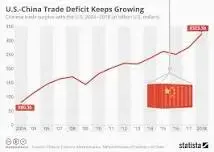
U.S. goods and services trade with China totaled an estimated $737.1 billion in 2018. Exports were $179.3 billion; imports were $557.9 billion. The U.S. goods and services trade deficit with China was $378.6 billion in 2018.
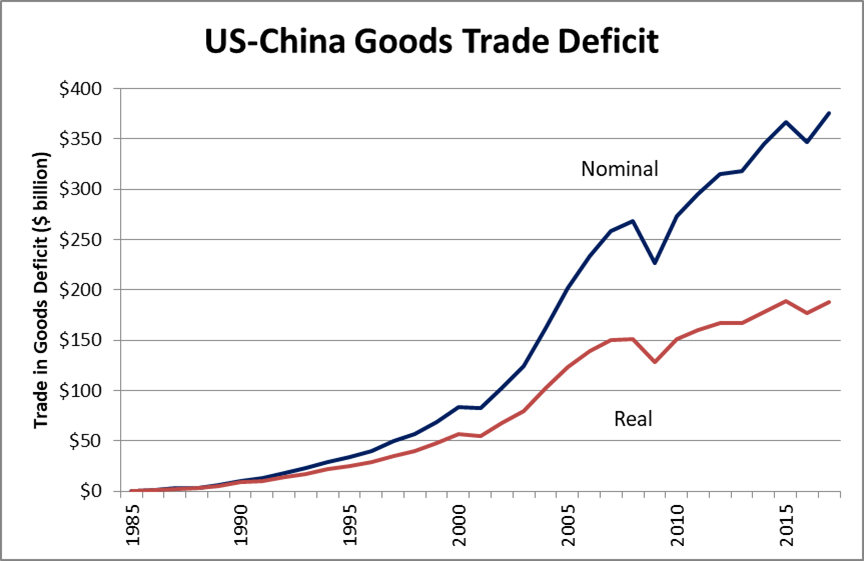
The difference in inflation (currency value) shows what happens when China devalues its currency to sell more goods.
Nominal GDP is the market value of goods
and services produced in an economy, unadjusted for inflation.
Real GDP is
nominal GDP, adjusted for inflation to reflect changes in
real output. Trends in the
GDP deflator are similar to changes in the Consumer Price Index, which is a different way of measuring inflation.
I am well aware of how currency manipulation works. I spent my entire working life in banking and law, both at high levels. Conservatives have emphasized the use of currency manipulation by the Chinese, but the Chinese haven't used anywhere near as much as Republicans have claimed. What Americans should be MORE concerned about than currency manipulation, is the control the Chinese have over their economy.
The Chinese are building worldwide trade networks using US dollars. They're investing in infrastructure and development in South America and Africa. Things that Americans USED to do, when the US had a strong economy.
Trump promised to help the "forgotten Americans" - the people displaced by the off-shoring of low end manufacturing, and technology in higher end manufacturing. Instead of offering retraining for the 21st Century economy, Trump is promising to bring their jobs back. You can't go backwards. Those jobs are gone, and it wasn't the Chinese who "took" them. American corporations CHOSE to move production to China because it was more profitable.
It's time for Americans to face the reality that their government is doing NOTHING to help its citizens adapt to the 21st Century economy. So much of the US economy is tied to the military-industrial complex that the USA has a vested interest in ginning up foreign hostilities to boost sales. Continuing to spend your nation's wealth on foreign wars and the military, instead of spending it on health care, education, research and infrastructure, is causing the USA to fall behind other first world nations.
The rest of the world has prospered by staying out of foreign wars, while the USA has declined.
Generally agree with your post. You didn't even mention how stupid the US is to borrow money to give away as foreign aid, or to pay for expensive foreign wars. The current foreign aid budget is about $55b. Plus we borrow about $24b a year to keep troops in the EU to protect the EU from Russia, who the EU buys gas from to fund Russia's military.
The good news is that the democrats want free college for everyone, so we can have all of those unemployed "critical thinking" Art-History, Philosophy, and Liberal Art majors. While Trump wants to provide free 2-year job training programs for workers via Community Colleges to fill the jobs that industry needs filled, I call it the "German Model" to better match the job training with the job opportunities, like they have in Germany.
Pledge to America's Workers
I have a lot of issues with using borrowed money to support a lifestyle your income isn't paying for. I have a very strong belief in balanced budgets in a strong economy. Trump keep touting the strength of the US economy, but everything is being done with borrowed funds.
Much of American foreign aid is tied to military purchases, so foreign aid becomes this massive government subsidy to the American military industrial complex. There are a lot of good and valid reasons for giving foreign aid - like the aid to El Salvador to help them fight the drug gangs, so people don't flee and seek refuge in the USA. Trump cut out all of the aid to Central America which was helping keep people from fleeing to the USA, and then complained that the numbers of refugee claimants went up.
The biggest problem you have is that far too much money is going into the military, on equipment and weapons you have no plans of using, instead of into infrastructure investment which your country sorely needs. If, as Trump says, you're bringing the troops back home, why are you buying all of the military equipment? If you're not deploying hundreds of thousand of troops all over the world, and not getting involved in wars, why is the military spending increasing? Shouldn't you be paring these expenses back and reducing the size of your forces if all they're going to be doing is protecting the homeland?
Trump keeps going on about how Canada and the EU needs to spend more money on defense. Why? No one is attacking Europe or Canada, as and far as Canada goes, the only country who has ever attacked us, is the USA. The only reason for the rest of us to spend more money on defense, is because the USA is our military equipment supplier. We get most of our military hardware from you. Trump is trying to boost our spending, to help your economy.
Here's a better idea. If YOU spend less on your military, you could spend the money on your own people, and your own infrastructure, education, healthcare and retraining. Stop using taxpayer dollars to subsidize wages for low income workers. Raise the minimum wage to a living wage and stop with these ridiculous income supplements.
Your corporations are awash with cash. They setting records for stock buybacks. This is what is driving record stock market prices. The wealth gap between rich and poor is widening under the Trump, and it's widening faster - all due to the tax cuts that billionaires and corporations really didn't need.
In the meantime, your for-profit health care system has given your country the least healthy population in the first world. Life expectancy is declining in the USA - the only first world country where this is happening. And while there is good new in terms of cancer treatments, the "diseases of despair" - depression, drug addiction, and alcoholism are raging out of control, especially in the areas of the country where manufacturing plants have closed.
You have the highest rates of obesity, heart disease and diabetes in the first world. You have the highest rates of maternal death in childbirth, and infant mortality in the first world.
My tax dollars go to programs for the Canada people. Health care, infrastructure, education, child care. Our best universities offer tuition of $10,000 per year for a business degree which is ranked on a par with Harvard. What my tax dollars don't do, is blow up shit in foreign countries, to no good purpose.