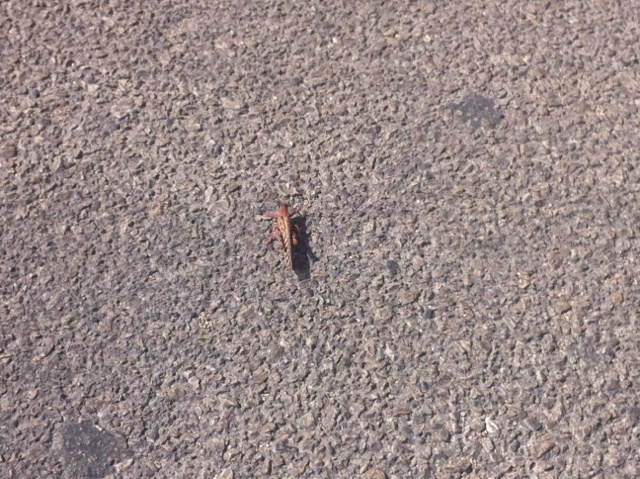
The desert locust, the most notorious of about a dozen locust species for its ability to rapidly multiply and travel long distances, threatens an area of 32 million square kilometres, stretching across 50 countries from west Africa to India. The fearsome insect has been farmers' foe since the earliest days of agriculture. When solitary, locusts are harmless. But when they congregate into groups they transform in behaviour and even appearance into killer vegetarians. In turn, swarms can be as large as several hundred square kilometres, of which a single square kilometre can comprise at least 40 million bugs, at times even double that.
In the immature adult phase, a locust can consume its own weight about two grams in vegetation per day, according to the UN's Food and Agriculture Organization (FAO). One tonne of desert locusts ("a very small part of an average swarm", according to FAO's website) could guzzle in a single day an amount of food equivalent to that consumed by 2,500 people. Locust plagues could therefore seriously imperil crop production, and in turn food security. An ongoing desert locust upsurge, primarily along the Red Sea periphery, possibly acts as a reminder to a natural threat that is often overlooked, or even deemed a thing of the past.
Swarms of locusts spread from North Africa
Countries today are considerably better equipped to deal with the threat than they used to be. The second half of the twentieth century has seen a dramatic decline in frequency, duration and intensity of desert locust plagues, largely thanks to improved control and monitoring capacities in the affected countries. "What we have done as a big improvement is to be able to monitor where the locust are and try to control them," says Pietro Ceccato, an environmental remote sensing expert with the International Research Institute for Climate and Society (IRI) at Columbia University. "Now we have that information both from the control teams and from the satellite. We know where to target the control."
And yet, in anticipating future locust invasions, climate change appears to be one key unknown. "This year is a bit unusual," says Keith Cressman, senior locust forecasting officer at FAO. Normally, he explains, after a good breeding season like this year's, the locusts would move from Sudan to the interior of the Arabian Peninsula, across the Red Sea. This autumn, however, while some did reach Saudi Arabia, groups started migrating northwards to the interior of Sudan and further to Egypt, not before Sudanese authorities treated close to 270 square kilometres.
More
Locust plagues point to grim future of climate change | Environment | guardian.co.uk