They have the same exact rights as other Israelis, you ignorant Turkish dumbass!
”
I hope after reading your posts the readers understand why Turks are considered the donkeys of the Middle East.
Arab citizens of Israel is the Israeli government's designation for non-Jewish Israeli citizens, the majority of whose cultural and linguistic heritage or ethnic identity is Arab or Palestinian and commonly self-designate as Palestinian citizens of Israel.[4] The traditional vernacular of most Arab citizens, irrespective of religion, is the Palestinian dialect of Arabic. Most Arab citizens of Israel are functionally bilingual, their second language being Modern Hebrew. By religious affiliation, most are Muslim, particularly of the Sunni branch of Islam. There is a significant Arab Christian minority from various denominations as well as Druze, among other religious communities. Israeli Mizrahi Jews are not usually considered to form part of this population.
Arab political parties
There are three mainstream Arab parties in Israel:
Hadash (a joint Arab-Jewish party with a large Arab presence),
Balad, and the
United Arab List, which is a coalition of several different political organizations including the
Islamic Movement in Israel. In addition to these, there is
Ta'al. All of these parties primarily represent Arab-Israeli and Palestinian interests, and the Islamic Movement is an
Islamist organization with two factions: one that opposes Israel's existence, and another that opposes its existence as a Jewish state. Two Arab parties ran in Israel's
first election in 1949, with one, the
Democratic List of Nazareth, winning two seats. Until the 1960s all Arab parties in the Knesset were aligned with
Mapai, the ruling party.
A minority of Arabs join and vote for
Zionist parties; in the
2006 elections 30% of the Arab vote went to such parties, up from 25% in
2003,
[123] though down on the
1999 (30.5%) and
1996 elections (33.4%).
[124] Left-wing parties (i.e.
Labor Party and
Meretz-Yachad, and previously
One Nation) are the most popular parties amongst Arabs, though some Druze have also voted for right-wing parties such as
Likud and
Yisrael Beiteinu, as well as the centrist
Kadima.
Representation in the Knesset
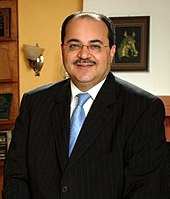 Ahmad Tibi
, leader of the Arab party Ta'al currently serves as Deputy Speaker of the Knesset
Palestinian Arabs sat in the state's
first parliamentary assembly; as of 2011, 13 of the 120 members of the
Israeli Parliament are Arab citizens, most representing Arab political parties, and one of Israel's
Supreme Court judges is a Palestinian Arab.
[130]
Some Arab Members of the Knesset, past and present, are under police investigation for their visits to countries designated as enemy countries by Israeli law. This law was amended following MK Mohammad Barakeh's trip to Syria in 2001, such that MKs must explicitly request permission to visit these countries from the Minister of the Interior. In August 2006, Balad MKs
Azmi Bishara,
Jamal Zahalka, and
Wasil Taha visited
Syria without requesting nor receiving such permission, and a criminal investigation of their actions was launched. Former Arab Member of Knesset
Mohammed Miari was questioned 18 September 2006 by police on suspicion of having entered a designated enemy country without official permission. He was questioned "under caution" for 2.5 hours in the
Petah Tikva station about his recent visit to Syria. Another former Arab Member of Knesset, Muhammad Kanaan, was also summoned for police questioning regarding the same trip.
[131] In 2010, six Arab MKs visited
Libya, an openly anti-Zionist Arab state, and met with
Muammar al-Gaddafi and various senior government officials. Gaddafi urged them to seek a
one-state solution, and for Arabs to "multiply" in order to counter any "plots" to expel them.
Knesset: Arab citizens of Israel have been
elected to every Knesset, and
currently hold 12 of its 120 seats. The first female Arab MP was
Hussniya Jabara, a Muslim Arab from central Israel, who was elected in 1999.
[143]
Supreme Court: Abdel Rahman Zuabi, a Muslim from northern Israel, was the first Arab on the Israeli Supreme Court, serving a 9-month term in 1999. In 2004,
Salim Joubran, a Christian Arab from
Haifa descended from Lebanese Maronites, became the first Arab to hold a permanent appointment on the Court. Joubran's expertise lies in the field of
criminal law.
[144] George Karra, a Christian Arab from
Jaffa has served as a Tel Aviv District Court judge since 2000. He was the presiding judge in the trial of
Moshe Katsav. In 2011, he was nominated as a candidate for the
Israeli Supreme Court.
[145]
Foreign Service: Ali Yahya, an Arab Muslim, became the first Arab ambassador for Israel in 1995 when he was appointed ambassador to
Finland. He served until 1999, and in 2006 was appointed ambassador to
Greece. Other Arab ambassadors include Walid Mansour, a Druze, appointed ambassador to
Vietnam in 1999, and
Reda Mansour, also a Druze, a former ambassador to
Ecuador. Mohammed Masarwa, an Arab Muslim, was Consul-General in
Atlanta. In 2006,
Ishmael Khaldi was appointed Israeli consul in San Francisco, becoming the first Bedouin consul of the State of Israel.
[146]
Israel Defense Forces: Arab Generals in the IDF include Major General Hussain Fares, commander of Israel's border police, and Major General
Yosef Mishlav, head of the
Home Front Command and current
Coordinator of Government Activities in the Territories.[
citation needed] Both are members of the
Druze community. Other high-ranking officers in the IDF include Lieutenant Colonel
Amos Yarkoni (born Abd el-Majid Hidr/ عبد الماجد حيدر) from the Bedouin community, a legendary officer in the Israel Defense Forces and one of six Israeli Arabs to have received the IDF's third highest decoration, the
Medal of Distinguished Service.
Israeli Police: In 2011, Jamal Hakroush became the first Muslim Arab deputy Inspector-General in the
Israeli Police. He has previously served as district commander of two districts.
[147]
Jewish National Fund: In 2007, Ra'adi Sfori became the first Arab citizen of Israel to be elected as a JNF director, over a petition against his appointment. The court upheld the JNF's appointment, explaining, "As this is one director among a large number, there is no chance he will have the opportunity to cancel the organization's goals."
[148]


