Fair enough, even though right wingers historically preferred free trade over the government having a financial stake in private industry. So to maintain your consistency, can we assume you oppose trump's hope for the Us to own much of chip manufacturer on a consistent basis?
This is a very complex issue.
On principle, yes.
(We should add the caveat, that these should be sourced from nations we know will always be free, who share our values, and are friendly to the U.S . . . . . )
With that said, those foreign nations which have different environmental and labor regulations who seek to compete with us, in what I believe is an unfair way, clearly make domestic production more costly.
Some commodities and resources are necessary for the security of the nation. Food, energy, pharmaceuticals, and yes, high tech items.
The economic history of petroleum is a good example of this. Right after WWII, the U.S. recognized the need to have a dominant and strong domestic oil sector, both to secure our economic growth, and ensure our ability to fight wars.
So, was the production and subsidizing of that sector a good idea, or a bad idea? I suppose it depends on if you believe economic growth and security are a national priority.
Ideally, our trade should be dependent on whether other nations respect their workers and their environment as much as Americans, but the reality is, they don't.
. . . . and our politicians, at least since Nixon opened up China? Morally and ethically, have no problem taking advantage of poor people in other nations. It is like our rulers had no problem outsourcing our environmental and social degradation.

The process really took off with Clinton and that whole Chinagate/Campaign controversy. Even the left leaning/establishment supporting wiki admits the corruption.

en.wikipedia.org
See this post for a complete breakdown.
Thus, we can see, since both Nixon and Clinton were complicit in this destruction of the middle class, and the outsourcing of critical technology necessary for national security and domestic economic security . . . all for the profits of Wallstreet and the ruling oligarchs, I don't think the destruction of our domestic industries that were, and are, critical to national security and economic security, was a mistake.
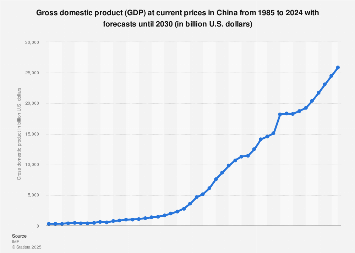
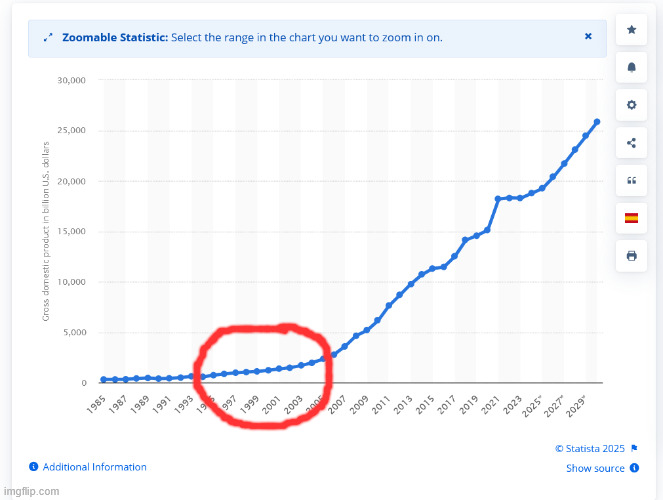
As we can see here, after Chinagate and the subsequent fallout from those decisions, (i.e., the economic/technological selling out of America, is what MADE them America's biggest competitor.)
Gross domestic product (GDP) at current prices in China from 1985 to 2024 with forecasts until 2030
The GDP of China grew by 5.0 percent in 2024 reaching around 18.7 trillion U.S. dollars.

www.statista.com
We see this obvious fallout from the transfer of all the technology.
Then came the COVID years. Powerful and well funded interests, along with politicians in all parties, realized that the chickens were coming home to roost. How do we know? Even Biden did not attempt repeal the Trump negotiated tariffs on China from his first term . . . . . .
Sep 2, 2015
. . . . why do you suppose Biden didn't try to get rid of those tariffs? Because, as I maintain, in matters of economics, and trade, there really is little difference which party is in charge, regardless of what our modern day partisan propaganda would have us believe.
The only thing that matters for the powerful folks that fund the parties, is who can achieve the national priorities in the most efficient and painless manner possible.
I really don't know WHAT the solution to this problem is, which clearly both parties have created.
Do I want us to rely on foreign nations for our supply of food, energy, consumer electronics, defense technology and pharmaceuticals? Obviously not.
With that said, I don't really know what the solution is to recreate those critical industries, and on-shore them here, or in our allies' nations who agree with our values and will trade on a level playing field. Regardless of what any individual republican or democrat believes, the ruling class of this nation, largely all agree it should be done. The big debate though, are Trump's unstable and erratic trade policies the best way to do that?
I can't say. I am neither a policy expert, nor a politician.