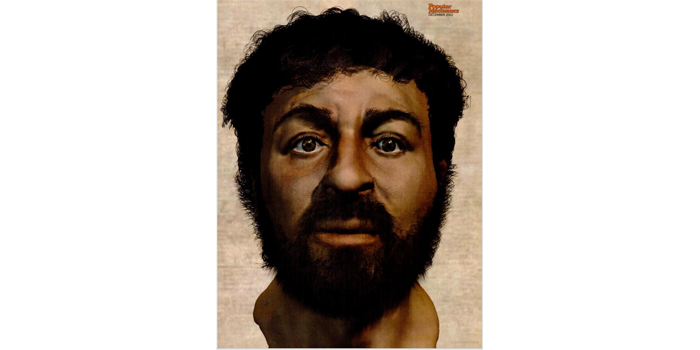
The focus of many early sources was on Christ's physical unattractiveness rather than his
beauty. The 2nd century anti-Christian philosopher
Celsus wrote that Jesus was "ugly and small"
[20] and similar descriptions are presented in a number of other sources as discussed extensively by Eisler,
[21] who in turn often quotes from Dobschütz' monumental
Christusbilder.
[22] Tertullian states that Christ's outward form was despised, that he had an ignoble appearance and the slander he suffered proved the 'abject condition' of his body.
[23]According to Irenaeus he was a weak and inglorious man
[24] and in
The Acts of Peter he is described as small and ugly to the ignorant.
[21]:439 Andrew of Crete relates that Christ was bent or even crooked
[21]:412 and in
The Acts of John he is described as bald-headed and small with no good looks.
[25]
As quoted by Eisler,
[21]:393–394, 414–415 both Hierosolymitanus and John of Damascus claim that "the Jew Josephus" described Christ as having had connate eyebrows with goodly eyes and being long-faced, crooked and well-grown. In a letter of certain bishops to the Emperor Theophilus, Christ's height is described as three cubits (four feet six), which was also the opinion of Ephrem Syrus (320–379 AD), "God took human form and appeared in the form of three human ells (cubits); he came down to us small of stature." Theodore of Mopsuhestia likewise claimed that the appearance of Christ was smaller than that of the children of Jacob (Israel). In the apocryphal Lentulus letter (see below) Christ is described as having had a reddish complexion, matching Muslim traditions in this respect. Christ's prediction that he would be taunted "Physician, heal yourself"
[26] may suggest that Christ was indeed physically deformed ('crooked' or hunch-backed) as claimed in the early Christian texts listed above. In fact, Justin Martyr,
Tertullian, and
Ambrose actually considered lack of physical attractiveness in Jesus as fulfilling the Messianic prophecy "Suffering Servant" narrative of
Isaiah 53.
[27]...
Quranic and hadith traditions such as
Sahih Bukhari as well as
tafsir have given an oral depiction of what Jesus looked like, although some accounts do not match, such as Jesus being both curly haired and straight-haired. The hadith refer to Muhammad's account of the
Night Journey, when he is supposed to have been taken up to heaven by the angel Gabriel (Jibra'il), where he saw Jesus and other prophets. Most versions of this say that "Jesus had curly hair and a reddish complexion".
[33] Others say his face was flushed as if he just had a bath ("a reddish man with many freckles on his face as if he had just come from a bath"
[34][35]). In another account from Bukhari Jesus is seen in a dream near the Kaaba, as "a man of a wheatish complexion with straight hair. I asked who it was. They said: This is the Messiah, son of Mary".
[36] However, other narrations give variations in the color.
Salim ibn Abd-Allah reports from his father
Abdullah ibn Umar that the prophet "did not say that Jesus was of red complexion", rather he was "a man of brown complexion and lank hair".
[37] In contrast
Abd Allah ibn Abbas says that Jesus was of "moderate complexion inclined to the red and white colors and of lank hair."
[38]
These variations have been explained in various ways, and have been co-opted to make assertions about race. For example, Ana Echevarría notes that medieval Spanish writer
Jiménez de Rada in his
Historia arabum chooses a version to emphasise that Jesus is whiter than Muhammad, quoting the Ibn Abbas version: "I saw Jesus, a man of medium height and moderate complexion inclined to the red and white colours and of lank hair". Echevarría comments that "Moses and Jesus are portrayed as specimens of a completely different 'ethnic type', fair and blond; 'ethnic' or 'racial' differences between them and Muhammad are thus highlighted."
[39]