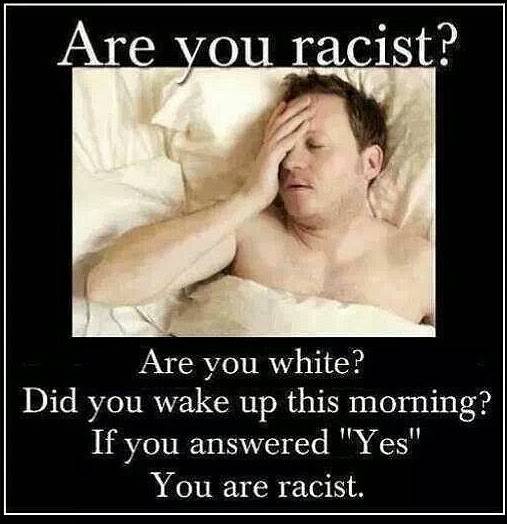
So, at this point, which of the following lines have appeared in refutation of the OP? I don't know, and I'm not going looking for them, but I'll rebut them here.
Colorblind
“People are just people.” “I don’t see color.” “We’re all just human.” “Character, not color, is what counts with me.”
“Colorblindness” negates the cultural values, norms, expectations and life experiences of people of color. Even if an individual white person can ignore a person’s skin color, society does not. Claiming to be “colorblind” can also be a defense when someone is afraid to discuss racism, especially if the assumption is that all conversation about race or color is racist. Color consciousness does not equal racism.
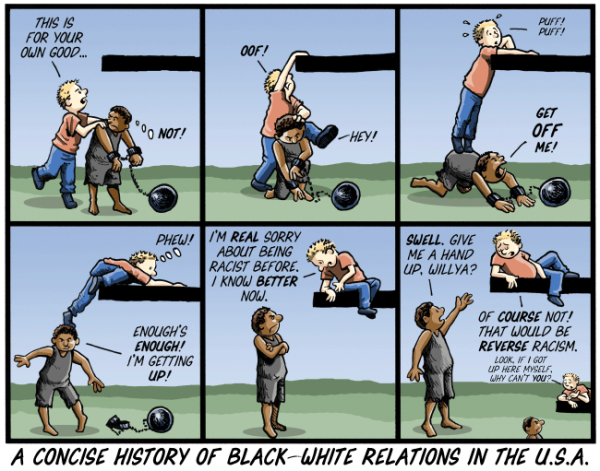
Reverse Racism
“Blacks cry ‘racism’ for everything, even though they are more or just as racist as white people.”
Racism = racial prejudice + systemic institutional power to act on one's prejudices. To say people of color can be racist, denies the power imbalance inherent in racism. Although some Black people dislike whites and act on that prejudice to insult or hurt them, that’s not the same as systematically oppressing them and negatively affecting every aspect of their lives. People of color, as a social group, do not possess the societal, institutional power to oppress white people as a group. An individual Black person who is abusing a white person, while clearly wrong, is acting out a personal racial prejudice, not racism.
Blame the Victim
“Blacks are not willing to work hard.” “Blacks feel entitled and want everything handed to them.” “Blacks hold themselves back, not racism.” “We have advertised everywhere, there just aren’t any qualified blacks for this job.”
When blame-the-victim tactics are used, it provides an escape from discussing the real problem: racism. Therefore, the agents of racism, white people and their institutions, can avoid acknowledging a system of oppression exists. As long as the focus remains on black folks, white people can minimize or dismiss our experiences and never have to deal with their responsibility or collusion in racism and white privilege.
Deny, Deny, Deny
“Blacks are unfairly favored, whites are not.”
This form of denial is based on the false notion that the playing field is now level. When some white folks are expected to suddenly share their privilege, access and advantage, they often perceive it as discrimination. White people’s attacks on programs like affirmative action and black History Month are usually rooted in this false perception.
Pull Yourself Up by Your Bootstraps
“America is the land of opportunity, built by rugged individuals, where anyone with grit can succeed if they just pull up hard enough on their bootstraps. So Blacks need to pull themselves up from the bottom like everyone else.”
U.S. social propaganda has convinced many people that an individual’s hard work is the main determinant of success in the country. This ideology totally denies the impact of either oppression or privilege on any person’s chance for success, and pretends that every individual, regardless of color, gender, disability, etc., has the same access to the rights, benefits and responsibilities of society. It also implies that blacks have only their individual character flaws or cultural inadequacies to blame, and not racism.
Racism Is Over
“Blacks live in the past. We dealt with racism in the 1960s with all the marches, sit-ins and speeches by Martin Luther King Jr. Laws have been changed. Segregation and lynching have ended. We have some details to work out, but real racism is pretty much a thing of the past. They need to get over it and move on.”
The absence of legalized, enforced segregation does not mean the end of racism. This denial of contemporary racism, based on an inaccurate assessment of both history and current society, romanticizes the past and diminishes today’s reality.
If there is no race problem, there would be no
school-to-prison pipeline in Mississippi that leads to the arrest and sentencing of Black students for infractions as insignificant as wearing the wrong color socks. New York City’s Stop and Frisk policy that led to 400,000 police encounters with innocent Black and Latino New Yorkers, would not have happened.
If there is no race problem,
a black person would not be 3.73 times more likely to be arrested for marijuana possession than a white person, even though Blacks and whites use marijuana at similar rates.