There are still some variety in the opinions of the actual experts and Fauci is certainly earned the right to hold one. Here is the latest assessment from the Director of National Intelligence and the National Intelligence Council
This assessment responds to the President’s request that the Intelligence Community (IC) update its previous judgments on the origins of COVID-19. It also identifies areas for possible additional research. Annexes include a lexicon, additional details on methodology, and comments from outside experts. This assessment is based on information through August 2021.
The IC assesses that SARS-CoV-2, the virus that causes COVID-19, probably emerged and infected humans through an initial small-scale exposure that occurred no later than November 2019 with the first known cluster of COVID-19 cases arising in Wuhan, China in December 2019. In addition, the IC
was able to reach broad agreement on several other key issues.
We judge the virus was not developed as a biological weapon. Most agencies also assess with low confidence that SARS-CoV-2 probably was not genetically engineered; however, two agencies believe there was not sufficient evidence to make an assessment either way. Finally, the IC assesses China’s officials did not have foreknowledge of the virus before the initial outbreak of COVID-19 emerged. After examining all available intelligence reporting and other information, though,
the IC remains divided on the most likely origin of COVID-19. All agencies assess that two hypotheses are plausible: natural exposure to an infected animal and a laboratory-associated incident.
Four IC elements and the National Intelligence Council assess with low confidence that the initial SARS-CoV-2 infection was most likely caused by natural exposure to an animal infected with it or a close progenitor virus—a virus that probably would be more than 99 percent similar to SARS-CoV-2. These analysts give weight to China’s officials’ lack of foreknowledge, the numerous vectors for natural exposure, and other factors.
One IC element assesses with moderate confidence that the first human infection with SARS-CoV-2 most likely was the result of a laboratory-associated incident, probably involving experimentation, animal handling, or sampling by the Wuhan Institute of Virology. These analysts give weight to the inherently risky nature of work on coronaviruses.
Analysts at three IC elements remain unable to coalesce around either explanation without additional information, with some analysts favoring natural origin, others a laboratory origin, and some seeing the hypotheses as equally likely.
Variations in analytic views largely stem from differences in how agencies weigh intelligence reporting and scientific publications and intelligence and scientific gaps. The IC judges they will be unable to provide a more definitive explanation for the origin of COVID-19 unless new information allows them to determine the specific pathway for initial natural contact with an animal or to determine that a laboratory in Wuhan was handling SARS-CoV-2 or a close progenitor virus before COVID-19 emerged.
The IC—and the global scientific community—lacks clinical samples or a complete understanding of epidemiological data from the earliest COVID-19 cases. If we obtain information on the earliest cases that identified a location of interest or occupational exposure, it may alter our evaluation of hypotheses.
China’s cooperation most likely would be needed to reach a conclusive assessment of the origins of COVID-19. Beijing, however, continues to hinder the global investigation, resist sharing information, and blame other countries, including the United States. These actions reflect, in part, China’s government’s own uncertainty about where an investigation could lead as well as its frustration the international community is using the issue to exert political pressure on China.
So, there is certainly no strong consensus that COVID-19 came from a lab.
No, he wasn't.
Allegations of a cover-up
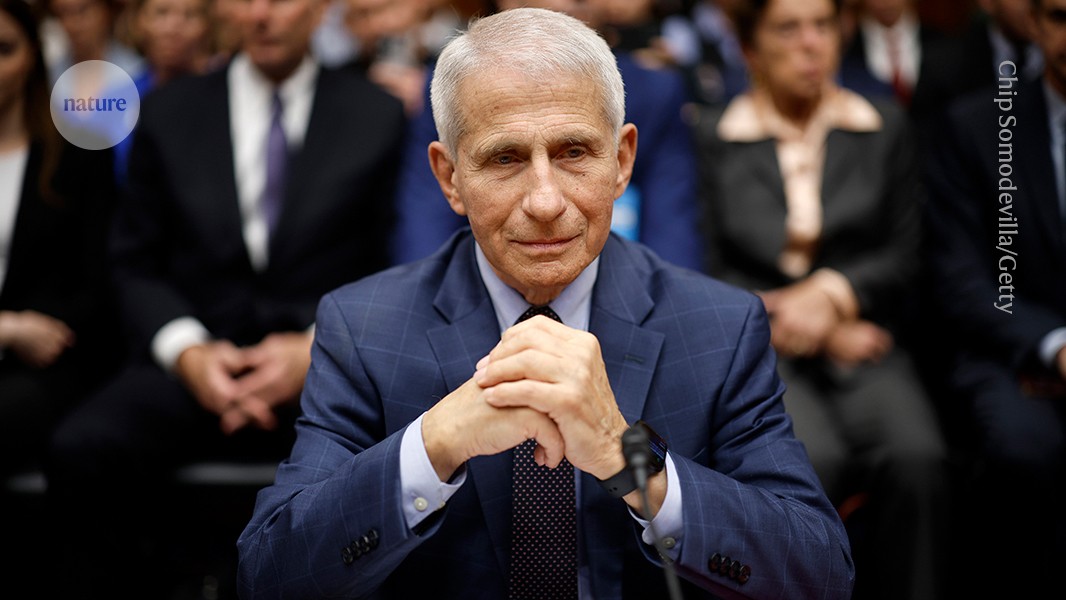
Fauci, who
stepped down from his role at NIAID in December 2022 after leading the agency for almost 40 years, was the face of the US pandemic response during both the Trump and Biden administrations.
Some critics have accused Fauci of suppressing the idea early in the pandemic that China might have accidentally or intentionally released SARS-CoV-2 from a laboratory in Wuhan, the city where the first cases of COVID-19 were detected. Some have alleged that Fauci, along with Francis Collins, former director of the US National Institutes of Health (NIH) — of which NIAID is a part — encouraged a group of virologists to publish an article in
Nature Medicine1 concluding that a lab-leak scenario was not plausible. (
Nature is editorially independent of
Nature Medicine, and
Nature’s news team is independent of its journals team.)
These critics also say that Fauci and Collins were motivated to suppress the lab-leak theory because, before the pandemic, the NIAID had awarded a research grant to the New York City-based non-profit organization EcoHealth Alliance, which had been partnering with the Wuhan Institute of Virology (WIV) to study coronaviruses in bats. They have raised the possibility that the WIV used NIAID resources to conduct research that could have spawned SARS-CoV-2. At the hearing, Fauci responded that the available genetic data indicate that the viruses investigated at the WIV “could not be the precursor to SARS-CoV-2”.
Most virologists say that although a lab-leak origin is possible, the preponderance of scientific evidence points to a zoonotic origin for the COVID-19 pandemic, meaning that the virus spread to humans from wild animals. At the hearing, Fauci said he has always been open to both origin hypotheses, pointing to a February 2020 e-mail he sent to a prominent scientist who was alarmed that SARS-CoV-2 could have leaked from a lab. In the correspondence, Fauci said that any concerns should be reported to intelligence officials if they were substantiated. “It is inconceivable that anyone who reads this e-mail could conclude that I was trying to cover up the possibility of a laboratory leak,” he testified.
Raul Ruiz, a Democratic representative from California and ranking member of the subcommittee, said at the hearing that House Republicans have used the guise of investigating the pandemic’s origins to weaponize “concerns about a lab-related origin to fuel sentiment against our nation’s scientists”.
Long-awaited testimony ends in fireworks as US lawmakers spar over the former infectious-disease official’s pandemic actions.

www.nature.com
Distancing undeniably reduces transmission
Masks undeniably reduce transmission.
School closures and any action to reduce large gatherings will reduce transmission
Fauci never made that claim. It was made early in the vaccination effort by the director of the CDC, Rochelle Walansky and then retracted as more data came in.
“We are continuing to evaluate the evidence,” a CDC spokesman said.

thehill.com
So, your contentions fail. Fauci has told no lies.