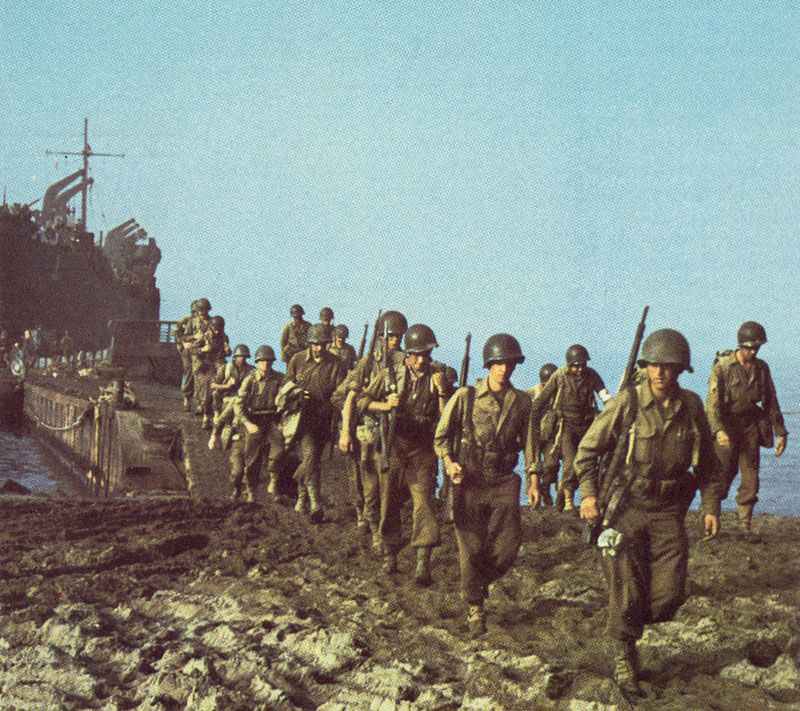
I didn't mean all those fancy sea-battles or Lend-lease (however useful) or carpet bombings of cities. I meant actual joining the war, like large-scale invasion in Europe.
At the beginning of World War II (1939-1941), the United States Army was relatively small and unprepared for a large-scale global conflict.
Size: In 1939, the US Army had about 190,000 active-duty
soldiers. By December 1941, when the US entered the war, this number had grown to around 1.6 million.
Equipment: Much of the Army’s equipment was outdated, with some
weapons dating back to
World War One.
Training: The Army lacked sufficient training facilities and experienced
officers to prepare for modern warfare.
Mobilization: The Selective Training and Service Act of 1940 allowed for peacetime conscription, which helped grow the Army’s ranks.
Modernization: The Army began modernizing its equipment and tactics, but progress was slow.
Leadership: General George C. Marshall became Army Chief of Staff in 1939 and led efforts to prepare the Army for war.
Doctrine: The Army was still developing its understanding of modern combined arms warfare.
Air Corps: The Army Air Corps (predecessor to the
US Air Force) was expanding but still relatively small.
Isolationist sentiment: Public opinion in the US was largely against involvement in another European war, which affected military preparedness.
Rapid expansion: After the Pearl Harbor attack in December 1941, the Army underwent massive expansion and modernization efforts.
Overall, the US Army at the beginning of World War II was not ready for a major conflict but would undergo significant changes and growth throughout the war.
...
The main factor which limited the size of the US Army, apart from the capacity of the American economy to equip such a large force quickly,
was shipping.
The shipping estimates showed that no more than 4,170,000 men could be shipped overseas by the end of 1944.
In the event the number of divisions shipped abroad did not exceed 88. This fact was an important restraint on Allied strategy.
Thus, although expansion between December 1941 and December 1943 was unprecedented, with the Army growing from 1,657,157 to 5,400,888, a further increase in the number of units was not undertaken. By December 1944, 4,933,682 Americans were serving abroad in 80 divisions; these were supported by a mere three divisions in reserve.
In 1945 the US Army reached a total of 91 divisions, but three of these were broken up for reinforcements. The remaining 88 were maintained at full combat strength despite the fact that by the end of the Ardennes Campaign in January 1945, 47 regiments in 19 divisions had suffered between 100 and 200 per cent
battle casualties.
...
US Army at the beginning of WW2 > Strength and Organization of the US Army in North America, Great Britain and Mediterranean theatre in 1941-42.

www.ww2-weapons.com
IIRC, the US Army was something like #18 in size compared to others on the planet on Sept.1, 1939. That invasion of Poland started some here thinking there might be a large war and the USA might get dragged into such, again. So plans started to shape for enlarging the USA military. In the course of such, ramping up production was essential and the USA found much of that early production going to Lend-Lease for other nations in the fight against the Axis.
The USA was just starting more focus on build up of our Army a few months before the Pearl Harbor attack, and that give a further incentive to ratchet up the pace.
Point is it took a while before we had the men, weapons, other supplies, and especially the transport ships to get all of that across the world to where you all had started your second world war. A war we were hoping to stay out of when you all started it in Sept. 1939.