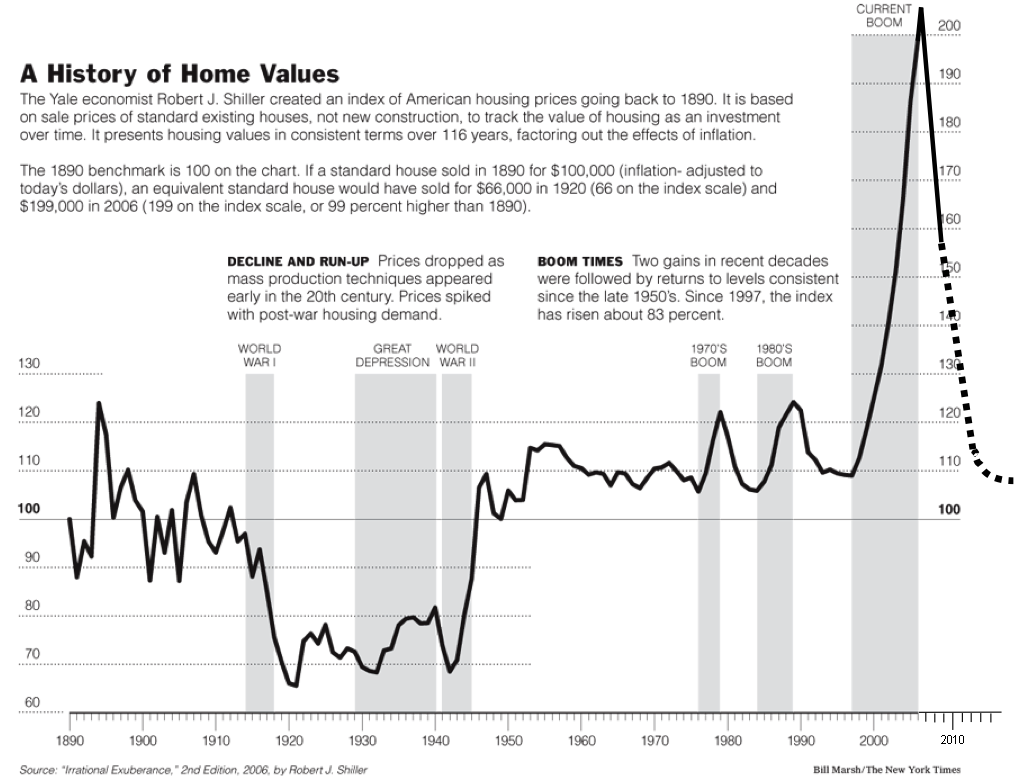
Toro, the standard measure for real estate is $/sq. ft. It tells you whether to build or buy existing property or rent for a given acreage. That was standard when Granddad used a workout to buy the house I lived in after granny died. And he had been a contractor in the late 1890s.
Two things happened in the 1970s the development of the nail gun and a lighter recipe for building block. The next iteration of Case-Shiller will be build/buy/rent ratios which are much more important than the current index but the current index does create a starting point for more fruitful research. At the moment just a quick down and dirty index does start the ball rolling and is long overdue.
Fair enough.
However, if the price of something stays constant, as Shiller's graph demonstrates, and the quality improves, as you are arguing, that's not inflation, that's deflation. So how can you have a bubble during deflation?
Leon Juglar wrote several volumes on this subject. James Grant tried to popularize the theory and in my opinion failed so here comes my attempt and may God have mercy on your brain as you try to follow me.
In any major innovation economies of scale, scope and network are found in distribution, production and supply chain. These discovered economies create areas of increasing marginal returns that do not fit into standard micro-economic models nor macro-economic models. Such economies are found again and again in highly innovative industries such as IT, aerospace and so on. This causes overbuilding of capacity as seemingly lunatic strategies pay off again and again
until everybody's brain stops functioning and a deflation driven bubble results. Examples would include this era's dotbomb, telebomb and housing finance or in the 1920s cars, radio and film.
The obvious error is in the standard model of innovation which does not permit increasing marginal returns due to the continuous discovery of new economies right up to the point of market saturation and subsequent bust. Add in structural and financial leverage failing safe with dismaying regularity and deflationary bubbles and busts as in the 1800s become understandable. What they don't become is something you can model.