Certainly.
http://www.ahip.org/content/default.aspx?docid=25216
The average privately insured household pays $1800 per year to subsidize Medicare and Medicaid losses.
Hmm, I do see what led you to believe that. A private study engineered, and paid for by a consortium of health insurance corporations. However, there is no proof that there is a "Cost Shift" only that there is a theory held by private insurers that there is a cost shift.
Hospitals, Pharma Companies, and various other private health concerns are making LOTS of money from what they do. Huge amounts of it in fact.
And this discredits the study how?
You only believe facts that agree with your position, it seems...typical.
Price control by fiat (government power) is one of the most economically destructive things a government can do.
Except in the case of a desperately needed essential, where it is deemed that price gouging is happening.
Like health care.
How many times must humans repeat their mistakes before they learn?
The more essential a good is, the MORE damage price controls do. Nixon put price controls on gasoline because "EVERY AMERICAN HAS THE RIGHT TO CHEAP GASOLINE! THE EVIL GAS COMPANIES ARE PRICE GOUGING!"
Guess what happened, Sherlock? The 1973 oil crises, where there WAS NO GAS. Oopsies!
Price controls, now and forever, are a
failure.
The price of healthcare is increasing dramatically because the types of treatments are improving dramatically. Modern medical technology is incredibly complex and expensive to produce
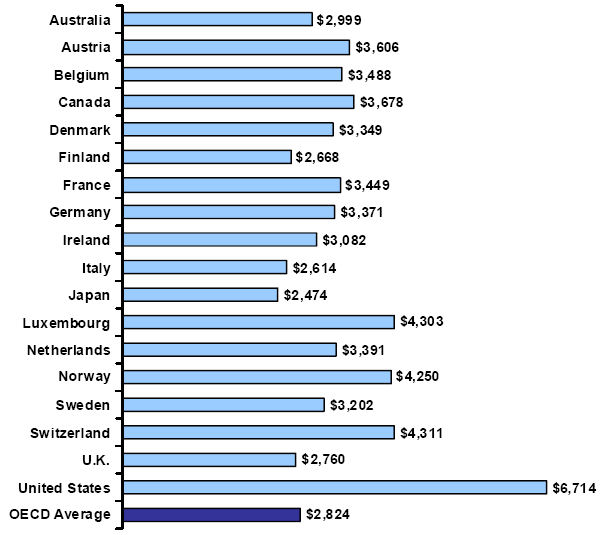
How is it that technology has DESCREASED costs in every other industry except health care? And if technology is in fact increasing the cost of health care, than it is not an effective technology.
That is what the free market is all about, right? various entities are supposed to compete with one another until prices go down, right?
Only that's not happening.
Technology does not necessarily decrease gross costs, particularly when it opens up new product markets.
Case in point? Cellular phone service. Before cellular phones were invented, cheap landline telephone service was all a family needed. Today, families spend way more on cellphones for each member of the family than they did on that single landline back in the 1970s, so objectively, the invention of cell phones increased the costs of living in America.
Now, the Free Market has dramatically reduced the price and increased the quality of cellular service since the early 1990s, but they still cost more than just one solitary landline.
Likewise, the free market has reduced the costs and improved the quality of older, well-established treatments and medical technology.
But today, everyone "needs" the latest prescription drug, "needs" the latest surgical devices, "needs" the latest implants. New Medical Technologies in the US have a 10-year "avoiding the market" patent whereby for a decade after invention, the company can keep the price artificially high.
Drugs and treatments more than a decade old are MUCH cheaper than top-of-the-line medicine. A bottle of antibiotics discovered 30 years ago is $5. A bottle of antibiotics developed 3 years ago is $80.
So then why are our health care costs increasing exponentially? Because the number and types of new treatments are increasing exponentially. You can get treatments here simply not yet available in Canada or most of Europe.
There are statistical methods for eliminating differences in demographics from your comparisons between countries. Methods that you have ignored, thus invalidating your comparison.
But I notice you don't mention what those factors are, do you?
One can only imagine what rationalizations will be presented. Please, be specific.
I definitely did note those factors...in the part of my post you omitted in your quote. I suggest you go back and re-read it.


 It's not a superiority thing, Klan Boy. It's just a fact of life. Some ethnic groups have greater longevity than others, and the difference persists regardless of what country they live in (provided we're talking about industrialized, modern countries) and what healthcare system they have.


