Carbon emissions are pollution
Bullshit.
The extra CO
2 in our atmosphere bear the tattle-tale signs of recently burnt fossil fuels ... as a waste product of man's activities simply dumped into the environment ... it is pollution ... is it dangerous like Cesium-135, or harmless like Helium? ... either way, it's pollution ...
How can CO2 be pollution when it is a vital part of the carbon cycle?
CO2 is exhaled by your body, too much in your system will kill you because it is pollution.
Now you understand dingy
No. I don't see how that relates to 400 ppm of CO2 in the atmosphere. Can you tell me why 400 ppm of CO2 in the atmosphere is a pollutant?
You are saying that excess CO2 in a system is not a pollutant. This is wrong as CO2 will kill you. Are you aware of this?
Seems not. As for how much CO2 should be in the atmosphere, no one knows because it has only been monitored for a very short time. CO2 may or may not be instrumental in climate change, I never said that it was, but too much CO2 in any mammal system is a pollutant, this has nothing to do with the global climate.
Correct. It's the carbon cycle. It's not toxic. What heating effect it provides is good for the planet. And you can't define the threshold where you say below this number it's not pollution and above this number it is pollution.
It doesn't meet the definition of pollution.
Again kid CO2 is lethally toxic
An eruption of lethal gas from Lake Nyos in Cameroon kills nearly 2,000 people and wipes out four villages on August 21, 1986. Carbon dioxide, though ubiquitous

www.history.com
At what concentration is CO2 lethally toxic, Frannie?
Your continued assertion that CO2 is not dangerous is a sign of delusional thinking
Dangers of CO2: What You Need to Know
June 04, 2019

Carbon dioxide is a natural gas found in our atmosphere. It is colorless, odorless, and tasteless - indistinguishable by individuals.
By volume, dry air contains approximately 78% nitrogen, 21% oxygen, 1% argon, but only 0.04% carbon dioxide and small amounts of other gases.
At 0.04% CO2 (
400 parts per million) under normal conditions, you will never have to worry about Carbon Dioxide.
However, there are 3 ways carbon dioxide levels can be dangerous to individuals, given high concentrations and your exposure to the gas.
Breathing in a sealed environment
The most common way CO2 can be dangerous, is breathing in a sealed environment.
Your exhaled breath contains about 3% CO2. As we breath in a sealed environment, oxygen is slowly converted into CO2. The oxygen level falls while the CO2 level rises. The
Occupational Safety and Health Administration, OSHA, has determined the optimal breathing range to be between 19.5 and 23.5 percent oxygen. Serious side effects will occur if the oxygen levels are outside of the safe zone. At levels 17 percent or below, your mental abilities become impaired.
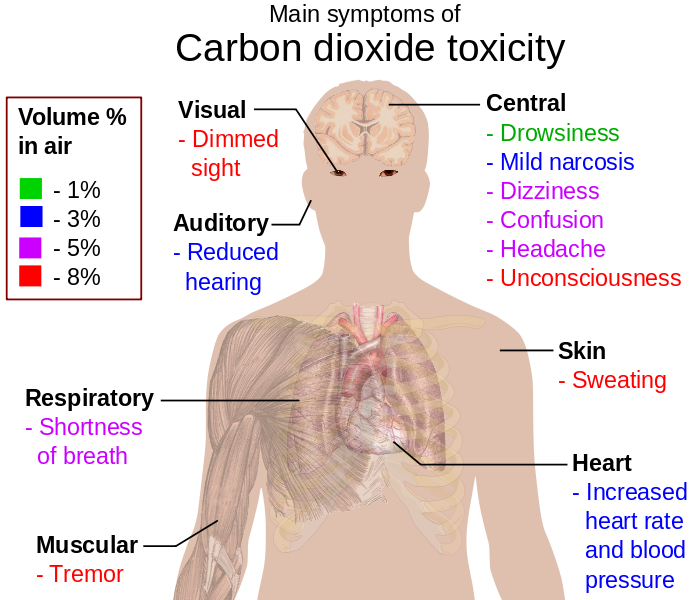
In a sealed environment, as oxygen levels drop from 21% to 17%, the CO2 level will rise to 4%. This level of CO2 can result in symptoms like dizziness, asphyxiation, confusion, fatigue, vertigo, headaches, tinnitus, and even seizures.
At higher levels of CO2, it can be life-threatening; and prolonged exposure to Carbon Dioxide (CO2) can even cause change in one's metabolism and bone calcium.
A real world example of this was
Apollo 13, where the CO2 buildup was a more urgent problem than the oxygen shortage.
Always remember that in confined spaces or when breathing in a sealed environment, CO2 can
quickly accumulate and your overall health could very well be at risk.
Other areas to be aware of in terms of CO2 exposure include:
- Skin Contact - Liquefied CO2 or Dry Ice, can quickly burn and irritate the skin once made contact. For safety, gently remove any clothing that may restrict circulation, loosely cover the affected areas with a sterile cloth and immediately call a poison center or doctor professional.
- Eye Contact - When coming into contact with Liquefied CO2 or Dry Ice, immediately flush eyes with lukewarm water and cover both eyes with a sterile cloth. Treatment is urgently required.
Natural out-gassing of CO2
The second way CO2 can be dangerous is a sudden out-gassing of CO2 from the ground.
Out-gassing is defined particularly when in reference to indoor air quality, or the release of a gas that was dissolved, trapped, frozen or absorbed in some material.
Under the right conditions, mines, volcanoes, or fissures in the earth’s surface can suddenly leak tremendous quantities of CO2. The heavier-than-air carbon dioxide settles into low areas and becomes a death trap for any living organisms inside it.
For example, in 1986 Lake Nyos in Cameroon emitted a large cloud of CO2, which suffocated 1,700 people and 3,500 livestock in nearby towns and villages.
Leaking compressed CO2 system
The third way CO2 can be dangerous is a leak in a compressed CO2 system. Virtually every restaurant, bar or brewery in the country stores pressurized tanks of carbon dioxide on premises. A CO2 leak inside an enclosed space becomes a potential death trap for anyone caught inside.
While death by CO2 leaks are rare, they do happen.

To ensure CO2 safety among individuals, customers, and employees worldwide, CO2Meter designed the
Remote Storage Safety 3 Alarm (RAD-0102-6) which meets all local fire codes, NFPA, IFC, NFPA Requirements, OSHA/NIOSH TWA standards and is designed to protect customers and workers near stored carbon dioxide (CO2).
Currently, state and local municipalities around the country continually are writing new codes that require the use of
CO2 safety alarms in buildings where anywhere more than 100 lbs. of compressed CO2 is stored or produced.
Signs of CO2 poisoning
If there is one thing you can take away, remember the signs of CO2 poisoning: disorientation, fatigue, dizziness, increased heart rate, muscle tremors, and shortness of breath.
Should you think your overall health, employees health or those around have been severely affected by exposure to Carbon Dioxide (CO2), contact your nearest health care professional.
For more information on CO2Meter Safety Solutions,
Speak to an expert today:
(877) 678 - 4259 or Sales@CO2Meter.com
Resources:


www.climatehotmap.org