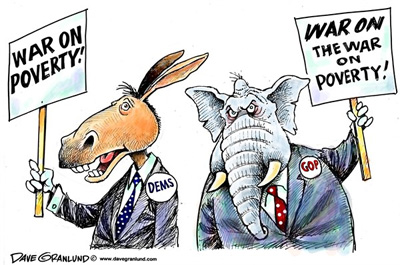
Yeah, BOTH equally at fault, ONE party didn't get Citizens United overturned at SCOTUS to get money out of politics
The opposite party isn't trying to get Buffet rule, min 30% tax on $1,000,000+ incomes
Or trying to get Corps to bring jobs back to US by giving them tax credits and incentives, being blocked by the GOP...
ONE PRESIDENTIAL CANDIDATE DIDN'T CALL CORPS ARE PEOPLE MY FRIEND RIGHT?
Our Hidden History of Corporations in the United States
When American colonists declared independence from England in 1776, they also freed themselves from control by English corporations that extracted their wealth and dominated trade. After fighting a revolution to end this exploitation, our country’s founders retained a healthy fear of corporate power and wisely limited corporations exclusively to a business role. Corporations were forbidden from attempting to influence elections, public policy, and other realms of civic society.
Initially, the privilege of incorporation was granted selectively to enable activities that benefited the public, such as construction of roads or canals. Enabling shareholders to profit was seen as a means to that end. The states also imposed conditions (some of which remain on the books, though unused) like these*:
- Corporate charters (licenses to exist) were granted for a limited time and could be revoked promptly for violating laws.
- Corporations could engage only in activities necessary to fulfill their chartered purpose.
- Corporations could not own stock in other corporations nor own any property that was not essential to fulfilling their chartered purpose.
- Corporations were often terminated if they exceeded their authority or caused public harm.
- Owners and managers were responsible for criminal acts committed on the job.
- Corporations could not make any political or charitable contributions nor spend money to influence law-making.
For 100 years after the American Revolution, legislators maintained tight control of the corporate chartering process. Because of widespread public opposition, early legislators granted very few corporate charters, and only after debate. Citizens governed corporations by detailing operating conditions not just in charters but also in state constitutions and state laws. Incorporated businesses were prohibited from taking any action that legislators did not specifically allow.
Our Hidden History of Corporations in the United States