The Gold and Silver Thread

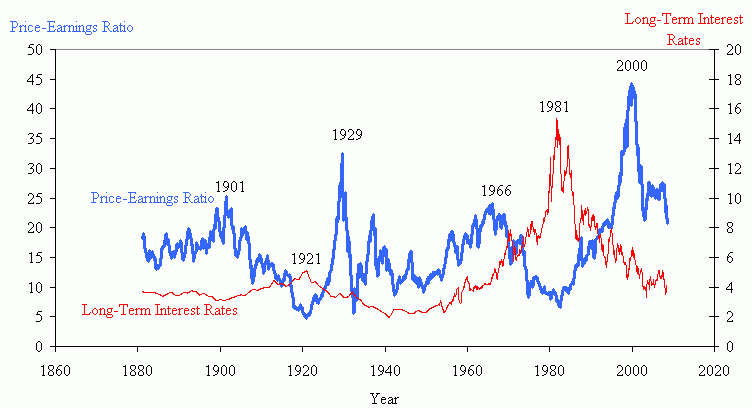
You have a better chance of being right being bullish now than bearish. According to the Dow vs Gold chart we are closer to the bottom than the top. But I think we still have more to go on the Dow PE/Ratio & Dow vs Gold Ratio. I think 2013 will be the year of the Bull. Elections will bring optimism, the health-care law will start paying out instead of just taxing & we will be past the mortgage resets, defaults & foreclosure hump.

dj-au-ratio-lt.gif

DOW_PE_1860to2008.gif

feb-2009-option-arms-alt-a-subprime-reset_2.gif

The mortgage thing is over. The housing market is near a bottom, if it hasn't bottomed already. People waiting for this huge next wave down in housing are going to be sorely disappointed. The math works like this.

Household formation in this country averages about 1.3-1.4 million a year. Depreciation of the housing stock each year is 100-300k. So each year, we need 1.5-1.6 million houses to be built. Housing starts, however, have been about 600k. In the last few months, we are building new, single family homes at the lowest level in recorded history, which is over 40 years. Thus, we are eating through normalized inventory at about 1 million homes a year. I say "normalized" because actual household formation has been 1-1.1 million homes a year for the past few years as people delay getting married or moving out of their parent's house.

Currently, outstanding inventory is about 1.9 million units. This represents about six months of supply, i.e. it takes on average six months to sell a house. This is the long-term average. A few years ago, it was 12 months supply. Now, we are back to average. But this is off depressed sales. What will happen is that demand will snap back faster than people think because we have depressed demand. Thus, on a normalized basis, we will completely wipe out supply in less than two years, but in fact, it will be faster as household formation will start to accelerate above trend.

The bears' biggest argument is the "shadow inventory," which is the inventory that will come onto the market as banks increase foreclosures. This is true. But let's look at that. There are currently 4.5 million homes with mortgages that are 60 days delinquent. Historically, 90% of those will default. Thus, there will be about 4 million defaults and repos. However, there is always a shadow inventory. There are roughly 150 million households. The normal rate of 60 day delinquency is about 0.25%, this represents about 400k households. So the "excess" shadow inventory is about 3.6 million. However, what will happen is that as the economy starts to improve, that delinquency number will fall because the disruption has been so huge, and as people start feeling more confident and get new jobs, will start paying their mortgage again. There are many companies buying mortgages from banks and working out new payment schedules to keep people in their homes. So there may be perhaps 3 million foreclosures that will eventually hit the market. Remember, we have a normalized supply deficiency of about 1 million homes. Even more intriguing is that about a quarter of the foreclosures are in one state, Florida. So excluding Florida, you may have a shadow inventory of maybe 2-2.25 million homes. And as demand accelerates, this shadow inventory will get eaten away pretty quickly.

And even that may be an exaggeration. I have contacts into the two biggest real estate brokers in the Tampa Bay region, and they are saying that they are at their lowest inventories ever, i.e. they don't have enough homes to sell. And I have also heard that buyers have started popping up in numbers in the Sarasota region over the past few months.

Thus, the shadow inventory is likely to get cleared away in about two years. Thus, this problem is likely to have ended by 2013 or 2014. I wouldn't expect a big rebound however. Normally, it takes some time for people to adjust their expectations, so maybe home prices don't really start climbing until 2015, a full nine years after home prices peaked, about on track with other global housing booms and busts. But as a catalyst to create another big leg down in housing, it's simply not there IMHO.
 
Last edited:
The mortgage thing is over. The housing market is near a bottom, if it hasn't bottomed already. People waiting for this huge next wave down in housing are going to be sorely disappointed. The math works like this.

Household formation in this country averages about 1.3-1.4 million a year. Depreciation of the housing stock each year is 100-300k. So each year, we need 1.5-1.6 million houses to be built. Housing starts, however, have been about 600k. In the last few months, we are building new, single family homes at the lowest level in recorded history, which is over 40 years. Thus, we are eating through normalized inventory at about 1 million homes a year. I say "normalized" because actual household formation has been 1-1.1 million homes a year for the past few years as people delay getting married or moving out of their parent's house.

Currently, outstanding inventory is about 1.9 million units. This represents about six months of supply, i.e. it takes on average six months to sell a house. This is the long-term average. A few years ago, it was 12 months supply. Now, we are back to average. But this is off depressed sales. What will happen is that demand will snap back faster than people think because we have depressed demand. Thus, on a normalized basis, we will completely wipe out supply in less than two years, but in fact, it will be faster as household formation will start to accelerate above trend.

The bears' biggest argument is the "shadow inventory," which is the inventory that will come onto the market as banks increase foreclosures. This is true. But let's look at that. There are currently 4.5 million homes with mortgages that are 60 days delinquent. Historically, 90% of those will default. Thus, there will be about 4 million defaults and repos. However, there is always a shadow inventory. There are roughly 150 million households. The normal rate of 60 day delinquency is about 0.25%, this represents about 400k households. So the "excess" shadow inventory is about 3.6 million. However, what will happen is that as the economy starts to improve, that delinquency number will fall because the disruption has been so huge, and as people start feeling more confident and get new jobs, will start paying their mortgage again. There are many companies buying mortgages from banks and working out new payment schedules to keep people in their homes. So there may be perhaps 3 million foreclosures that will eventually hit the market. Remember, we have a normalized supply deficiency of about 1 million homes. Even more intriguing is that about a quarter of the foreclosures are in one state, Florida. So excluding Florida, you may have a shadow inventory of maybe 2-2.25 million homes. And as demand accelerates, this shadow inventory will get eaten away pretty quickly.

And even that may be an exaggeration. I have contacts into the two biggest real estate brokers in the Tampa Bay region, and they are saying that they are at their lowest inventories ever, i.e. they don't have enough homes to sell. And I have also heard that buyers have started popping up in numbers in the Sarasota region over the past few months.

Thus, the shadow inventory is likely to get cleared away in about two years. Thus, this problem is likely to have ended by 2013 or 2014. I wouldn't expect a big rebound however. Normally, it takes some time for people to adjust their expectations, so maybe home prices don't really start climbing until 2015, a full nine years after home prices peaked, about on track with other global housing booms and busts. But as a catalyst to create another big leg down in housing, it's simply not there IMHO.

I also have 2 realtor friends in the Tampa, FL area. I have been telling them to start putting in low-ball bids & try to get some houses because the will hit bottom mid 2012. They keep telling me I am crazy & the market is not near bottom. Of course they also told me I was crazy when I told them to sell all their real-estate except for farm land in in 2006. I have bought 4 houses in the midwest since the crash & have 3 rented. I am looking to get a REO for vacation in Tampa & another rental here.

I have a couple of stupid in-laws in the Tampa area who bought expensive lake front lots for a couple of million dollars at the peak in 2007. They mortgaged everything to get them. They lost their ass & their properties. Now they only have their homes they occupy & are extremely upside down on them.
 
Last edited:
From 2001 to 2006 the U.S. Treasury’s issued no long bonds. At the end of 2009, 36% of government debt was due within a year. This means up until operation twist most of the government debt was short to medium term being rolled over rapidly. Now that the rates are very low, Bernanke is pushing this debt out to 10 year treasuries. This is the secret sauce in "Operation Twist" in order to make room to allow for a potential short term rate hike to stave off hyper-inflation if necessary. Bernanke thinks he can keep the "Gold Bugs" at bay with this scheme while not bankrupting the treasury with unfordable interest rates. If they push enough low interest debt into long term, a rate hike will hit the main street economy very hard & keep unemployment high. Government dependents, workers & contractors will reap the benefits again. Bernanke believes he can keep the dollar & government in tact with this scheme.
 
February 17, 2012


Billionaire hedge-fund manager John Paulson wrote a letter to investors saying now is the time to buy gold, as prices are going to soar this year.

Paulson said government spending will trigger inflation, and investors should stock up on gold as protection.

John Paulson Says Now's the Time to Buy Gold - Money Morning


:eusa_shhh:


Paulson & Co., the hedge fund founded by billionaire John Paulson, cuts its stake in the SPDR Gold Trust by 15 percent in the fourth quarter ...

Paulson, Vinik, Tudor Sell SPDR Gold ETF Shares; Soros Buys - Businessweek


:eusa_whistle:
 
February 17, 2012


Billionaire hedge-fund manager John Paulson wrote a letter to investors saying now is the time to buy gold, as prices are going to soar this year.

Paulson said government spending will trigger inflation, and investors should stock up on gold as protection.

John Paulson Says Now's the Time to Buy Gold - Money Morning


:eusa_shhh:


Paulson & Co., the hedge fund founded by billionaire John Paulson, cuts its stake in the SPDR Gold Trust by 15 percent in the fourth quarter ...

Paulson, Vinik, Tudor Sell SPDR Gold ETF Shares; Soros Buys - Businessweek


:eusa_whistle:

That's not the Treasury Sec. Paulson, though. That was Hank.
 
February 17, 2012


Billionaire hedge-fund manager John Paulson wrote a letter to investors saying now is the time to buy gold, as prices are going to soar this year.

Paulson said government spending will trigger inflation, and investors should stock up on gold as protection.

John Paulson Says Now's the Time to Buy Gold - Money Morning


:eusa_shhh:


Paulson & Co., the hedge fund founded by billionaire John Paulson, cuts its stake in the SPDR Gold Trust by 15 percent in the fourth quarter ...

Paulson, Vinik, Tudor Sell SPDR Gold ETF Shares; Soros Buys - Businessweek


:eusa_whistle:

That's not the Treasury Sec. Paulson, though. That was Hank.


Yes, my bad... JOHN Paulson sold 15% of his holdings of gold as he tells his investors it's a good time to buy gold...........


IMO it's time to sell Gold on peak days...Sell into the strength.
 
You have a better chance of being right being bullish now than bearish. According to the Dow vs Gold chart we are closer to the bottom than the top. But I think we still have more to go on the Dow PE/Ratio & Dow vs Gold Ratio. I think 2013 will be the year of the Bull. Elections will bring optimism, the health-care law will start paying out instead of just taxing & we will be past the mortgage resets, defaults & foreclosure hump.

dj-au-ratio-lt.gif

DOW_PE_1860to2008.gif

feb-2009-option-arms-alt-a-subprime-reset_2.gif

The mortgage thing is over. The housing market is near a bottom, if it hasn't bottomed already. People waiting for this huge next wave down in housing are going to be sorely disappointed. The math works like this.

Household formation in this country averages about 1.3-1.4 million a year. Depreciation of the housing stock each year is 100-300k. So each year, we need 1.5-1.6 million houses to be built. Housing starts, however, have been about 600k. In the last few months, we are building new, single family homes at the lowest level in recorded history, which is over 40 years. Thus, we are eating through normalized inventory at about 1 million homes a year. I say "normalized" because actual household formation has been 1-1.1 million homes a year for the past few years as people delay getting married or moving out of their parent's house.

Currently, outstanding inventory is about 1.9 million units. This represents about six months of supply, i.e. it takes on average six months to sell a house. This is the long-term average. A few years ago, it was 12 months supply. Now, we are back to average. But this is off depressed sales. What will happen is that demand will snap back faster than people think because we have depressed demand. Thus, on a normalized basis, we will completely wipe out supply in less than two years, but in fact, it will be faster as household formation will start to accelerate above trend.

The bears' biggest argument is the "shadow inventory," which is the inventory that will come onto the market as banks increase foreclosures. This is true. But let's look at that. There are currently 4.5 million homes with mortgages that are 60 days delinquent. Historically, 90% of those will default. Thus, there will be about 4 million defaults and repos. However, there is always a shadow inventory. There are roughly 150 million households. The normal rate of 60 day delinquency is about 0.25%, this represents about 400k households. So the "excess" shadow inventory is about 3.6 million. However, what will happen is that as the economy starts to improve, that delinquency number will fall because the disruption has been so huge, and as people start feeling more confident and get new jobs, will start paying their mortgage again. There are many companies buying mortgages from banks and working out new payment schedules to keep people in their homes. So there may be perhaps 3 million foreclosures that will eventually hit the market. Remember, we have a normalized supply deficiency of about 1 million homes. Even more intriguing is that about a quarter of the foreclosures are in one state, Florida. So excluding Florida, you may have a shadow inventory of maybe 2-2.25 million homes. And as demand accelerates, this shadow inventory will get eaten away pretty quickly.

And even that may be an exaggeration. I have contacts into the two biggest real estate brokers in the Tampa Bay region, and they are saying that they are at their lowest inventories ever, i.e. they don't have enough homes to sell. And I have also heard that buyers have started popping up in numbers in the Sarasota region over the past few months.

Thus, the shadow inventory is likely to get cleared away in about two years. Thus, this problem is likely to have ended by 2013 or 2014. I wouldn't expect a big rebound however. Normally, it takes some time for people to adjust their expectations, so maybe home prices don't really start climbing until 2015, a full nine years after home prices peaked, about on track with other global housing booms and busts. But as a catalyst to create another big leg down in housing, it's simply not there IMHO.

Just tell me I still have another year or so to get my money right and buy a house. I've wasted 10 years of my life and I'm way behind on where a man my age should be, but I have 2 businesses now that are doing well and I'm saving. I thought I was ready to buy a house in 09 but I missed an opportunity and then put it off, and now I'm ready to get back in the game, but I need another year.
 
You have a better chance of being right being bullish now than bearish. According to the Dow vs Gold chart we are closer to the bottom than the top. But I think we still have more to go on the Dow PE/Ratio & Dow vs Gold Ratio. I think 2013 will be the year of the Bull. Elections will bring optimism, the health-care law will start paying out instead of just taxing & we will be past the mortgage resets, defaults & foreclosure hump.

dj-au-ratio-lt.gif

DOW_PE_1860to2008.gif

feb-2009-option-arms-alt-a-subprime-reset_2.gif

The mortgage thing is over. The housing market is near a bottom, if it hasn't bottomed already. People waiting for this huge next wave down in housing are going to be sorely disappointed. The math works like this.

Household formation in this country averages about 1.3-1.4 million a year. Depreciation of the housing stock each year is 100-300k. So each year, we need 1.5-1.6 million houses to be built. Housing starts, however, have been about 600k. In the last few months, we are building new, single family homes at the lowest level in recorded history, which is over 40 years. Thus, we are eating through normalized inventory at about 1 million homes a year. I say "normalized" because actual household formation has been 1-1.1 million homes a year for the past few years as people delay getting married or moving out of their parent's house.

Currently, outstanding inventory is about 1.9 million units. This represents about six months of supply, i.e. it takes on average six months to sell a house. This is the long-term average. A few years ago, it was 12 months supply. Now, we are back to average. But this is off depressed sales. What will happen is that demand will snap back faster than people think because we have depressed demand. Thus, on a normalized basis, we will completely wipe out supply in less than two years, but in fact, it will be faster as household formation will start to accelerate above trend.

The bears' biggest argument is the "shadow inventory," which is the inventory that will come onto the market as banks increase foreclosures. This is true. But let's look at that. There are currently 4.5 million homes with mortgages that are 60 days delinquent. Historically, 90% of those will default. Thus, there will be about 4 million defaults and repos. However, there is always a shadow inventory. There are roughly 150 million households. The normal rate of 60 day delinquency is about 0.25%, this represents about 400k households. So the "excess" shadow inventory is about 3.6 million. However, what will happen is that as the economy starts to improve, that delinquency number will fall because the disruption has been so huge, and as people start feeling more confident and get new jobs, will start paying their mortgage again. There are many companies buying mortgages from banks and working out new payment schedules to keep people in their homes. So there may be perhaps 3 million foreclosures that will eventually hit the market. Remember, we have a normalized supply deficiency of about 1 million homes. Even more intriguing is that about a quarter of the foreclosures are in one state, Florida. So excluding Florida, you may have a shadow inventory of maybe 2-2.25 million homes. And as demand accelerates, this shadow inventory will get eaten away pretty quickly.

And even that may be an exaggeration. I have contacts into the two biggest real estate brokers in the Tampa Bay region, and they are saying that they are at their lowest inventories ever, i.e. they don't have enough homes to sell. And I have also heard that buyers have started popping up in numbers in the Sarasota region over the past few months.

Thus, the shadow inventory is likely to get cleared away in about two years. Thus, this problem is likely to have ended by 2013 or 2014. I wouldn't expect a big rebound however. Normally, it takes some time for people to adjust their expectations, so maybe home prices don't really start climbing until 2015, a full nine years after home prices peaked, about on track with other global housing booms and busts. But as a catalyst to create another big leg down in housing, it's simply not there IMHO.

Just tell me I still have another year or so to get my money right and buy a house. I've wasted 10 years of my life and I'm way behind on where a man my age should be, but I have 2 businesses now that are doing well and I'm saving. I thought I was ready to buy a house in 09 but I missed an opportunity and then put it off, and now I'm ready to get back in the game, but I need another year.

(Almost) All real estate is local.

However IMHO even though I think we are bottoming nationally, I don't think there is a spike in home prices coming anytime soon.
 
Wall Street Journal: Why can not we believe the Fed

A review of the Federal Reserve from 1986 to 2006 discovered that they missed with their forecast 100% of the time. Most of the time the Fed missed the forecast by 50% or more. And 50% of the time the Fed missed with their forecast by 100%.

Private companies were far more accurate at forecasting.
 
Last edited:
Gold and silver getting crushed this morning on the Bernank's testimony. We've had too many of these downdrafts lately to make precious metals safe.

Interesting that it hit the top end of it's channel before collapsing.
 
A hands off fed can make that happen. Downshifting to 2% in gold and lost a bit on silver.
the good news is the dollar should see some short term strengthening.
 
Warren Buffett just bought Cookson gold refinery. Also Iran is now accepting Gold for Oil.
 
Last edited:
15th post
it'll slow climb back. But there is sure to be a correction since the wizard made his announcement.
 
Europe to Seize Greece’s Gold
According to the fine print of a treaty signed on February 21, the European Union now has the power to seize Greece’s gold reserves. The modifications the EU is forcing into the Greek constitution vest Greece’s creditors, mainly European banks and the European Central Bank, with the authority to take gold from the Bank of Greece.
 
ECB Balance Sheet Jumps to a Record $3.96 Trillion Amid Lending to BanksÂ… 31 Percent Bigger Than The German Economy
The European Central BankÂ’s balance sheet surged to a record 3.02 trillion euros ($3.96 trillion) last week, 31 percent bigger than the German economy, after a second tranche of three-year loans.

Lending to euro-area banks jumped 310.7 billion euros to 1.13 trillion euros in the week ended March 2, the Frankfurt- based ECB said in a statement today. The balance sheet gained 330.6 billion euros in the week. It is now more than a third bigger than the U.S. Federal ReserveÂ’s $2.9 trillion and eclipses the 2.3 trillion-euro gross domestic product of Germany (EUANDE), the worldÂ’s fourth largest economy.

The ECB last week awarded banks 529.5 billion euros for three years in the biggest single refinancing operation in its history, adding to the 489 billion euros it lent in December. The flood of money...has increased the risk exposure of the 17 euro-area central banks that together with the ECB comprise the Eurosystem.

“With the dramatic expansion of its balance sheet since last summer, the ECB has become the most active central bank in the world”...
 

New Topics

Back
Top Bottom