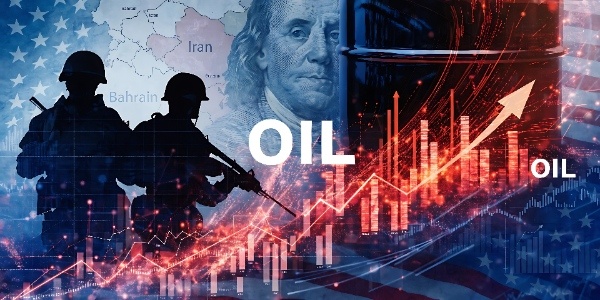
The Failing "Dollar" - Inflation and the "BRICS Nations", Is America rushing to another "Great Depression"?

With consideration towards the increasing decline of "The Dollar", ever since it was taken off the Gold Standard and backed by nothing more than a "Promise to Pay", & Our Military, The "Treasonous & Unrestrained Federal Spending since 9-11", The "Tarriffs", as well as the endless printing/counterfeiting of the Dollar by the Government,......

I Believe that America is soon to experience an Unprecedented Economic Collapse.

==================================================

"The TL;DR on the petrodollar, although it’s certainly been written about in much greater detail with much greater precision by others, is that virtually all global oil trade, the lifeblood of every modern economy, is conducted in dollars, thereby inflating demand for dollars and allowing the unlimited money-printing bonanza that the U.S. government has been on since the end of the gold standard in the 70s.

Conversely, reduced dollar demand would lead inevitably to higher interest rates, in turn leading to higher interest rates on U.S. treasuries and eventually, if it’s bad enough, collapse of the U.S. economy.

Related: Kenya Abandons U.S. Dollar, Petrodollar Decline Accelerates

Critically, in the context of the Iran war, the petrodollar regime is part of the longstanding arrangement with the Gulf States dating back to the 1970s, following Nixon's unpegging of the dollar from gold, in which they agree to trade oil in dollars in exchange for U.S. security guarantees."
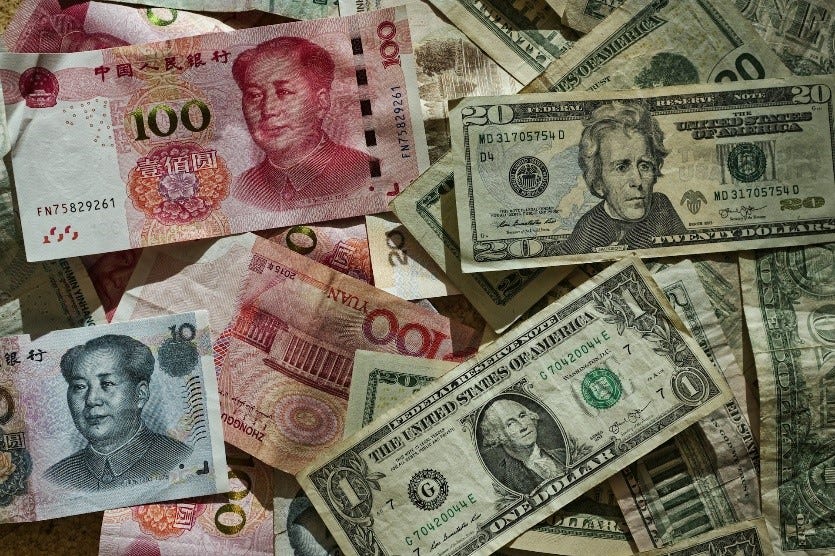

While the U.S. and Israeli militaries have severely degraded Iran’s capabilities, the regime still retains enough to combat power to selectively close off the Strait of Hormuz—unless countries negotiate safe passage and pay in Chinese yuan

But even before the Iran war, the petrodollar regime had come under pressure, Deutsche Bank noted. U.S. sanctions on oil from Russia and Iran created an illicit trade that relied on other currencies, like the yuan.

Saudi Arabia also joined mBridge project, a central bank digital currency initiative led by China that takes on the dollar-payment infrastructure.

“The current conflict may expose further fault lines, by challenging the US security umbrella for Gulf infrastructure and the maritime security for global trade in oil,” analysts warned.“
Predictions of doom for the dollar have proven overblown in the past, but the current situation lends more credibility to the CCP’s “petroyuan” project designed to usurp the dollar as the preferred currency for global oil trade."


I'm Thinking, that the Majority of Americans do not realize the full affect, that this "War", will soon bring down upon them.

=============

The Economic Destruction Of Trump's War Goes Far Beyond High Gas Prices


by Tyler Durden

Authored...

Authored by Connor O'Keeffe via the Mises Institute,

"For the past six weeks, as this US-Israeli war with Iran has played out, the economic impact of the conflict has gotten a lot of attention. And rightfully so."

"
However, throughout all of this, most of the discourse about the economic impacts of the war has focused on the rising prices drivers are facing at the gas pump. That isn’t surprising, as gas prices are an early cost that impact consumers directly.

But the emphasis on pain at the pump threatens to badly understate the economic damage of this war. And it helps feed the false impression that, if this new attempt at a ceasefire holds and the war ends somewhat quickly, gas prices will fall back down as fast as they rose, and then all the global economic turmoil the world’s been worrying about will be avoided.

It won’t. A lot of economic pain has already been locked in by this war. But to really understand it, it’s necessary to keep a few important economic truths at the front of our minds.

First is the fact that the entire purpose of the economy is to produce goods and services that consumers value enough to pay for. All of the production happening anywhere in the economy is geared towards that end."

"About 8 percent of the world’s aluminum travels through the Strait. And aluminum is used across many sectors, including construction, manufacturing, and technology. Nearly a third of the world’s helium supply comes from Qatar, which is an important component in semiconductor production as well as MRI systems.

Polyethylene and other kinds of plastics and resins are also greatly affected. More than 40 percent of the world’s polyethylene is exported from the Middle East. And these are used in all stages of production in all sorts of industries—packaging, auto parts, medical equipment, consumer containers, industrial components, electronics, and much, much more."


The Economic Destruction Of Trump's War Goes Far Beyond High Gas Prices<!-- --> | ZeroHedge
 

Doug Casey on the Strait of Hormuz, the Dollar, and the Coming Energy Crisis​

by Doug Casey

"International Man: Iran is reportedly accepting yuan, Bitcoin, and its own rial currency as payment for the Hormuz transit tolls. If more oil-related trade starts moving outside the dollar system, what does that mean for the dollar’s status as the world’s reserve currency and the ability of the US government to impose financial sanctions?


Doug Casey: The US Government has a problem with its currency. The dollar was once redeemable at a fixed price ($35) for gold. But since 1971, which precipitated the first Great Oil Crisis, it’s been a faith-based fiat currency, something called the petrodollar.
Essentially, the Saudis promised to accept only dollars for their oil in exchange for military protection. But now it seems that being a US ally not only doesn’t yield safety, but can turn your country into a missile magnet.


The world sees that the dollar is rapidly depreciating.
And, even worse, dollar assets can be arbitrarily confiscated, as they were with Russia. The BRICS have been making efforts to stop using the dollar. The US fiasco with Iran is accelerating de-dollarization. The US is increasingly seen as an out-of-control bully, a failing empire with an unreliable currency. Other countries want an alternative to the dollar. But it won’t be some other fiat currency. Governments have zero reason to trust each other or their currencies.


I believe the world is returning to gold, a money with no counterparty risk."

"The US government has already lost this war. It’s punched a tar baby and can’t withdraw its fist. It’s further bankrupting itself, precipitating the Greater Depression, risking WW3, and destroying its moral standing. The only possible winner is Israel. Perhaps it’s trying to expand from the Nile to the Euphrates, as some say Yahweh has promised."


"Why the Fertilizer Crisis Won’t End When the Iran War Does

A fragile fertilizer system meets geopolitical shock, exposing deeper cracks in supply, pricing and farmer profitability that won’t disappear when conflict subsides."
"
A System Already Under Strain

Long before ships stalled and supply tightened, the fertilizer system was heading toward imbalance. Demand has continued to grow, but investment in new production has lagged behind.


There’s a mismatch between consumption growth and new facilities,” Keyman says. “In the next few years, we would be in a chronic shortage of nitrogen if we do not come up with new investments. But these are two- to three-billion-dollar projects. It takes years to permit, financing is difficult and natural gas price visibility is not always there.”

While nitrogen gets the most attention, Keyman points to an even more immediate risk hiding in plain sight.

The war is causing bigger havoc on the phosphate side,” he says. “Sulfur is the biggest problem, causing production outages globally. Phosphate reserves are concentrated in only a few places, so when something goes wrong, the consequences are much faster and more severe.”

Those consequences do not stay contained within fertilizer markets. They cascade.


“If China is not exporting phosphates over the summer, you can expect major yield losses in Brazil,” Keyman says. “That results in higher soybean prices and risks for global supply. This thing happens very quickly.”


Last spring, the U.S. farmer paid about $200 per ton more than Brazil because of last-minute buying,” Keyman says. “This year, again, they waited too long. Urea in New Orleans was $390 in January and now it’s trading at $730. We thought there was a lesson, but history tells me we have short memories.”

That pattern — delayed purchasing followed by price spikes — is not just a logistical issue. It is now colliding with a deeper economic problem on the farm."
Why the Fertilizer Crisis Won’t End When the Iran War Does
 

Wait another 60 days for the Full Effects of this Iranian War, The Tariffs, The Value of the "Dollar" collapsing, & much more!


It will be "Unprecedented"!

=======================

Mercuria, Goldman, JPMorgan See Major Aluminum Market Shock​

Tyler Durden's Photo

by Tyler Durden
Authored...
Analysts at Mercuria, the Geneva-based Swiss commodities trading firm, are sounding the alarm on the global aluminum market after severe disruptions in the Gulf region, adding to a growing list of trading desks and research teams warning of a deepening supply shock.

"The scale of the supply shock we're seeing in the aluminum market is probably the largest single supply shock a base metals market has suffered in the post-2000 era," Mercuria commodities analyst Nick Snowdon told Reuters on the sidelines of the Financial Times Commodities Global Summit in Lausanne, Switzerland.

Snowdon then told Reuters, "We are already in a 'black swan' event. No one could have foreseen something on this scale."


Mercuria is a Swiss commodities trading house based in Geneva. Its traders sell, ship, store, and finance physical commodities across markets such as oil, gas, power, LNG, and metals.

Snowdon's alarm over the global aluminum market is mainly because the Gulf region accounts for 9% of world supply, and with major smelters already declaring force majeure and the Hormuz chokepoint blocked for much of this week, this is shaping up to be one of the most memorable shocks in the metal market in decades."


There is a Strong Possibility that it will be "Unprecedented"!​

==========​

Oil Shock Warning: Economists’ Greatest Fear Is Almost Here​


April 25, 2026 9:07 pm by Alex


By Peter Reagan

Screenshot-2026-04-25-210634-1024x545.png


"At the moment, there’s a strange disconnect between the growing disruption in the Strait of Hormuz and the fact that, for most Americans, life still feels normal.

Gas prices did surge, but they’ve stabilized during the two months since the conflict began. Store shelves are still stocked. Most people can go about their routines without feeling like anything is seriously wrong.

On the other hand, we keep being told this is a truly monumental economic shock. Economists and analysts warn that something far more significant may already be unfolding beneath the surface.

A major portion of the world’s oil supply has been disrupted for weeks. Tankers are being intercepted. Shipments are delayed or halted. And yet, the full impact hasn’t reached us – not yet.

That gap between cause and effect matters more than most people realize.

Because if history tells us anything, it’s that energy shocks rarely hit all at once. They build quietly… and then show up everywhere.


And by the time they do, it’s usually too late to prepare.

The (Dire) Strait of Hormuz

We’ve seen what happened in the past when oil supplies were constricted by just a small amount. Just in the last half century or so, analyst Andrei Jikh explains we’ve had two such incidents. (His video is worth watching, by the way.) Both episodes are likely seared into the memories of everyone who lived through them.

First, there’s the 1973 oil crisis. OPEC restricted oil sales to the West, a drop of about seven percent of the world’s oil supply for five months.

Now, that doesn’t really sound like much, does it? But then, consider the results. According to Jikh’s summary:

  • Global oil prices increased by 300% for five months (and never returned to pre-embargo prices)
  • U.S. GDP dropped 2.1%
  • Inflation peaked at 12.3%
  • Unemployment hit 9%
  • The recession lasted 16 months
The fallout was a severe recession in the U.S. (and the Federal Reserve notes that the embargo “helped push most of the world’s major economies into recession.”)

Second, in the 1990 Gulf War, again, seven percent of the world’s oil supply was cut off for about two months. The result?

  • Oil prices increased by 75%
  • U.S. GDP dropped by 1.4%
  • Inflation peaked at 6.3%
  • Unemployment hit 7.8%
  • The recession lasted eight months
The fallout was labeled a “mild” recession.

Now, those were both pretty unpleasant economic situations! Both give us an idea of what to expect from the ongoing conflict.

This time, though, there’s more at stake…

As Bloomberg reported back in March, some 20% of the world’s crude oil and liquid natural gas (LNG) go through the Strait of Hormuz. The current blockade is therefore three times worse than the two previous historical episodes.

Today’s blockade been going on for about eight weeks. As of today, the shooting has stopped. But both the U.S. and Iran are preventing tankers from entering or exiting.

We have no indication when that oil will start shipping again.

How will that affect oil prices long-term? History points towards serious oil price increases coming our way. Macquarie Group estimates that oil prices will hit $200 a barrel by June, but frankly, that’s just a guess.

Today, no one knows how bad the fallout will be.

The shock hasn’t hit yet

The most important thing to understand about an oil shock is also the easiest to miss: You don’t feel it right away.

Right now, everything still looks… normal. Like I said before, everything seems fine. Which might lead us to suspect that all the hand-waving over the blockade might simply be “fake news.”

Here’s the thing: We aren’t feeling the impact because the disruption is small.

It’s because the whole economy is massively complex, and slow to shift.

Oil moves first. The price at the pump we’re seeing today reflects oil conditions from about three weeks ago, according to the Federal Reserve Bank of Dallas. Not what’s happening right now.

Then shipping costs rise. Then manufacturers pay more for inputs derived from petroleum (petrochemical derivatives are used in a number of industries, including plastics, synthetic rubber, fertilizer, solvents, pharmaceuticals, lubricants and waxes). That pushes up wholesale prices. Then retailers raise prices. On top of all that, transportation costs have risen in the meantime…

By the time we see the new price on the store shelf, weeks – sometimes months – have passed.

That lag is exactly what made past energy shocks so damaging.

After the 1973 embargo, the initial disruption lasted a few months. The economic consequences lingered for years. Even the shorter 1990 shock still became a recession that outlasted the supply interruption .

Today’s disruption is larger – about three times bigger. And it’s still ongoing.


According to Bloomberg, traders already expect a “guaranteed supply loss of around 1 billion barrels.”


Of course,.... "Polls" are not always Accurate, but, I Believe that when all of the Available Data is considered,..... What the Middle-class, & Poor, are experiencing, is not what Trump keeps "preaching", about America's Economy.​

==============​

55 Percent Of Americans Say That Their Financial Situations Are Getting Worse – That Is An All-Time Record High​


April 28, 2026 9:51 pm by Alex


55 Percent Of Americans Say That Their Financial Situations Are Getting Worse – That Is An All-Time Record High​


April 28, 2026 9:51 pm by Alex


by Michael

Screenshot-2026-04-28-215124.png


"Americans were not even this stressed about their financial situations during the Great Recession. As you will see below, a brand new Gallup survey has discovered that 55 percent of Americans believe that their finances are getting worse. That is higher than any reading that Gallup recorded during the recession of 2008 and 2009, and it is higher than any reading that Gallup recorded during the pandemic. But of course this shouldn’t exactly be a surprise to any of us. We have been in a historic cost of living crisis since 2020, and our standard of living has been steadily deteriorating as the purchasing power of our money has gone down.


If you are making the same amount of money as you did at the beginning of this decade, you are in far worse shape financially today.

That is just the reality of the time that we are living in.

The cost of just about everything has been going up and up and up.

As a result, people are more concerned about the economy than anything else.

According to Gallup, the percentage of Americans that believe that their finances are getting worse has been rising for five years in a row and is now at the highest level ever recorded

Americans’ financial outlook in 2026 is also historically poor, with a record 55% now saying their financial situation is getting worse. While similar to last year’s 53%, this is up from 47% in 2024 and marks the fifth consecutive year more Americans say their finances are worsening rather than improving.

The only similar multiyear period when the larger share felt their financial situation was worsening was during the Great Recession.
At this stage, there is no denying the trend that we are witnessing.

Gallup found that Americans are particularly concerned about monthly bills, healthcare and retirement…"


Of course,.... "Polls" are not always Accurate, but, I Believe that when all of the Available Data is considered,..... What the Middle-class, & Poor, are experiencing, is not what Trump keeps "preaching", about America's Economy.​

==============​

55 Percent Of Americans Say That Their Financial Situations Are Getting Worse – That Is An All-Time Record High​


April 28, 2026 9:51 pm by Alex


55 Percent Of Americans Say That Their Financial Situations Are Getting Worse – That Is An All-Time Record High​


April 28, 2026 9:51 pm by Alex


by Michael

Screenshot-2026-04-28-215124.png


"Americans were not even this stressed about their financial situations during the Great Recession. As you will see below, a brand new Gallup survey has discovered that 55 percent of Americans believe that their finances are getting worse. That is higher than any reading that Gallup recorded during the recession of 2008 and 2009, and it is higher than any reading that Gallup recorded during the pandemic. But of course this shouldn’t exactly be a surprise to any of us. We have been in a historic cost of living crisis since 2020, and our standard of living has been steadily deteriorating as the purchasing power of our money has gone down.


If you are making the same amount of money as you did at the beginning of this decade, you are in far worse shape financially today.

That is just the reality of the time that we are living in.

The cost of just about everything has been going up and up and up.

As a result, people are more concerned about the economy than anything else.

According to Gallup, the percentage of Americans that believe that their finances are getting worse has been rising for five years in a row and is now at the highest level ever recorded


At this stage, there is no denying the trend that we are witnessing.

Gallup found that Americans are particularly concerned about monthly bills, healthcare and retirement…"


Speak for yourself. I am living much better. Ten years ago, I had debt. Now I have none. Maybe 55% should learn to live within their means.
 
Speak for yourself. I am living much better. Ten years ago, I had debt. Now I have none. Maybe 55% should learn to live within their means.
Dang!.... So without the Higher cost of LIving that existed prior to the "Tarrifs", The "Failing Dollar", The Higher Cost of Fuel, & Electricity,....... You'd be Living like a King, Right?
My Wife & I have been
"living within Our means". Our Properties are fully Paid Off, as are Our Vehicles, & Credit Cards.
But I'm not going to "Speak as a FOOL", & State that America's Economy is "Booming & Affordable" for the "Working Man", & The "Poor",.... For that is metaphorically a "Wagon load of Orwellian Bullcrap"!
How is it so easy for the "Elites", who are "Livin' Large", to Forget that it was Trump's Promises made to The "Working Class", that Won him the Office of POTUS.
Pay Attention to this Song.It;s "Raining Down Th' Truth"!

 
Dang!.... So without the Higher cost of LIving that existed prior to the "Tarrifs", The "Failing Dollar", The Higher Cost of Fuel, & Electricity,....... You'd be Living like a King, Right?
My Wife & I have been
"living within Our means". Our Properties are fully Paid Off, as are Our Vehicles, & Credit Cards.
But I'm not going to "Speak as a FOOL", & State that America's Economy is "Booming & Affordable" for the "Working Man", & The "Poor",.... For that is metaphorically a "Wagon load of Orwellian Bullcrap"!
How is it so easy for the "Elites", who are "Livin' Large", to Forget that it was Trump's Promises made to The "Working Class", that Won him the Office of POTUS.
Pay Attention to this Song.It;s "Raining Down Th' Truth"!


Whine some more, loser, LOL.
 

Real personal Income per CAPITA hasn’t grown for the past 15+ Months​


May 1, 2026 7:48 pm by Alex

"If they are pushing withholding changes as a “real wage increase,” then underlying wage pressure is worse than they want to admit publicly.


UNREAL:

🇺🇸 U.S. Treasury Secretary Scott Bessent just said something extraordinary.

"Change your withholding. You will get an automatic real wage increase."

Translation: stop letting the government take your money upfront.
Keep it yourself. Every week. Every month.

The U.S.… pic.twitter.com/Q8QymkDIvC

— Merlijn The Trader (@MerlijnTrader) April 16, 2026"


New Topics

Back
Top Bottom